



For some people, it’s not enough to run a 5K race. In a culture of couch potatoes, running a 5K should be an accomplishment, while getting a good dose of cardio exercise. But, the challenge may leave some wanting more. Like the participants in the popular TV show “American Ninja,” the challenge of testing one’s endurance and strength to the nth degree is more appealing.
Enter the age of extreme obstacle courses that would leave the average person lying on the ground during the first 50 yards. Events like the Tough Mudder Mud Run, the Superhero Scramble, the Warrior Dash and the Spartan Race leave some participants with bruised egos and a few scrapes to boot. Making it to the finish line, on the other hand, provides a real sense of accomplishment.
If you are a devotee of these kinds of events, and you happen to own some land, the opportunity might present itself to build your own course. This takes the DIY concept to a whole new level.
Meet Tim Bowers, a biomedical engineering manager for VCU Health Community Memorial Hospital in South Hill, Virginia, who is all in when it comes to obstacle courses and doing it yourself. Bowers has spent many a weekend involved in events like the Tough Mudder, the Rugged Maniac and the Battle Frog series. Alas, the family farm beckoned, and it wasn’t asking for more corn or cows.
“When I’m not working, I’m building obstacles on the family farm to train on,” Bowers says. “I set up training runs with folks locally that are interested in OCR on the three-mile trail we have cut through the farm. Anyone who can complete the trail and all obstacles two times in a row earns a medal.”
Bowers got involved in challenging himself through 5K and 10K races. He then began training for half marathons.
“After awhile, the training runs became very monotonous and boring to me, so I started to look into alternative activities,” he says. “I kept seeing the advertisements for Tough Mudder on social media — 10 to 12 miles of possibly the toughest event on the planet — and it seemed to be something that not only looked tough but fun.”
“What intrigued me most about the events is that, instead of being a solitary event where the goal is to get yourself across the finish line, it seemed the goal is to get everyone to the finish line regardless of your physical abilities and that appealed to me greatly,” he adds.
The popularity of many obstacle course events can’t be understated. The Warrior Dash alone claims to have more than two million participants worldwide since 2009. With 12 obstacles included in the 5K event, with names like Goliath and Great Warrior Wall, the event offers a medal, T-shirt and Warrior helmet to those who complete the course.
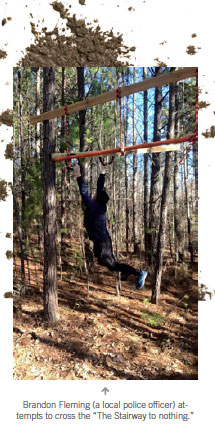 The Tough Mudder is a “team-oriented 10-12 mile obstacle course,” according to the organizer’s website. Tough Mudder events have attracted more than two million participants to more than 150 events since 2010. Likewise, the Rugged Maniac claims “25 epic obstacles” over a three-mile course. The Rugged Maniac doesn’t settle for an obstacle alone, but includes a daylong festival. A T-shirt, professional race photos and a medal are available to those who make it across the finish line.
“I have done everything from 5K road races and mud runs up to a 26.2-mile trail marathon at Medoc Mountain State Park in North Carolina after a hurricane came through (lots of mud),” Bowers remembers.
“The toughest race I have attempted by far was the Virginia Tough Mudder this past year. The course itself was considered a stadium style event which is relatively flat consisting of lots of weaving in and out of the state fairgrounds parking areas,” he says. “What made it tough was the heat. This event was in June and the temperatures at the event neared the 100-degree mark the entire day. There were a lot of people who were not prepared for this and were unable to finish.”
Build your own Mousetrap
It’s a big jump from competing in these kinds of events and creating your own course. Bowers says that there were a few trails on the family farm that he would run when he first started training.
“Since most of the events I trained for were team based, I started to invite people over that were interested in doing the runs with me,” he says.
“I wanted to help them get used to running the varied terrain they would see at the event. I would throw in some push-ups and pull-ups throughout the run to help with the strength portion. During the runs, I noticed the obstacles that were giving my teammates and others the most trouble, so I decided to figure out a way to add some things to my course that would help,” he adds.
Those things initially included a few old tires here and there. He then added an eight-foot wall, and the idea took off from there. He now has the equivalent of a 5K, 18-obstacle course on the farm.
“The biggest challenge by far is the upkeep of the trail and making sure the obstacles are safe to use,” Bowers adds.
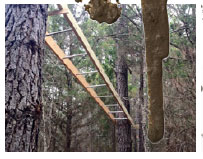 The course is called “The Blitzkrieg” and has 18 obstacles. Although there are no plans for officially sanctioned events, participants who finish the course successfully twice in the same day earn a medal.
When not jumping walls, running trails or traversing hanging rings, Bowers can be found at VCU Health Community Memorial Hospital managing the two-man biomedical engineering department. The two biomeds handle all the medical equipment service for the 99-bed hospital, a long-term care facility and nine clinics. He was recently also involved in the equipment planning for a new hospital.
Facing the challenge of equipping a new facility or jumping over fire, this is one biomed who takes on a challenge and then goes home to help others train for their own.
