


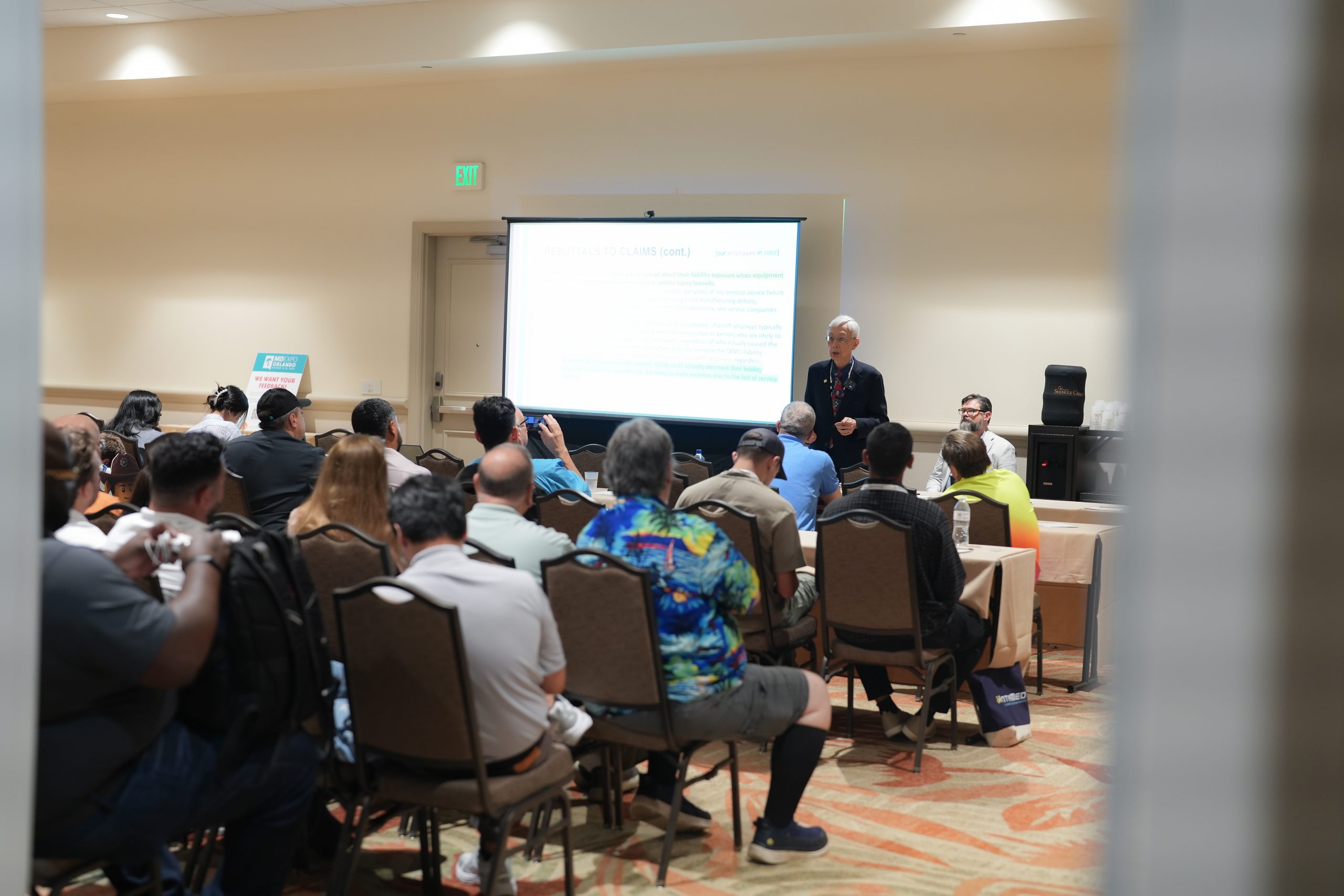
The MD Expo session “Medical Device Right to Repair (RtR): Call for Action” was presented by Nathan Proctor and Binseng Wang, ScD, CCE.
By Dave Francoeur | Chief Operating Officer, iMed Biomedical
After attending MD Expo Orlando, I left thinking about how our healthcare technology management (HTM) community can turn a shared concern into a coordinated effort. We have capable professionals, committed advocates and a compelling purpose. What would it take to bring those strengths together so that our collective voice carries greater weight in decisions affecting medical equipment maintenance and patient care?
First, MD Publishing deserves tremendous credit. Through MD Expo and TechNation, it gives our profession a place to learn about advances in HTM, exchange practical experience and build relationships across organizations. The opportunity to bring technicians, healthcare leaders, service providers and manufacturers into the same conversation is invaluable. Providing that venue strengthens the entire profession.
One session that prompted this reflection was Medical Device Right to Repair (RtR): Call for Action, presented by Nathan Proctor and Binseng Wang, ScD, CCE. They examined repair restrictions, findings from the 2026 U.S. PIRG Education Fund BMET survey and the need for a broader coalition. [1]
Many challenges they described were familiar to those of us working in HTM. That familiarity speaks to how persistent these issues have become. Their presentation provided an important foundation. My question is “How we build on that foundation together?”
Define the purpose we can share
My position is that healthcare organizations should have meaningful choices about who services their equipment, with qualified providers able to obtain the information, training, parts and tools needed to perform that work safely, under reasonable terms that protect cybersecurity and intellectual property.
Our purpose should be clear: safe, high-quality and effective maintenance of medical equipment that supports timely care, better patient outcomes and a better patient experience. Access to service information, parts, training and diagnostic tools should be evaluated against that purpose.
The presentation reported that 94% of surveyed BMETs believed Right to Repair would improve patient safety and timely care. That finding reflects respondents’ views; it does not establish that every repair should be performed by every technician. It does tell us that the people responsible for keeping equipment available see a connection between repair access and patient care. [1]
With access comes responsibility. We should expect documented competence, appropriate test equipment, secure software access and verification before equipment returns to clinical use. Those expectations should apply to everyone performing the work.
Apply consistent expectations across service models
The distinction between manufacturers and independent service providers becomes more complicated when manufacturers service equipment made by other companies. GE HealthCare describes its HTM offering as a multivendor solution covering imaging, ultrasound and biomedical equipment. Philips markets multivendor services for Philips and non-Philips systems. Block Imaging, acquired in 2023 by a joint venture between Siemens Healthineers and CommonSpirit Health, provides multivendor imaging equipment, parts and service. [2-4]
These offerings demonstrate that manufacturers themselves recognize a role for service beyond their own products. They also raise a fair question: When a manufacturer services another company’s equipment, what makes that work safe, and how can other qualified providers meet comparable expectations?
Employment by one manufacturer does not, by itself, establish competence on another manufacturer’s device. Competence must be supported by relevant training, experience, resources and demonstrated performance. Specific service agreements and access arrangements may differ, but the underlying expectations for safe work should be consistent.
When restrictions are justified on safety grounds, we should ask for the specific risk, the evidence supporting it and a practical pathway for qualified providers to address it. Manufacturers operating multivendor businesses have valuable experience to contribute to that discussion. Their participation could help us establish workable expectations across the industry.
Invite AdvaMed into the solution
AdvaMed’s published opposition to medical device Right to Repair illustrates the strength of organized manufacturer representation. Its concerns about technician qualifications, cybersecurity and service quality deserve serious consideration. Those concerns should also lead us toward practical solutions. [5,6]
AdvaMed distinguishes manufacturer-authorized service providers from other independent organizations. That distinction deserves examination. What qualifications, quality controls and access arrangements make an authorized partnership acceptable, and can we establish a transparent, reasonable pathway for other qualified providers to demonstrate comparable capabilities? [5]
I would welcome AdvaMed’s participation in defining that pathway. Our shared objective should be equipment that performs safely and is available when patients need it. We should establish clear expectations for competence, documentation, secure access and verification, then evaluate providers against those expectations.
Give every contributor a practical way to participate
Manufacturers bring substantial resources and organized representation to policy discussions. Our HTM community brings practical experience from the people who maintain equipment and support patient care every day. A shared platform could help us bring that knowledge together and turn individual contributions into collective progress.
I envision a welcoming, easy-to-use platform where technicians, managers, healthcare facilities, service providers and manufacturers can share successes, ask for help and recommend improvements.
We should build on the work of existing professional associations and advocacy organizations, creating a common opportunity for participation across our industry.
Contributing data should take only a few minutes. Participants could choose to share a success, describe a challenge or suggest an improvement. A few straightforward questions could capture what happened, who helped, what was learned and what others might find useful. Contributions could include a manufacturer that provided timely technical support, a training opportunity that strengthened a team’s capabilities, a successful service partnership or an access barrier that still needs attention.
The platform should also make it easy to recognize people and organizations whose collaboration made a difference. When an issue is resolved, participants could share how it was addressed and acknowledge those who helped. These examples would give others practical approaches to consider and show where cooperation is producing results.
Submissions should protect patient privacy and confidential information, with a fair review process to ensure accuracy. Findings could be shared regularly with the industry, highlighting successful approaches, opportunities for improvement and progress on common priorities.
Every contribution matters. A technician’s experience, a manager’s solution or a manufacturer’s willingness to help could provide the insight another organization needs. Once a platform is established, I would encourage everyone in our profession to participate. By sharing what we know and remaining open to learning from one another, we can build a stronger collective voice grounded in evidence, cooperation and better care for patients.
Bring manufacturers into a workable solution
Financial pressures reach every part of this industry. Manufacturers must fund innovation and support their products. Independent service organizations must sustain their businesses. Hospitals must remain financially viable while meeting clinical needs. Recognizing those realities gives us a more honest starting point for collaboration.
The FDA’s 2018 report found that many manufacturers and third-party entities provide high-quality, safe and effective servicing. The evidence available at that time did not justify additional burdensome servicing regulations. Those findings provide a foundation for cooperation while leaving substantial opportunity for improvement. We should examine how every service model can improve training, documentation, access to technical resources and verification of equipment performance. [7]
Workforce capacity makes that cooperation increasingly urgent. Healthcare organizations already face difficulty recruiting qualified HTM professionals while equipment complexity and service responsibilities continue to grow. We must develop more technicians and make better use of the expertise available across manufacturers, independent providers and in-house teams. [8]
If we cannot coordinate those resources effectively, we risk longer repair delays, reduced equipment availability and greater pressure on the people responsible for supporting patient care. A shared approach should help healthcare organizations select qualified support, give those providers appropriate access to service resources and establish clear accountability for results. Patients benefit when we combine our capabilities and measure how well we meet their needs.
The FDA’s report also proposed a collaborative community built on trust, openness and shared responsibility to address medical device servicing. That remains a worthwhile objective. Our challenge is to translate that spirit of cooperation into defined projects, completed work and measurable improvements. [7]
I recognize that bringing these groups together has been attempted before. I served in a co-chair role in the industry collaborative effort initially known as the Medical Device Servicing Collaborative Community (MDSCC), and led the benchmarking, data collection and analytics subgroup as the effort continued. [9] Through years of involvement in these discussions, we made less progress than I had hoped, frequently finding ourselves at odds over the same fundamental questions. That experience reinforced my belief that bringing people to the table is essential, but progress also requires a shared purpose and an agreed process for reaching decisions.
I believe we should try again, beginning with a narrowly defined project that participants are willing to complete together. An initial roundtable involving HTM associations, healthcare organizations, independent providers, manufacturers and AdvaMed could identify a willing coordinating organization and select one equipment category or service-access issue to address.
Before beginning, participants should agree on the question to be answered, the evidence needed, the responsibilities of each participant and a realistic deadline. A pilot could test a defined pathway for qualified providers to obtain needed service resources, with appropriate safeguards, and measure the results. We should measure repair turnaround, repeat failures, safety findings and service costs.
Success should be judged by completed work and measurable improvements. A brief public summary should document what worked, what remains unresolved and the next action. Where agreement cannot be reached, we should record the specific disagreement and the evidence needed to move forward, while continuing work on areas where cooperation is possible.
MD Publishing has already shown the value of bringing this profession together. Its conferences and publications could help convene a discussion about the next step, alongside organizations already working on Right to Repair. That is an invitation to explore what is possible.
I encourage everyone in our profession to attend and actively participate in MD Expo and ICE. MD Publishing provides valuable opportunities to learn, exchange ideas and build relationships that strengthen our industry. Whether you are a technician, manager, healthcare leader, manufacturer or service provider, your experience and perspective matter. Bring your questions, share what you have learned and contribute to the conversations shaping our future. Our profession grows stronger when we learn from one another and work together to improve the care patients receive.
Wang and Proctor challenged us to act. I would like us to carry that challenge into a sustained effort where every technician, manager and healthcare facility has a way to contribute. Our influence will depend on the quality of our evidence and our willingness to hold ourselves to the standards we ask of others. We should come to the table prepared to work with manufacturers toward a shared result: equipment that is safely maintained and available when patients need it.
References
- Nathan Proctor and Binseng Wang. Medical Device Right to Repair (RtR): Call for Action. MD Expo Orlando, October 13-15, 2026. Supplied presentation, slides 27, 30, 36 and 38. Survey figures are attributed to the presentation and describe respondents’ views.
- GE HealthCare. Healthcare Technology Management. Describes its multivendor HTM offering. Accessed October 18, 2026.
https://www.gehealthcare.com/en-gb/services/healthcare-technology-management - Philips. Multi-vendor services. Describes services for Philips and non-Philips imaging and biomedical assets. Accessed October 18, 2026.
https://www.usa.philips.com/healthcare/service/healthcare-multi-vendor-services - Block Imaging. Block Imaging Welcomes Mitch Foldi as Executive Vice President. March 3, 2025. Confirms the 2023 acquisition by the Siemens Healthineers and CommonSpirit Health joint venture and describes multivendor services.
https://www.blockimaging.com/news/mitch-foldi-as-executive-vice-president - AdvaMed. The “Right to Repair” is Wrong for Patients. Position page, including its discussion of OEM multivendor servicing and contracted third-party providers. Accessed October 18, 2026.
https://www.advamed.org/our-work/key-issues/right-to-repair-wrong-for-patients/ - AdvaMed. AdvaMed Urges FTC to Not Implement Right to Repair Policies for Medical Devices. February 8, 2024. Accessed October 18, 2026.
https://www.advamed.org/industry-updates/news/advamed-urges-ftc-to-not-implement-right-to-repair-policies-for-medical-devices/ - U.S. Food and Drug Administration. FDA Report on the Quality, Safety, and Effectiveness of Servicing of Medical Devices. May 2018. Section 6, Summary of Key Issues and On-Going Activities, and Section 7, Conclusion; printed pages 23 and 26-27.
https://www.fda.gov/media/113431/download - Association for the Advancement of Medical Instrumentation. The State of HTM: 2025 Demand and Job Satisfaction Remain High as Roles Evolve. January 7, 2026. Discusses the AAMI and TechNation 2025 workforce survey. Accessed October 18, 2026.
https://aami.org/news/the-state-of-htm-2025-demand-and-job-satisfaction-remain-high-as-roles-evolve/ - K. Richard Douglas. Collaborative Approach: What is the Future of HTM Regulation? TechNation. October 1, 2020. Documents the MDSCC history and Dave Francoeur’s leadership of its successor community’s benchmarking, data collection and analytics subgroup. Accessed October 18, 2026.
https://1technation.com/collaborative-approach-what-is-the-future-of-htm-regulation/