



If your customers are saying you’re doing a good job; you’re doing a good job. Who else’s opinion matters more? Companies rise to super success when they get a reputation for superior customer service and others are lost to the winds of time because they ignored this virtue.
At the TriHealth hospitals in Cincinnati, Ohio, the clinical engineering department has received superior feedback from its customers and the rating numbers prove it. As part of Catholic Health Initiatives (CHI), the department at TriHealth handles the equipment responsibilities at four in-patient facilities and a number of remote locations.
The four primary hospitals, where the department has its main shops, include: Good Samaritan Hospital with 672 beds, Bethesda North Hospital with 524 beds, Bethesda Butler Hospital (adding a new patient unit and expanding from 10 beds to 48 beds) and TriHealth Evendale Hospital with 29 beds.
Bethesda Butler is currently a short stay surgical hospital with eight ORs and TriHealth Evendale has 10 ORs and complete imaging and diagnostic departments. Good Samaritan is Cincinnati’s oldest and largest private teaching specialty health care facility and Bethesda North is the city’s leader in acute heart attack care, as well as a top choice for maternity care.
Those last two facilities also have on-site account managers who oversee the daily operations of clinical engineering at each hospital. The CE program reports through Supply Chain to the Director of Logistics and Purchasing. Catholic Health Initiatives National Clinical Engineering program is part of Physical Asset Services.
Managing the TriHealth system’s 32,000 assets and keeping customers happy is all in a day’s work for clinical engineering; the proof is in the pudding.
“Customer satisfaction scores of 4.69 or 93.8 percent and 4.8 or 98 percent respectively for Good Samaritan Hospital and Bethesda North Hospital,” says Chris Hamant, CBET, director of clinical engineering, TriHealth.
These great ratings came while the departments worked on a major project.
“They consistently met and exceeded CHI’s PM completion benchmarks; and averaged greater than 80 percent completion of corrective maintenance work-orders opened monthly,” he says.
The department’s 25-member staff includes Regional Director Chris Hamant, Manager Tony McClanahan, two lead technicians, an administrative assistant, a CE-IT network engineer, five imaging specialists, two lab specialists and 12 BMETs.
The team works well with their IT counterparts.
“Both of our groups have worked for a long time and very hard to develop a strong partnership that focuses first on patient safety and user satisfaction,” Hamant says. “While there are always gray areas, we ultimately land on what is best for the patient and users safety/satisfaction, and from that starting point we work to improve our processes.”
Device Integration
Big projects have been on the menu for the team at TriHealth in the recent past. Working toward achieving the mandate to have data flowing and connected for electronic records, the department took on several projects and saved money in the process.
“The CE departments at Good Samaritan Hospital and Bethesda North Hospital were heavily involved with the system’s EMR implementation project,” Hamant says. “CE’s piece of the project was focused on leading the device integration. CE provided equipment planning, device integration inventories, and installation of over 400 medical interface devices on all medical equipment within the scope of phase one of this multi-year project.”
Every data port connection, for a wide array of model-specific patient care equipment had to be researched, identified and reported.
“CE provided the documentation and planning reviews for all departments having patient care equipment throughout the major TriHealth facilities,” Hamant says. “Additionally, while assisting with these extra responsibilities, it was expected that CE would oversee the completion of the installation of the new hardware needed — thin client computers, articulating monitor arms, keyboard trays, etcetera — for the end-user EMR documentation equipment mounted to the anesthesia machines.”
Because the department has an excellent relationship with the anesthesia staff, and has knowledge of their workflows, Hamant says that the department took on the project, even though it would not normally fall under the scope of their responsibilities.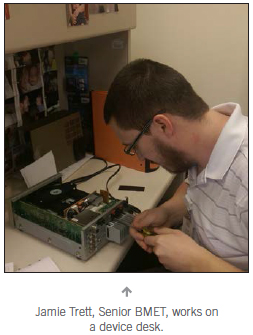
“In addition to the work on the specialized biomedical equipment — anesthesia and patient monitoring — CE was expected to work with the vendors providing service on all imaging modalities connected to PACS to make network configuration changes during PACS server upgrades in order that patients’ imaging information would also interface into the new EMR system,” he says.
The department put its savings hat on and came up with a strategy for cutting costs. During the planning process, it was decided that they would second-source the articulating arms for anesthesia carts and developed a plan for installation of the flat panel monitors and desktop equipment on 61 different machines.
“After researching the cost, our staff came up with a plan of action that enabled the facility to realize a savings of $119,000 in parts and labor avoidance,” Hamant says.
Beyond these savings, the CE department found another area within device integration, where the budget could be improved in the patient monitoring equipment area.
“By adding another NIC, and integrating through the database servers, CE was able to eliminate the need for over 260 EMR provided communication devices. This provided an addition savings of $324,000,” Hamant adds.
When the department reviewed the cardiac and radiology PACS server and modality upgrade equipment list, they discovered another area for savings.
“CE’s Field Service Specialists, in partnership with the PACS administrators, were able to make over 95 percent of the configuration changes needed to communicate with the new servers which amounted to approximately 84 hours of labor,” Hamant explains.
The department was also ahead of the curve on cyber-security. This included reviewing many of the offsite locations.
Hamant says that the department has a means for identifying HIPAA equipment in their database and drilling down on equipment type and identifying highly portable types of equipment.
“We worked with various members of the system’s Security Council to develop a plan for PHI Security Education to all directors, office managers and end-users on this topic,” he says. “CE then performed a PHI Risk Assessment — as directed by OEM’s Manufacturer Disclosure Statement for Medical Device Security Form MDS2 — at each of the off-site locations and department locations where this type of equipment is used.”
“Remediation was implemented as indicated and the results of the assessments were reported to the System Security Council for follow-up actions by other agencies,” he adds.
Away from work, several of the department members belong to the HTM associations in Ohio and Kentucky, according to Hamant.
“One member serves on the Kentucky association as a board member and association officer,” he says.
The good work that the TriHealth team is doing should keep those scores up on future assessments.
