



by K. Richard Douglas
Community Health Network is a not-for-profit health system based in Indianapolis, with over 200 sites of care and affiliates throughout Central Indiana. The health system includes hospitals, nursing homes, behavioral health centers, outpatient locations and school-based clinics. It also partners with Marian University’s College of Osteopathic Medicine and is one of the top 15 large employers in Central Indiana.
Managing an inventory of 21,238 active devices is the task of the health system’s 25-member clinical engineering department. In 2013, the department handled 9,430 repair requests and 5,904 scheduled inspections.
“Our HTM team supports the five Community Health Network hospitals in Indianapolis and one located about an hour north, in Kokomo,” says Pat Holliday, radiology service leader for Community Health Network. “In addition to the hospitals, we support many off-site facilities such as surgery centers and imaging centers. We have a total of 25 people in the department, providing service for the imaging and biomedical equipment.”
“We have a technical site leader who serves as the main point of contact for the clinical care team in each facility,” Holliday explains.
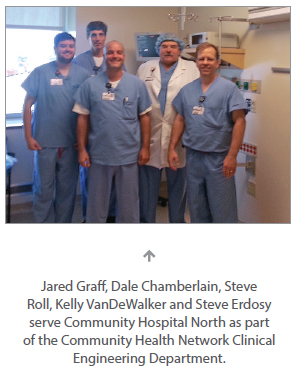
Those site leaders include Dwight Crowmer at the Community Hospital East, Andrew Moore at Community Howard Regional Health, Steve Erdosy at Community Hospital North and Matt Smith at Community Hospital South. Holliday leads the department’s imaging service team. Karen Waninger is the department’s director.
“Eighteen of the 25 members of our team have earned the credential of Certified Biomedical Equipment Technician (CBET) in addition to their assorted levels of formal education. Additionally, many hours are spent each year for advanced technical training and professional development classes,” Holliday says.
The team has a diverse skill-set with imaging specialists who support cardiac cath equipment, MRI, CT, ultrasound, CD/DR and rad/fluoro.
“On the biomedical side, we support specialty devices such as lasers, anesthesia, ventilators, neonatal intensive care, balloon pumps, physiological monitoring, neurology, pulmonary function and all general care areas and devices,” Holliday says.
The need for service contracts is handled through a strategic process, according to Holliday.
“Each device is evaluated to determine the most appropriate service strategy, based on the technology, the availability of training and alternative suppliers for replacement parts,” he says. “Our organization utilizes a mix of full service, shared risk, parts-only and time and materials agreements, with the desire to have all service activities tracked through our equipment management database.”
He says that the clinical engineering team has a good working relationship with the IT department, with a healthy respect for the skills each brings to the table.
Going Beyond
 “As a team, we have accepted the responsibility for supporting additional facilities as our healthcare network has grown, and have even agreed to provide service, for a fee, to some other organizations in our geographical area who have needed support for their healthcare technology,” Holliday says.
“Each facility, each business affiliation arrangement, and each new bulk of additional inventory allows us to further demonstrate our value, by helping reduce the total cost of service for the medical equipment,” he adds. “Since the beginning of 2013, we have expanded our area of responsibility to deliver services to more than 10 additional locations.”
Holliday says that many in the department choose to participate in the volunteer program that their organization has implemented to give back to the communities in the surrounding area. Called “serve360°,” this program includes a wide variety of activities.
“Last year, we were instrumental in the development of a playground area at a local church school, where none had existed previously,” Holliday says. “We put on the jeans, T-shirts and gloves, picked up the hammers, shovels and rakes, and had a great day of physical exertion and team building, while creating some great play areas and structures for underprivileged children.”
The team is very involved in the HTM profession even while away from work.
“We are a highly involved group, with great support from our vice president at the hospital,” Holliday says. “Everyone in our department, including our VP, is a member of the Indiana Biomedical Society (IBS). Each year, about 80 percent of us are able to attend the annual conference in Indianapolis in January.”
“We have many people who have been officers for IBS, including some who hold positions currently. We are proud to say that we have had representation at every MD Expo since 2008, except the last one in Washington D.C., and our entire Imaging Service team participated in the inaugural MD Imaging Expo in July of 2014,” he adds.
“We have several individuals who have been HTM award recipients, both locally and nationally, including numerous IBS Professional of the Year winners, AAMI BMET of the Year, AAMI HTM Leader of the Year. The first TechNation Professional of the Year award came to Community, as well.”

Analytical Minds
Not just repair experts, the team has also been called upon to evaluate acquisition decisions.
“Recently, our biomedical service team has been instrumental in the consideration of evaluating different patient monitors for future purchases across Community Health Network. Our current standard monitor vendor has been adequate, but the life cycle cost of the systems has continued to increase with each expansion, while some of the desired features have been slow to be developed,” Holliday says.
“We spent a great deal of time talking to the clinicians, working with the product analysis team which is facilitated by our partners in purchasing, and coordinating on-site demonstrations and trial implementation/utilization areas,” he says. “The results have been positive from a variety of perspectives.”
The imaging service team has been working over the past year to find the right upgrade path to move its old portable X-ray machines into the digital radiography world.
“We are nearing the final stage of the first of the selected upgrades and are hopeful that this will lead to many more of these in the near future,” Holliday says. “If successful, this project alone will save our network more than $500,000 in planned capital expenditures next year.”
