



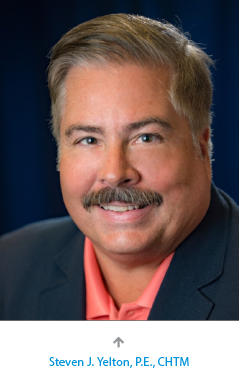
 By Steven J. Yelton, P.E.
As I write this column for the November 2022 issue, we are fully into the 2022 fall semester at Cincinnati State. This school year has started with a renewed interest in the healthcare technology management (HTM) field. Our program remains relatively small but solid for the past 30 years. We continue to wrestle with methods for increasing enrollment as we have cooperative education and full-time employers anxious to hire our students and graduates.
I recently had the opportunity to participate in a webinar hosted by AAMI. This webinar was titled “BMET Educators Share How to Teach Proper CMMS (Computerized Maintenance Management System) Data Entry.” This topic is one that we chose to feature in our HTM classes beginning this fall. We are adding software to our courses and students will learn more about this during their cooperative education assignments. A big thank you goes out to Heidi Horn and Nuvolo for providing software to educational institutions to allow us to teach “real-world” software in our laboratories. We are excited to implement this software and enhance our coverage of the CMMS topic this year.
We found that this topic is very important to educators and hospital personnel. The webinar was very well attended and many important questions were asked and answered.
The following link to the AAMI website has some additional resources on CMMS. AAMI website states, “Computerized maintenance management system (CMMS) software has become essential for healthcare technology management (HTM) program operations. Due to a lack of standardization in data collection, it has been all but impossible to assess their industry as a whole. That’s why six competing CMMS suppliers recently came together to standardize how medical device information is configured. In the first phase of their work, they outlined an agreed-upon method for optimizing and standardizing failure codes. The second phase of the group’s work focused on defining and standardizing CMMS work order types.” aami.org/HTM/htm-resources
I feel that this is a good time to review some additional educational resources that I find useful for educators and HTM professionals looking to update or upgrade their competencies. We use these in our curriculum.
A resource that I find very useful is the “Core Competencies guide” from AAMI. The AAMI website states, “The intent of Core Competencies for the HTM Entry-level Technician: A Guide for Curriculum Development in Academic Institutions is to provide academic institutions/schools that offer technician training for the healthcare technology management (HTM) profession with the following:
a standard set of competencies that graduates of technician training programs (certificate, diploma or degree) are expected to possess upon program completion; and
recommended topics that a program curriculum should include in order for students to learn and possess the core competencies identified in this guide.
The competencies and topics in this guide are relevant to HTM technicians entering the workforce, and the topics reflect the knowledge and skills that entry-level technicians are expected to perform successfully in entry level positions regardless of the employment organizations, e.g., hospitals, clinics, independent service organizations, military and manufacturers. This guide may also assist schools in preparing their graduates for professional certification, e.g., ACI certification exams.”
A PDF version of the “Core Competencies Guide” is available for free download from AAMI. https://store.aami.org/s/store#/store/browse/detail/a152E000006j64zQAA
Another resource that I use in the classroom and recommend to HTM professionals is the “HTM Career Planning Handbook.” The AAMI website states, “Career development is much more than getting a new job; it is about growing your skills and experience to advance in your career and be more valuable to your current and future employers. AAMI’s goal in creating AAMI’s Career Planning Handbook is to foster the development and advancement of its members. Many AAMI members work in institutions where they are part of a small staff of HTM professionals. Finding good guidance on career advancement can be challenging. This handbook provides you with tools you need to create meaningful career goals and chart the path to advancement. This guide also gives you the information you need to have conversations with your organization’s leaders on your future career objectives.”
We find this guide to be very helpful to students it also, as the description says, provides tools to create meaningful career goals and chart the path to advancement.
It is available at: https://store.aami.org/s/store#/store/browse/detail/a152E000006j61QQAQ
These are just a few of the resources available to you from AAMI. Many others are available from different HTM organizations and societies. Please take advantage of resources made available by your local HTM group.
I also want to mention that AAMI membership is complementary to full-time HTM students and full time faculty.
– Steven J. Yelton, P.E., CHTM; is a Senior Consultant for HTM in Cincinnati, Ohio and is a Professor Emeritus at Cincinnati State Technical and Community College where he teaches biomedical instrumentation courses. He is the Immediate Past Chair of AAMI’s Board of Directors, a member of AAMI’s Foundation Board of Directors, Former chair of AAMI’s Technology Management Council (TMC) and Chair of AAMI’s HTAC Committee.
