



By K. Richard Douglas
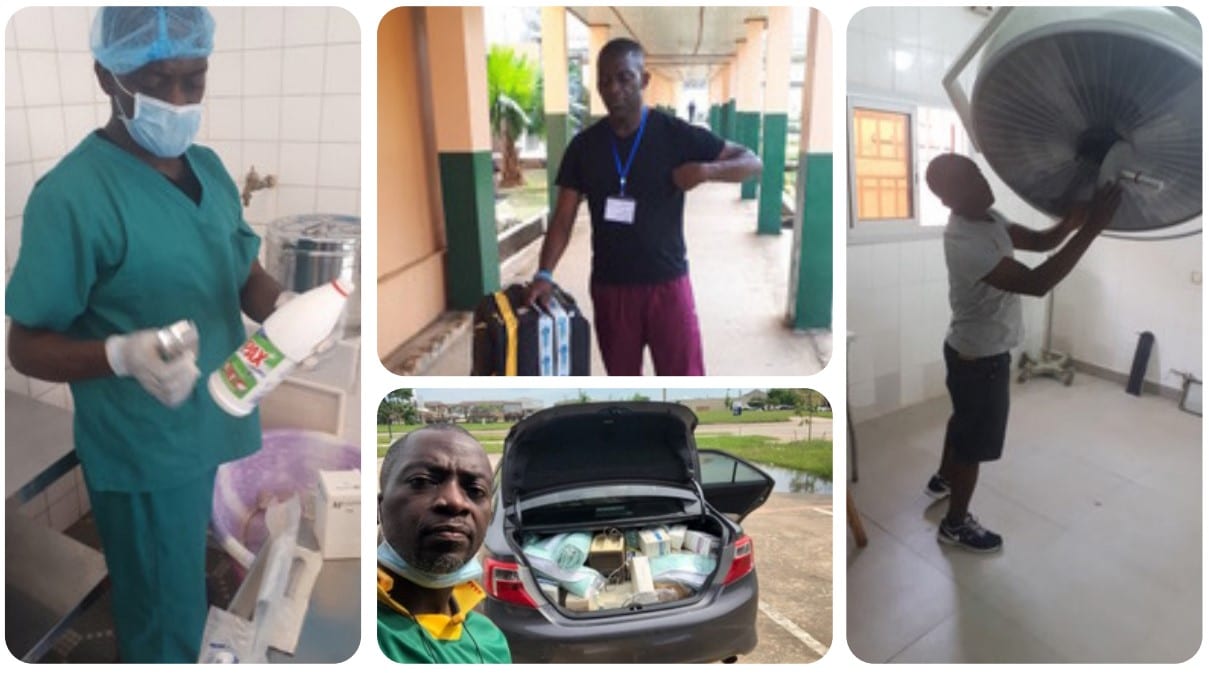
The western highlands of Cameroon can get 400 inches of rain from May through October; making it one of the wettest places on earth. The country, which lies on the coast of central Africa, is also one of the most ethically diverse in the world, with more than 200 different ethnic groups and 240 languages spoken.
There was a time when Cameroon was quite prosperous and it has natural resources like cobalt and oil, but an economic crisis during the 1990s impacted the country’s economy and resulted in major cut backs in health care spending. Medical supplies and health care professionals remain in short supply to this day.
That has been part of the impetus for Cameroon-born American biomed Alain Lengue to address the medical equipment and repair shortcomings in his homeland. He is a clinical engineer with Elite Engineering. Lengue has seen the vast disparity between the quality of health care in his adopted country and his native country and set forth to do something about it.
“I was born in Cameroon, Africa. I immigrated to the United States in year 1999. I did not speak English, and French was my first language. I went to school here to learn ESL (English as a Second Language). I continued my education and got my bachelor of science in biomedical engineering technology from DeVry University in Kansas City, Missouri,” Lengue says.
Lengue returned to Cameroon for a vacation in 2010 and got diagnosed with appendicitis. What followed was harrowing to consider.
“I almost died due to the lack of medical equipment to perform the surgery. I was told I will die. Finally, I got operated on a kitchen table with one barely working generator. The surgery was successful and that is where I discovered the desperate need of medical equipment,” he says.
As a result of that experience, Lengue created a not-for-profit 501(c)3 organization called the African Biomed Group to educate and train medical and technical staff in developing countries.
“Since then, I have been traveling to Cameroon to assist with medical mission trips. I have collected used and defective medical equipment here in the United States, fix them and ship them to some facilities in Cameroon. Consequently, it was not productive because it’s important to properly select the equipment and accessories for optimal performance for the medical procedure,” he says.
He says that now he intends to build a clinic there to train the trainer on how to diagnose and fix medical equipment.
“I want to create awareness of the vast differences in medical procedures between third-world countries and the United States of America,” Lengue says.
Training the Biomeds of Cameroon
Lengue says it was providence that he met Dr. Jean Louis Benae in Dallas, Texas in 2019. Benae, a neurosurgeon, also happens to be a fellow Cameroonian.
“He invited me to his house for New Year’s party. I went there with my children – Jason, (and twins) Jeanna and Jayden – for the party. Once I arrived there, he pulled me to the side and told me about a big project, that he has to go to Cameroon to perform difficult surgeries on people for free. He told me about his organization called Brain Project Africa. I then freely volunteered to donate my finances, time, talent and equipment to the cause,” Lengue says.
He paid for airfare, visas and immunization application fees, his lodging, including transportation fees, room and board fees; all out-of-pocket for a month.
“That medical mission was very successful. I got a lot done and the team also got a lot accomplished. I’m was very fulfilled and satisfied at the outcome of the mission. Unfortunately, the second medical mission trip to Ghana, I couldn’t go due to a lack of finances,” Lengue says.
He says that after seeing the need, he created the African Biomed Group to make an impact because of the severity of the need.
“They have no test equipment, no parts, no access to resources to troubleshoot and repair. For example, here in the USA, I have the luxury to call the manufacturer for troubleshooting or ordering parts. Over there, first of all, the access to the phone is a luxury, not to say calling an international line to ask about preventive maintenance or repair on a particular device,” Lengue says.
He says that it is important to understand that the concept of maintaining, repairing and performing regular PMs is non-existent in developing countries.
“If a piece of medical equipment does turn on, that’s good enough to be used despite the liability of that equipment,” Lengue explains.
Parts are often impossible to locate; including the most basic parts. Lengue provides an example from a real-life experience while working on a dental chair and a surgical table.
“I needed a fuse 250V and 0.5A and a few screws to complete my repair. It took me all day long to search and find the fuse. I drove around town and I still couldn’t find the basic fuse. Therefore, you have to adapt by being creative. Creativity is your main and most important tool that you have to possess in order to function there,” he says.
In most of the facilities that Lengue has visited, the only person doing any repairs or maintenance might be a part-time electrician.
“That electrician employee is the one doing pretty much everything including carpeting, plumbing; you name it,” Lengue says.
He says that his overall experience making medical mission trips to developing countries has been humbling.
“I’m so grateful and it helps me to be really appreciative of my life and the opportunities that I currently have here in the United States of America. Yet, I’m devoted to continue my mission, therefore I created the African Biomed Group to educate and train medical and technical staffs in developing countries,” Lengue says.
Right now, Lengue needs the finances to put up a website, rent a warehouse and purchase replacement parts. He also needs to collect some training materials.
“All I know is that I have an elephant in front of me to eat. In order to eat that elephant, I will take one bite at the time,” he adds.
