Sponsored by Innovatus Imaging

By Ted Lucidi, CBET
If you work in or support a metropolitan health care facility or one that specializes in cardiology, most likely, a good portion of your ultrasound support costs are consumed by addressing TEE probe failures. OEM replacement costs for the latest high-tech 3D TEE probes from Philips, GE and Siemens can range from $20,000 to $30,000. Believe it or not, some facilities are replacing one TEE probe every month.
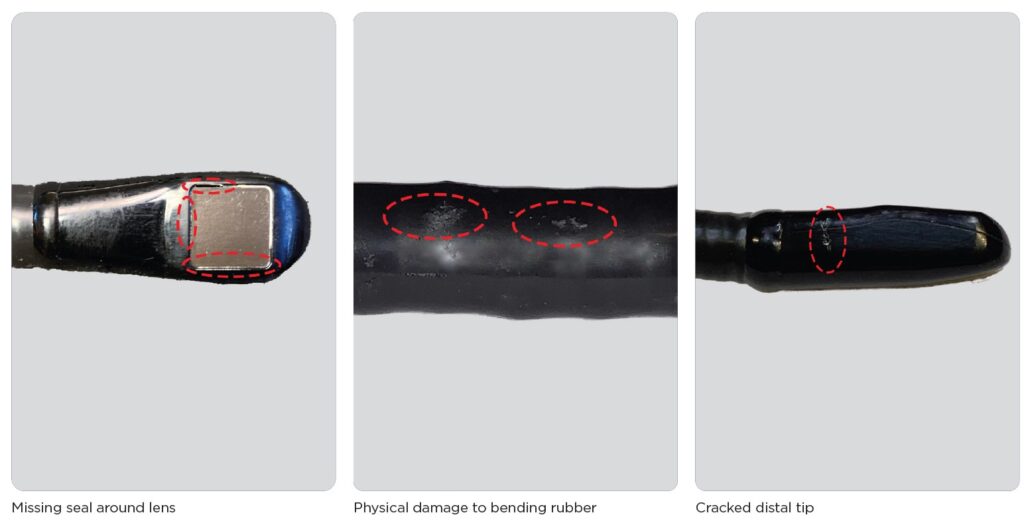
Every year, Innovatus repairs about 1,800 TEE probes. We have a massive database that enables us to investigate and cross reference failure analysis data and determine root causes. Believe it or not, over 60% of all TEE probe failures are a result of flooding, or what’s called “gross fluid invasion.” With most of these failures, some type of physical damage or worn and missing seals breaks the physical integrity of the fluid-proof components of the probe. TEE probes are high-level disinfected via immersion or automated reprocessor between every use. The process of high-level disinfecting a TEE probe with a break in physical integrity permits water and chemical disinfectants to enter the probe and cause massive damage to the electronics.
Options for TEE Probe Failures
You have several options for supporting TEE probes. Like most support models, the cost of each is offset by the amount of risk you are willing to accept.
- You may have a full-service contract on your ultrasound consoles that covers ALL of your TEE probe failures, no questions asked. These types of contracts are extremely costly; however, they eliminate all risk for your facility. Based on our data, they are most likely not the best use of your budget.
- You also might have a shared-service or event-based contract that covers x-number of TEE probe failures, no questions asked. Once the number of events would be consumed, you would have the option to purchase an OEM exchange/replacement at 50% list-cost. Even using this model, you would still be outputting over $11,000 to $15,000 per failure, on top of what the contract is costing you.
- A third option is to support your TEE probes via time and materials (T&M), addressing each failure as it occurs. Repairs on TEE probes can begin as low as about $900 and might top out at about $11,000. Based on our data, this scenario can provide the largest savings to your budget.
- There is a fourth option that blends options 2 and 3 together. Some facilities choose to maintain their event-based contract but augment it with option 3’s repair model. In this scenario, you would always begin by utilizing the T&M repair model. If the probe would be repairable, you would pursue the low-cost repair option, realizing significant savings. If the probe would happen to be catastrophically damaged beyond repair, you would use an event on your contract to replace that probe. In this scenario, you would realize significant savings to your budget and make the most of your contract.
No matter which model you have chosen, there are other items that need to be considered, such as downtime, patient throughput, uninterrupted workflow and customer satisfaction. Believe it or not, there were several occasions over the last few years when OEM-contracted customers could not obtain replacement TEE probes due to supply chain challenges and manufacturing shutdowns. There was no, or extremely limited, availability and it affected the ability for some health care providers to perform TEE studies. And there is no guarantee that it will not happen again. All the more reason to consider options 3 and 4 as the most viable solutions.
Path to Success
The path to success begins with minimizing your risk for preventable TEE probe failures. By having the proper controls in-place,100% of all preventable TEE probe failures can be eliminated. That is a powerful claim, but it is true. By understanding how your facility’s TEE probes are stored, transported, staged, used, cleaned, and disinfected, you can very easily reduce, if not eliminate, the need to replace a TEE probe due to preventable damage.
OEM user manuals are filled with lists of Do’s and Don’ts. Based on over 10 years of data, we can confidently say that many items on those lists are not in-practice in today’s health care facilities. Surprisingly, with only some very minor updates to the processes in each clinical area, costly catastrophic TEE probe failures can be eliminated. Also remarkably, the solutions are very low-cost and would add very minimal time to the existing processes.
Where do you begin?
In about an hour’s time, the clinical experts at Innovatus Imaging can train one or more members of your HTM team to be TEE probe experts. We will provide them with the knowledge and our proprietary tools to capture the current care and handling practices for TEE probes at your facility. Our experts will review your facility’s current practices and consult with you and your clinical teams to implement industry best-practices that have been proven to eliminate the potential for replacing TEE probes due to preventable damage.
Some of the items include if, when, and how clinical teams visually inspect a TEE probe; and what occurs if any concerns arise. Is leakage testing performed? When in the process; and, what is the process if a failure occurs? Are the proper chemicals in-use, and are they being used according to the instructions. How are TEE probes being stored as well as how are they transported from point A to point B?
What This Means for You
Innovatus Imaging is not just a repair provider, we are your service partner. We are here to assist you and your customers with obtaining the maximum lifespan for your ultrasound probes and MRI coils. Our SafeTEE program is designed to help you, your facility, and your customers reduce and even eliminate preventable TEE probe failures. For questions, assistance, or more information, please reach out to safetee@innovatusimaging.com. If you have a failed TEE probe, we can help! We have some of the most-comprehensive repair capabilities on standard and 3D TEE probe models, and we would appreciate the opportunity to assist you.