


 By K. Richard Douglas
Colonel William Lordan Keller was an Army doctor and surgeon who served during World War I and later as the chief of the surgical service at Walter Reed General Hospital. After retiring in 1935, he went on to be appointed by President Franklin D. Roosevelt as a lifetime consultant in surgery at Walter Reed. His contributions to Army medicine left a legacy.
Naming a hospital in his honor was part of that legacy. Keller Army Community Hospital can be found in West Point, New York. West Point is also home to the nation’s first military academy. West Point prepares young men and women to become officers in the U.S. Army. Cadets attend the academy for four years, graduating with a Bachelor of Science degree and a commission as a second lieutenant.
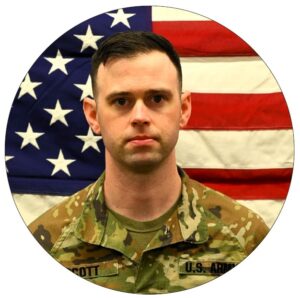
Keller Army Community Hospital Warrant Officer Tyler J. Scott, M.S., is chief of the equipment management branch at the hospitals.
“I come from a long lineage of military members, but was unsure if the military was for me, so I decided that I would instead go to college. I was unsure what I wanted to do for a career upon my completion of college. My father, Mark Scott, had worked on communication equipment while he served in the U.S. Army, and he suggested that I might like a career in repairing equipment,” Scott says.
He says that his dad was absolutely right.
“He encouraged me to become a 68a biomedical equipment technician and I grew a passion for repairing/maintaining equipment. I have since spent 10 years in the field and progressed to becoming a 670a health services maintenance technician operating at Keller Army Community Hospital in West Point, New York,” Scott adds.
He says that he attended an 11-month biomedical equipment technician program at the medical education and training campus at Fort Sam Houston, Texas as part of his advanced individual training to become a 68a biomedical equipment specialist.
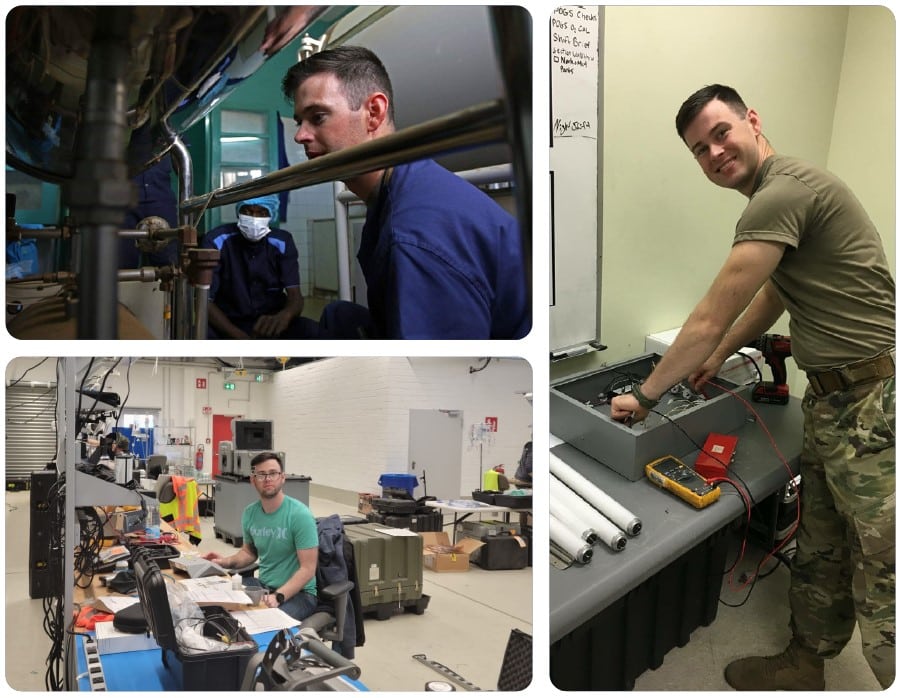
Scott explains that the biomedical equipment specialist (68a) is someone responsible for servicing and maintaining all medical equipment, calibrations and preventative maintenance, installations and keeping records of services performed.
“I also attended the warrant officer basic course at Fort Sam Houston as part of my 670a health services maintenance technician program. I have also completed the 70K medical logistics officer’s course to gain a wider scope of logistics as a whole,” Scott says.
He started his biomed career at the 14th Combat Support Hospital in Fort Benning, Georgia. He deployed with that unit three times to Kosovo, Iraq and to Puerto Rico during Hurricane Maria.
“I then became the chief of operations of the United States Army Medical Materiel Agency Medical Maintenance Operations Division Utah at Hill Air Force Base, Utah. From there, I became the Chief of the Equipment Management Branch at Keller Army Community Hospital, West Point, New York,” Scott says.
Currently, Scott’s area of specialty is project and life cycle management.
“I ensure that my staff acquire, maintain, sustain and repair our medical equipment within Keller,” he says.
Scott is a demonstrated logistician through the International Society of Logistics.
Making a Positive Impact
One of the challenges in the biomed field is staying up to date with the ever-changing medical field.
“The medical device industry is advancing so quickly, by the time you think you have the newest and greatest equipment; something new is on the market. This is great for us biomeds, though as we get to work on the latest and greatest equipment and integrate more with the information technology personnel. This allows us to have a greater presence among the hospital and build strong cohesive teams,” Scott says.
When not working, Scott remains the technician and keeps tools close at hand.
“I enjoy working on and repairing anything I can get my hands on from vehicles to Roomba robot vacuums. I also enjoy the outdoors and going fishing. I am a huge large-mouth bass fisherman,” he says.
Scott was recently married to his fiancée, Andrea Mills, in Central Park.
“We have a 10-year-old son, Braxton, and a 10-year-old daughter, Makenzie,” he says.
Scott still has several goals as he continues through his career.
“I want to continue to make a positive impact on the HTM field. I want to build strong independent teams that have the same passion as I do. I desire to eventually work at a strategic level of planning and development. My overall goal is to integrate emerging technologies to provide quick, accurate and precise diagnosis of patients,” he says.
The U.S. Army is lucky to have an HTM expert of Scott’s caliber.
BIOMETRICS
Favorite book:
“The Reaper” by Nicholas Irving
Favorite movie:
“Black Hawk Down”
Hidden talent:
The ability to remember almost everything I have ever heard. I am great with random knowledge.
Favorite food:
Texas Roadhouse ribeye rare with mushrooms
Favorite part of being a biomed?
Working with a close-knit team that ensures patient safety by placing life-saving equipment into the hands of providers.
Why do you read TechNation?
To stay up to date with anything and everything HTM-related.
