



By K. Richard Douglas
In existence for nearly 35 years, the Indiana Biomedical Society (IBS) has joined together and educated biomedical professionals from The Hoosier State.
The society’s leadership includes President Naka Piohia, Vice President Abdelkader Bouzar, Secretary Noah Graber and Treasurer Matthew VonBank.
The group originally formed following a survey conducted by HTM professionals Jim Sheets and Mike DeJaeger.
“Results from a clinical engineering survey at Methodist Hospital of Indianapolis indicated that BMETs believed that they weren’t a recognized group of employees. So, in an effort to heighten the awareness of the then biomedical industry (pre-HTM) community, Jim and Mike organized a meeting that took place on July 14, 1990, to establish the Articles of Incorporation and by-laws for the association. The other people in attendance included George Gladding, Bruce Mueller, Mike Mullane, Jack Simmons, Bob Cartmel, Mike Bernstein, Steve Sanghvi and William Ritcher,” Piohia says.
After the survey results led to the group’s first meeting, the 18 original attendees went on to form IBS.
Piohia says that the society holds quarterly training meetings every year. To accommodate biomeds from different areas of the state, the group does broadcast those meetings using Zoom.
Also, to help introduce new biomeds to the profession, IBS has a relationship with both Vincennes University and Indiana University-Purdue University Indianapolis (IUPUI).
“We support their biomedical engineering program with medical devices to use in their skills labs. Over the last years, several of their students served as interns at a few of our hospitals and we included them in our annual career fair,” Piohia says.
He adds that the group hopes to grow in its relationship with the existing schools and establish new relationships with other universities and technical colleges. IBS also has a scholarship program.
While education is often central to a biomed association’s offerings, the IBS has attempted to rally the field in Indiana in other ways as well.
“We encourage fellowship among the HTM community by sponsoring team-building events and activities such as ‘Family Day at TopGolf,’ ” Piohia says.
He says the event provides an opportunity for members to meet each other and get to know one another – and spouses and families – away from the healthcare business settings.
“We also promote the medical electronics technical field as a career path by offering educational scholarships,” he adds.
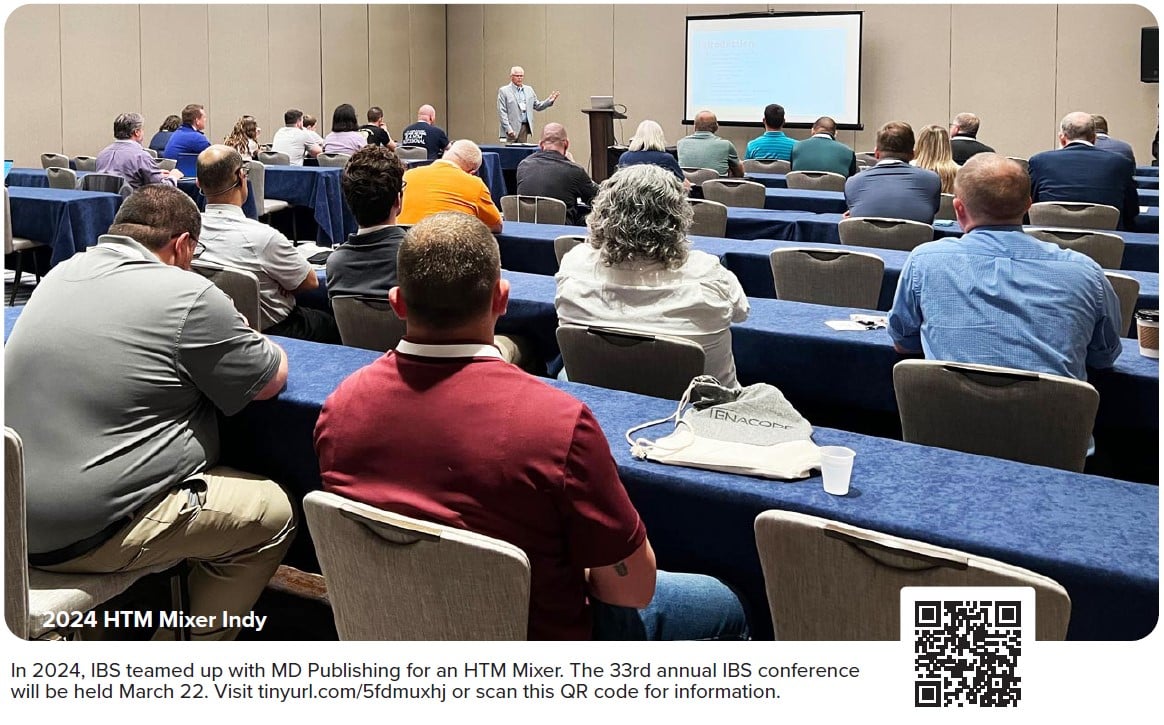
2024 CONFERENCE/HTM MIXER
The IBS 2024 conference was a special coordinated event with MD Publishing and TechNation.
“For the 32nd annual conference held on May 2 and 3, 2024, we partnered with MD Expo to host their HTM Mixer in Indianapolis, Indiana. It was at the Westin in downtown Indianapolis. IBS members were free to register,” Piohia says.
He says that the “Mixer” was a great opportunity for IBS.
“We had over 60 vendors attend. It was a two-part ‘Mixer’ type event, slightly smaller, shorter-duration and less-crowded, but still provided valuable continuing education, networking and vendor engagement opportunities. HTM Mixers were created during the novel coronavirus (COVID-19) pandemic when larger events were not possible. The mixers were a hit and served as a regional conference for HTM professionals eager to earn continuing education credits, explore solutions in an exhibit hall and network with peers,” Piohia says.
One of the members who attended the conference was Paul Neher, a biomed supervisor from Fort Wayne.
“I met many long-time friends, spoke at length to vendors and suppliers, but the real win for me was the education. I attended a full class schedule on such topics as CMMS automation, applying lean processes to motivation and team problem-solving, and contrast injectors. I always learn something at these events, but I took away many pages of notes and perspectives I had not had previously,” he says.
The event also included a business meeting.
Neher said that “the IBS business meeting was fairly well attended with the focus being the future of the IBS and the coming biomed shortage. It was a lively roundtable that left me feeling energized.”
Piohia says that the event also included industry-leading speakers covering the hottest topics in HTM such as compliance, IT, cybersecurity, management and equipment service.
Among the education opportunities were three courses: “Introduction to Contrast Injectors” by presenter Stephen Maull, owner of Maull Biomedical Training; “All in the Family: Building Teams by Bridging Generational and Demographic Gaps” by presenter Mark Cooksey, DME Quality Engineer, Norton Healthcare; and “AIAT & Service Access for Modern Diagnostic Imaging Systems (Right to Repair)” by presenter Todd Boyland, CEO, RSTI.
The event also included a welcome reception that was sponsored by USOC Medical.
“There was an open bar, delicious appetizers and great networking,” Piohia adds.
The conference/Mixer also included a door prize drawing at the conclusion of the exhibit hall.
“We drew names for the door prize giveaways provided by all the vendors which include gift cards, gadgets, tech and tools,” Piohia says.
As was the case with most state biomed associations, the pandemic played a key role in forcing adaption of workarounds and use of the Internet to keep members connected.
“The pandemic caused us to rethink how we provide our members with the information and support that we offer. We began by using Zoom to host our quarterly training meetings. We used social media, specifically Facebook, to promote social events and career fairs. And WebEx was very handy for hosting our board meetings so we could continue to organize and strategize our future plans for the organization,” Piohia says.
The Hoosier State has had its HTM community united and connected through a biomed society that has spanned more than three decades. IBS has also been instrumental in its role as a conduit, with local training programs, to bring new biomeds into the field.
