



By K. Richard Douglas
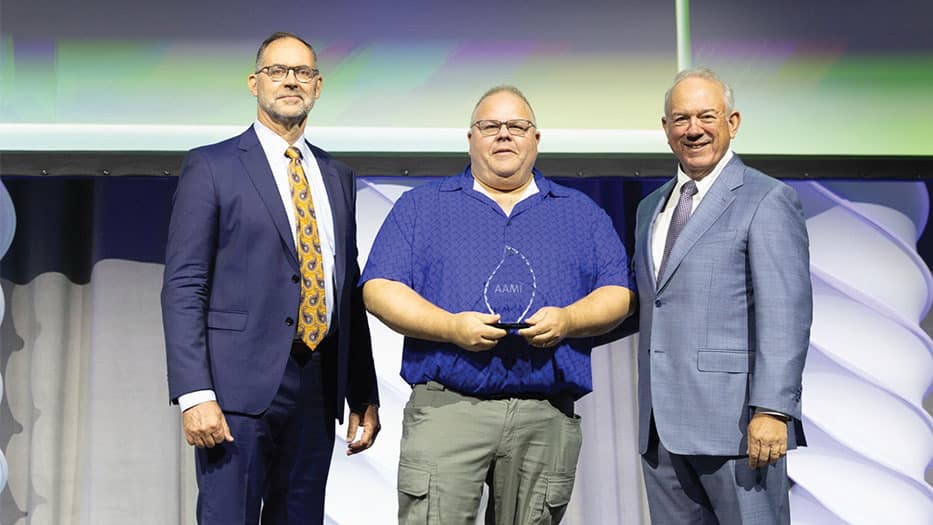
In the biomed world, you have to be pretty good to be recognized as the AAMI and GE HealthCare BMET of the Year. This year’s winner is Joe Deater, CBET, a BMET III with Munson Healthcare and a biomed engineering tech instructor at Northwestern Michigan College in Traverse City, Michigan.
Deater spends much of his time in Traverse City, Michigan, a place that is a popular tourist destination on the shore of Lake Michigan. It is known for its cherries and nearby Sleeping Bear Dunes National Lakeshore. It is an ideal location in which to work during the spring, summer and fall.
“I first heard about biomedical technologies from my brother that was in the Air Force. He knew that was my plan also; I was on an electronics track when I went in. He told me to try to get into biomed technologies. As any 17-year-old would do, I said what the heck is that? Well pretty much anyone not in a hospital would ask that too,” Deater says.
He gave it a try but did not land a slot.
“Instead, I got my electronics training background when I was assigned to work on F-16s avionics attack systems. Biomed tech always stayed in the back of my mind though. When I got out of the Air Force in 1993, after my four-year commitment, I moved back to [the] West Coast of Michigan. After a bit of time trying to figure out what I wanted to do with the rest of my life, I enrolled in Baker College of Muskegon and began gen ed classes,” Deater adds.
Baker College gave Deater credit for nearly all his Air Force courses which got him off to a good start.
“As I looked through the offerings at the college, I discovered they had a biomedical technologies degree program. The fates had aligned for me. I proceeded to declare my major in biomed and began taking the required pathway, which was much abbreviated since my Air Force credits took care of nearly all of the electronics and electrical theory classes,” he says.
By the time Deater graduated, he was already working in the field, getting a job at North Ottawa Community Hospital in Grand Haven, Michigan.
“I have always been a biomed tech, BMET. I was at North Ottawa for 1.5 years working for Service Master. We lost the contract to the newly emerging Sodexo. I then found myself and my family in Traverse City, Michigan, at Munson Healthcare in northwestern Michigan, that has grown from two hospitals and a couple community centers, to now an eight-hospital system,” he says.
Deater progressed up through the ranks, starting as a BMET, moving toward becoming a senior biomed.
“That changed a few years ago to the standard BMET I, II, III structure. I have been all three of them. I am also currently a CBET. I am also the adjunct instructor at Northwestern Michigan College in Traverse City for the Biomedical Technologies Associate Degree Program, where I teach the biomedical technologies courses at the end of the degree for two semesters,” Deater says.
He has been in that position since 2018.
“I also have my own business that I help some of the local veterinarians with their equipment needs. Being in a rural area, it is difficult and expensive to get equipment serviced. Generally, they would have to send things out and we all know shipping can be costly. So, I do what I can for them,” Deater adds.
Since 2019, Deater has also been involved with AAMI and the world of standards.
“I have since been an active part of AAMI Standards Committees. I have sat on groups developing white papers such as the BMET Gray Areas, and an updated, as of 2022, listing of the recognized BMET programs across the country. We identified what schools had active programs for BMET associate degrees. Sadly, this was in the midst of the pandemic. Since then, we know we have lost about 10 programs due to cutbacks and lack of enrollment,” he says.
TRAINING THE NEXT GENERATION
One of the challenges that Deater has faced as a biomed has been the lack of awareness of the biomed field in the rural community where he lives. He says that many people visit the area as tourists never considering that there are jobs there and they could live there as well.
“Munson for many years had open positions that would go unfilled. We had few applicants. So, my management finally approached our local community college about beginning a program,” Deater says.
At the time, he never imagined himself teaching a college course, but it just happened.
“I was meeting with my management and asked about the new program and how it was going. He laughed and said funny I should ask. The tech that was going to be teaching the biomed courses had to step out for some personal reasons leaving no biomed to teach the new biomed classes that had five students coming into it in January. This was all taking place in early November. My manager asked if I was interested in taking on the adjunct teacher position. If so, he would put me in touch with the director of the tech division for the school. I knew we couldn’t not have a biomed teaching the courses, so I reluctantly agreed,” Deater says.
He met with the director of the tech division that afternoon.
“I introduced myself, he shook my hand, handed me the book for the class and said, ‘Welcome aboard.’ I said wait, what? Should we discuss this first? I was officially a college educator now. I had 1.5 months to formulate a syllabus and put together a course to educate five guys ready to begin their careers. That happened in 2017,” Deater says.
He began teaching in 2018 and all five new techs graduated and landed jobs in biomed technologies.
“My next cohort began fall of 2019; I had three in this class. I had decided to change our book for the class, so I retooled for the next class, rework number two. Fall went well and then there was a little hiccup in spring semester 2020,” Deater says.
The pandemic required regrouping and converting the program to completely online within a month.
“We made it through that and I was then asked to change rooms for a third time so I had to reset my labs and how we would work. I have had all my graduates land biomedical tech jobs that have decided to stay in the field. I now have graduates across the country,” Deater adds.
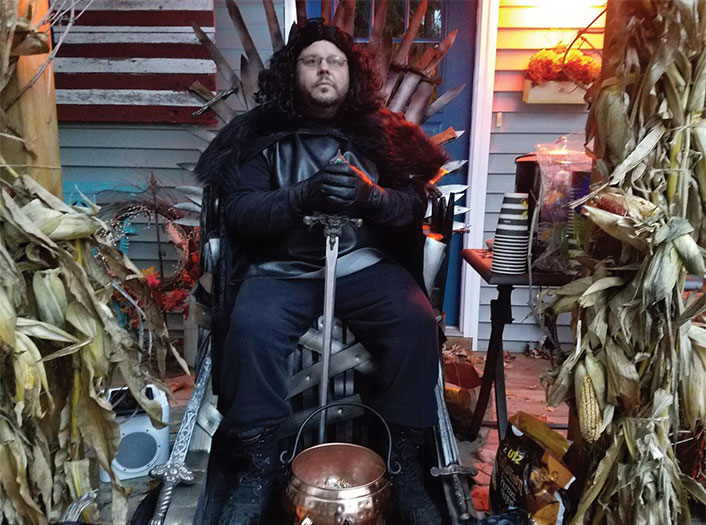
Away from work, Deater enjoys fishing small lakes in the area in his fishing kayak.
“Finding time to go is tricky most of the time though. I also Halloween. I have a different theme each year and decorate the yard for the big night. Oh, and my hobby garden, that I plant vegetables in. Great relaxation and is fun to see seeds transform into food,” he says.
He has been happily married to his wife, Tonya, for 30 years.
“We have two grown kids; my son, Jordan and my daughter, Logan. Both kids are college graduates. Logan is married, her husband Jarred is a sous chef in Ada, Michigan. Logan is working towards her Ph.D. at Western Michigan University in Kalamazoo, Michigan. Jordan works in IT in Grand Rapids, Michigan. We have three grand dogs. Both of us have both sets of parents still with us and doing relatively well,” Deater says.
Of the AAMI/GE HealthCare BMET of the Year Award, Deater is humble and reflects upon the focus of many in the field.
“I was in shock to hear that I had been awarded it. It isn’t a self-promoting award. Someone had to nominate me, then a review board had to look over the nomination amongst other stronger candidates from all of the world. As is the case for most BMETs, we are not looking for awards; we look to keep patients safe and equipment working. That’s our award; knowing we have a job well done,” he says.
