By Mark Cooksey
Healthcare technology management (HTM) service contracts are becoming more complex, more expensive and more critical to safe patient care. At the same time, biomeds are increasingly being asked to support, or directly participate in, contract evaluations and negotiations. That shift can be uncomfortable. Most of us were trained to troubleshoot devices, not to analyze contract language, benchmark pricing or defend recommendations to leadership.
Artificial intelligence (AI) won’t negotiate contracts for you – and it shouldn’t. But when used correctly, AI can serve as a practical analysis assistant, helping biomeds prepare better, ask smarter questions and communicate more effectively.
Why I Turned to AI for Contract Analysis and Negotiation
For many years, HTM service contracts followed a familiar pattern. Renewal notices arrived, pricing increased incrementally and contracts were renewed largely through a legal lens – focused on terms and conditions more than value. The unspoken assumption was that negotiating service contracts required specialized legal or purchasing expertise, outside the traditional HTM role.
That approach no longer works.
Service contracts have become crucial to cost control. Simply accepting proposals without structured review exposes organizations to unnecessary cost and risk. Rather than accepting contracts “as‑is,” we began treating service agreements the same way we treat any major purchase – like a home or a car.
We used AI to:
- Analyze contracts in clear, easy‑to‑understand terms
- Identify cost saving opportunities quickly
- Respond firmly and effectively to vendors
We paired AI‑assisted analysis with ECRI benchmarking to:
- Review proposals more consistently
- Identify savings opportunities or lock in favorable pricing
- Analyze key contract elements quickly
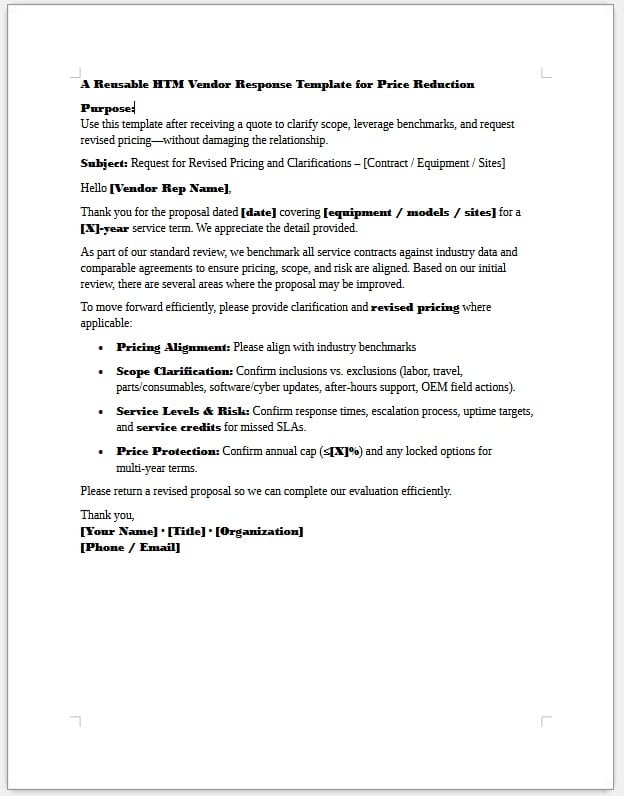
- Draft clearer, more effective vendor responses
Impact: In the first year, across more than 160 renewing service contracts, AI‑assisted evaluation and negotiation contributed to over $750,000 in savings and avoided cost increases – while maintaining appropriate coverage and service quality. Those results didn’t come from letting AI “negotiate.” They came from changing our stance. We no longer accept proposals without analysis, and we approach vendors with firm, clear expectations.
A Personal Example: Buying a Car Without Dreading the Negotiation
I’ll admit it. I had been avoiding buying a new car. Not because of the vehicle, but because I hated the negotiation process. That’s the same reason many of us avoid HTM contract negotiations: we don’t know how to approach the vendor firmly without creating conflict or wasting time.
This time, I did it differently.
Before stepping into a dealership, I used AI to help draft concise, professional language requesting out‑the‑door (OTD) pricing. That single AI‑generated message reframed the entire process. Some dealers responded promptly, transparently and professionally. Others didn’t – and I simply went elsewhere.
AI also helped by querying model‑specific details and providing a realistic range of what constituted a good price. Paired with publicly available industry benchmarks, I could quickly determine whether I was getting a good deal or a bad one.
What surprised me most was that the experience became enjoyable. Not because AI negotiated for me, but because it gave me clarity and confidence. It created a framework to be firm, fair and fast. For the first time, I felt like I was in the driver’s seat.
HTM service contracts aren’t cars – but the dynamic is similar. When we show up with clear expectations, objective benchmarks, and structured questions, vendors who value transparency engage. Those who won’t tell us something useful too.
AI for Contract Language Review
Service contracts often contain dense language that hides risk in exclusions, response‑time definitions, escalation clauses and ambiguous language. Reviewing this across multiple vendors is time‑consuming and inconsistent.
AI can quickly highlight:
- Service Level Agreements (SLAs) and response‑time commitments
- Exclusions that transfer risk back to the hospital
- Escalation triggers and termination conditions
- Areas requiring clarification or renegotiation
This allows biomeds to focus their expertise on what truly matters, rather than document mechanics.
AI for Benchmarking and Gap Analysis
Benchmarking is where AI and external references, such as ECR, work particularly well together. AI can:
- Compare vendor pricing against benchmarks
- Summarize scope of coverage in your language
- Identify cost drivers behind pricing differences
- Highlight areas where pricing is competitive versus misaligned
Sometimes the result is immediate savings. Other times, it’s locked‑in pricing that prevents future escalation. Both deliver value.
In the past, we didn’t formally track list price, discounts or negotiated savings. Now, using structured AI prompts, we put all the cards on the table and track progress. Negotiated savings that were once invisible are now documented and reportable.
AI for Negotiation Prep and Leadership Communication
One of the most valuable uses of AI is preparing clear, concise communication for both vendors and internal stakeholders. AI helps:
- Draft firm, professional ask‑letters (pricing clarification, scope gaps, SLA tighten‑ups)
- Summarize key contract terms, costs, savings, and risks
- Generate management‑ready summaries and Excel‑friendly comparison worksheets
This improves negotiation outcomes and builds leadership confidence in HTM recommendations.
Adding an AI “Virtual Contract Analyst” without adding headcount
Over the past year, we reviewed more than 160 renewing HTM service contracts. Before AI, that kind of volume would have stretched our team.
A traditional review often requires 6 to 10 hours per contract (reading the proposal, comparing scope and pricing, benchmarking, drafting responses, and summarizing for leadership). At 160 contracts, that’s 960 to 1,600 hours – roughly 0.5–0.8 FTE of analyst‑level work.
We didn’t hire a contract analyst.
We virtualized one.
AI handled the heavy lifting:
- First‑pass contract summarization
- Identification of scope and pricing gaps
- Drafting firm, professional vendor responses
- Building comparison tables and leadership summaries
Experienced HTM professionals then used their time where it matters most: judgment, risk tradeoffs and recommendations.
Governance and Guardrails
Use AI within clear boundaries:
- AI does not approve contracts
- Vendor‑sensitive data stays within approved systems
- All outputs are reviewed and verified by HTM professionals
AI supports analysis. It doesn’t replace accountability.
Human‑in‑the‑Loop Remains Essential
Final recommendations always belong to experienced HTM professionals. AI can accelerate preparation, but biomeds own:
- Risk interpretation
- Tradeoff decisions
- Final recommendations to leadership
Judgment and responsibility remain firmly human.
Risks to Avoid
AI introduces its own risks:
- Overconfidence in summaries
- Missing operational context
- Treating AI output as fact instead of draft
Disciplined AI prompting matters. For example here is a simple prompt to AI: “Help draft a professional response to this service contract proposal requesting improved pricing and clarification of exclusions.”
Closing Thought
AI doesn’t make you a negotiator. It makes you a better‑prepared biomed at the table.
By pairing AI with industry benchmarks and adopting a firm, fair, and structured approach, HTM teams can move from passive renewals to confident, data‑driven negotiations – protecting patient care, uptime, and the bottom line.
DOWNLOAD VENDOR RESPONSE TEMPLATE