



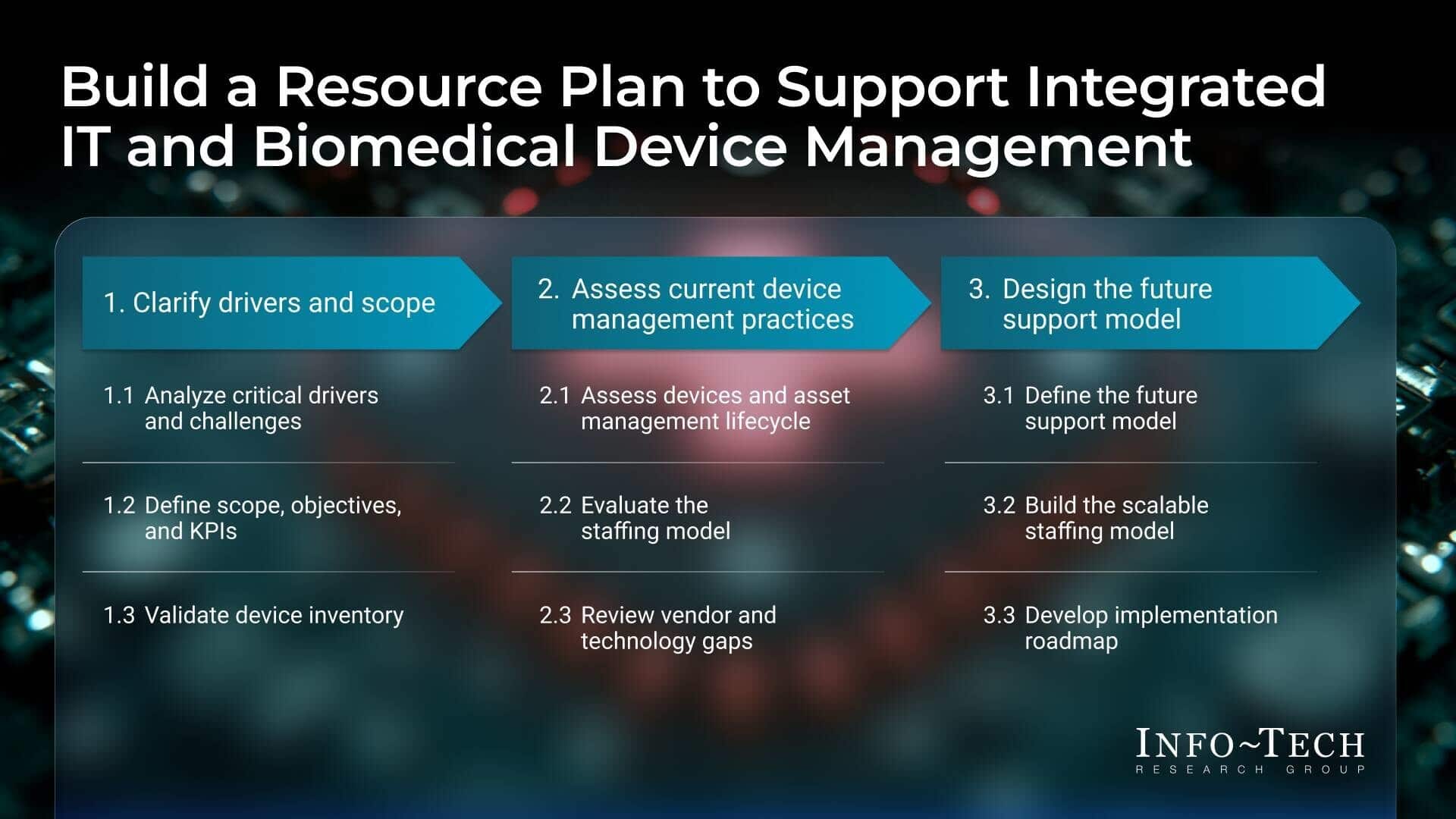
Healthcare organizations are rapidly expanding their fleets of network-connected biomedical, IoT, imaging, and clinical devices, but many continue to manage them through disconnected IT and biomed processes that were not designed for today’s cybersecurity and support demands. To help CIOs and healthcare technology leaders close this gap, Info-Tech Research Group recently published its “Build a Resource Plan to Support Integrated IT and Biomedical Device Management” blueprint, a practical framework for aligning staffing, governance, lifecycle management, and support models across IT and Biomed.
The firm’s research indicates that health IT leaders are required to support significantly more devices, including biomedical, IoT, and imaging systems, while many hospitals still lack standardized resource models, real-time inventory practices, and clear ownership for device security and support. As clinical technologies increasingly become part of the digital estate, gaps in asset tracking, after-hours support, cybersecurity readiness, and life cycle governance can create operational delays, security exposure, and risks to patient care.
“Healthcare CIOs are now responsible for 10 times more connected devices than a decade ago, yet many hospitals still track them on spreadsheets and split responsibility between IT and biomed,” says Kassim Dossa, research director at Info-Tech Research Group. “Healthcare organizations need a structured resource plan that aligns IT, biomed, security, and clinical operations around shared accountability before the next vulnerability exposes the gap.”
Key Challenges
Info-Tech’s “Build a Resource Plan to Support Integrated IT and Biomedical Device Management” blueprint highlights several recurring challenges that can limit safe, scalable oversight of connected medical devices:
- Incomplete device visibility and inventory: Many healthcare organizations still rely on manual spreadsheets, disconnected systems, or point tools to track biomedical and IoT devices, making it difficult to maintain accurate visibility into what is connected, where it is located, and who owns it.
- Unclear accountability across IT and biomed: As more clinical devices connect to enterprise networks, responsibilities for cybersecurity, patching, integration, support, and life cycle management are often split across teams without a shared governance model.
- Staffing and skills gaps: Healthcare leaders face shortages across biomedical equipment technicians, clinical engineering, cybersecurity, and health IT, while also needing more cross-trained teams that understand both clinical workflows and connected-device risk.
- Fragmented life cycle and vendor processes: Disconnected asset management, inconsistent maintenance practices, and limited vendor integration can increase downtime, complicate compliance, and weaken the organization’s ability to respond to vulnerabilities or recalls.
Three-Phase Framework
To help healthcare organizations move from fragmented oversight to an integrated support model, the firm’s blueprint details the following three-phase methodology:
Phase 1: Clarify Drivers and Scope
Healthcare leaders should identify organizational pain points through stakeholder interviews, define objectives and KPIs, and validate biomedical and IT device inventory to establish an accurate baseline. This phase helps teams align on scope, success measures, device categories, and ownership before resource planning begins.
Phase 2: Assess Current Device Management Practices
Organizations should evaluate asset life cycle processes, staffing capabilities, current support workflows, and vendor technology gaps to identify inefficiencies and improvement opportunities. This assessment helps leaders understand where device oversight is breaking down and where staffing, process, or technology changes are needed.
Phase 3: Design the Future Support Model
The blueprint advises healthcare organizations to define a risk-based integrated support model, build scalable staffing and training plans, and develop an implementation roadmap with phased milestones, governance structures, and communication plans. The goal is to create a future-ready model that supports clinical uptime, strengthens cybersecurity, and scales with device growth.
The blueprint is supported by the “Biomed–IT Device Management Resource Planning Tool,” which helps healthcare leaders define device support roles, input baseline device counts, estimate staffing ratios, and project future headcount and cost needs based on anticipated device growth.
By following Info-Tech’s structured approach, healthcare organizations can reduce fragmentation, close staffing and process gaps, improve device visibility, and build the capabilities needed to manage the life cycle, risk, and performance of thousands of critical devices with greater precision and confidence.
