



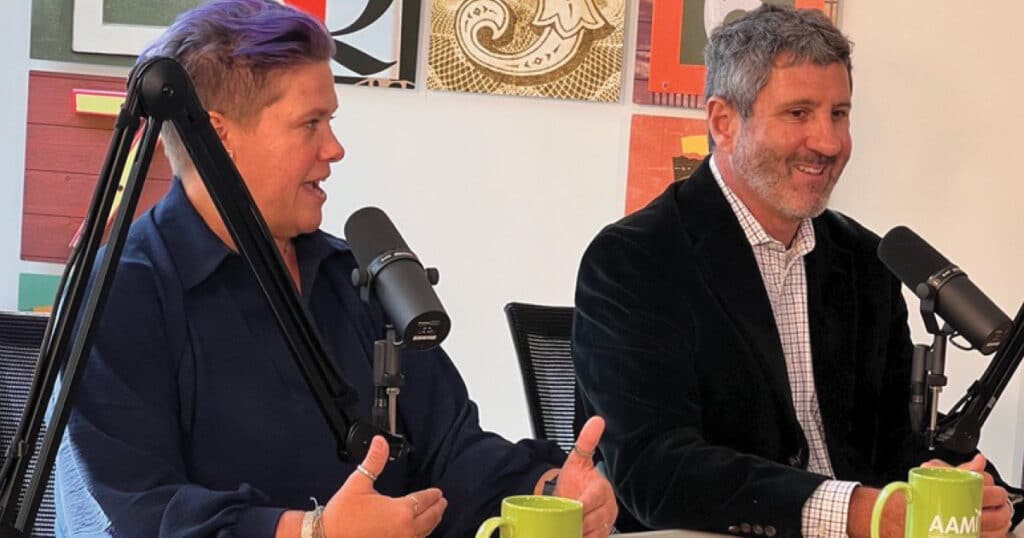
Lena Cordie-Bancroft and Jay Crowley, vice president of Medical Devices for USDM Life Science, discuss
expectations for ISC 2022.
In late 2022, the global medical device standards community came together in-person for a practical review of recent changes to the regulatory landscape and valuable lessons learned in the global medical device marketplace. Popularly called “THE international standards conference,” or ISC, the AAMI/FDA/BSI International Conference on Medical Device Standards and Regulation was hosted at AAMI headquarters in Arlington, Virginia. What follows are some highlights from the international event:
Enabling Innovation Through Regulation?
It was a tale of two devices. One was an AI-enabled medical device with premarket approval (PMA). Another was a consumer hardware product – a smartwatch – with a software application that’s received 510(k) premarket clearance. But at the end of the day, they shared an identical primary function – detecting atrial fibrillation.
“At what point in our industry do these two devices converge? At what point does that blurred line become confusing or challenging for companies to get products to market?” asked Jennifer McCaney, Ph.D., executive director of UCLA Biodesign, in her keynote address for ISC 2022. “One of the things that I examine is how change in technology [is] impacting the industry.”
McCaney’s work focuses on early-stage medical innovation training and development programs for aspiring innovators. She is also an associate professor of medicine and management at UCLA Health.
“How do we accelerate approval of new technology? How do we advance standards and regulatory policies so they can keep up with exponential change?” she asked.
In many ways there has been significant – even breakthrough – progress. McCaney cited a decade-old Stanford study that painted an unfavorable view of the regulatory landscape in the United States 10 years ago, one that increased cost and slowed innovation. But that’s not the story of U.S. standards and regulations today.
We’ve seen “an increase in regulatory policy that enables innovation” thanks to FDA initiatives like the Digital Health Center of Excellence, McCaney said. According to a 2022 report by McCaney and others at UCLA Biodesign, a “sea change” is underway when it comes to the preferred path to bring new products to market – investment from the FDA appears to be paying off when it comes to launching medical devices globally.
Global UDIs are Closer Than You Think
Unique device identifiers (UDIs) are “a first step” towards creating an identification scheme just like what you’d see on products in a grocery store. However, instead of identifying a box of cereal, UDIs help keep track a life-saving device.
Jay Crowley, vice president of Medical Devices for USDM Life Science and Lena Cordie-Bancroft, lead of the Medical Devices for BSI spoke about expectations the medical device industry will need to meet to implement UDIs during the ISC 2022.
They mentioned how, on July 22, 2022, the FDA published its final guidance on UDIs, describing submission requirements for certain Class I devices considered consumer health products.
“When fully implemented, the label of most devices will include a UDI in human- and machine-readable form, which will ultimately improve patient safety, modernize device postmarket surveillance, and facilitate medical device innovation,” the agency reported at the time.
“It was really beneficial, I think, for the entire industry when the Final Rule was published … and as manufacturers started to face the hurdles and address the challenges [of adopting a UDI system] they realized it wasn’t as difficult as it had been perceived,” said Cordie-Bancroft. “So, now the challenge is getting it adopted in the health care facilities. Getting it used and applied in health care records and closing that loop between regulation, the manufacturers and the users.”
And then there’s global adoption as well …
The pair noted that different countries and jurisdictions are creating their own unique UDIs, which could prove problematic.
Fortunately, according to Crowley, the International Medical Device Regulators Forum has provided internationally applicable guidance for the concepts that regulators should take. “And at a high level, regulators are following that. So, we’re seeing concepts that are the same,” he said.
“A UDI assigned to a medical device in the U.S. can be used in other countries,” Cordie-Bancroft added. “The application of that UDI in various databases could be different … but generally, once you assign one, it can be used globally. That’s the ultimate goal. And we’re a lot closer than people think we are.”
The Regulatory ‘Tsunami Wave’ Approaches
Regulatory standards are changing rapidly around the world. The problem is that innovators often are unaware or unprepared for the full extent of these changes, even years after they’re initially announced. A prime example is new European regulation for in vitro diagnostics, the EU’s IVDR.
That’s according to Kimberly Oleson, founder and principal consultant for Lucent Clinical Consulting, who surveyed IVD manufacturers about the new EU regulations during a special preconference symposium to ISC 2022.
“We did live audience polling so we could understand current trends for these key issues, and about one-third of our audience members claimed that their companies were ready for the change and comfortable,” said Oleson, “and yet, zero attendees said that they had read the IVD regulation and actually understood it.”
According to Oleson, IVDs are a hot commodity in booming markets, such as cancer diagnostics, a $50-billion market that’s expected to grow threefold by 2028. “If the market grows that fast, you’ve got to have enough of these diagnostics products available” to meet exponentially growing demand, she said.
And yet, Oleson has already witnessed that EU countries are not all following the new processes in the same way. “Because countries are learning and everyone is experimenting … the cycle time to get your IVD protocol approved could take up to 11 months,” she said. In some cases, “there are not enough notified bodies out there for this expected tsunami wave of certificate requests … get in line right now!”
Worse still are stories of companies backing out of Europe entirely.
“It just hurts me to know that a company thinks it has to back away. That gets in the way of innovation, and that’s not we want,” she said. “We want products available and helping patients as soon as possible … and so, we want to help manufacturers to stay on top of this as much as possible.”
