



5S and Lean are business concepts derived from the Japanese automotive industry that seek to organize the work environment so that problems are clearly visible. These concepts also find unnecessary process steps or waste that can be eliminated. Instituting these concepts in biomedical engineering will help create a smooth and efficient workflow, reduce waste, decrease turnaround time and improve the bottom line of biomedical equipment management companies.
 5S focuses on eliminating clutter in the work environment and promotes the maintenance of an orderly environment where everything that is needed has a place and there is a place for everything that is needed. It promotes the concept that care and thought must be brought to bear to determine what is truly necessary, ensuring that such things are always easily accessible, while everything else is put away, reflecting the fact that they are needed only infrequently. In the case of a biomed, this would ensure that the tools and parts needed for a particular job are always within arm’s reach. Properly labeled and color-coded bins should be used for frequently used parts. Where bins are not practical, well-engineered solutions need to be developed and deployed.
The 5 “S” principles of Sort, Set, Shine, Standardize and Sustain promote the notion that developing a clean and orderly work environment is a team effort. Every individual who works in the environment needs to participate in defining the standards and developing the tools necessary to maintain and sustain the standards established. 5S is a journey that never ends. Organizations need to understand that 5S is not housekeeping. It is the constantly evolving process of upgrading the work environment that is led by employees and supported by management. Its focus is the identification and elimination of inefficiencies in the workplace.
Lean is simply defined as the elimination of waste. The simplest way to think about this is to consider the 8 turns of a screwdriver that turn the screw as waste and only the ninth turn that actually tightens the screw as useful work.
The Lean journey is the examination of existing processes to understand where waste exists and how to eliminate it by streamlining processes that remove unnecessary steps. In an HTM environment waste is also found in the administrative processes surrounding the decision processes to send equipment for service, the massive amounts of paperwork needed to match a unit being returned from service and the filing and tracking paperwork needed to ensure all regulatory requirements are being met.
The process of waste elimination needs commitment from the organization’s leadership. Questions need to be asked about every step of every process to ensure that each step is truly necessary. If the step is not adding value every effort must be made to eliminate it. Implementing Lean also requires the ability to measure the current processes so you understand the impact of making improvements.
Conceptually, 5S and Lean are common sense steps and seemingly easy to accomplish. In reality, they are difficult concepts to master and even more difficult to implement in a large organization. Often, the organization will attempt small steps and secure those wins before making other small wins. A larger, more comprehensive program implemented in small steps can be a good strategy to secure long-term sustainable gains.
HTM organizations, and especially companies focused on service and repair, need to develop more competitive business processes to remain relevant in their customer environment (hospitals, HME companies, EMS, etc.). The least controversial way is to use 5S and Lean principles to find a competitive advantage within the organization and pass on the advantages of faster turn-around, seamless cloud-based interactions and excellent customer service to customers.
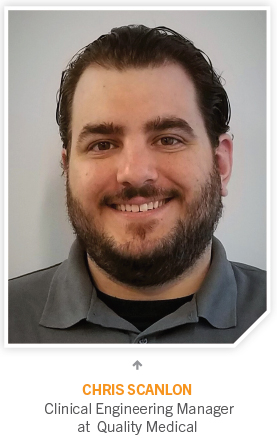
Chris Scanlon is the Clinical Engineering Manager at Quality Medical in Largo, Florida.
