
By Arleen Thukral, M.S. CCE, CHTM
Artificial intelligence (AI) has many applications. With the rise of large language models (LLMs) and OpenAI’s paid subscriber base for ChatGPT climbing to over 20 million in the past quarter, it has become common place to interact with AI. Aside from using prompts to generate meeting minutes from meeting transcripts, how else can HTM leverage AI in the workplace? Let’s dive into some use cases aiming to augment and facilitate HTM professionals that VISN 2 New York/New Jersey healthcare system is developing and testing using Azure OpenAI Retrieval-augmented generation (RAG model).
AI CHATBOX FOR SOPS
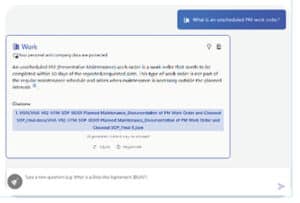
When onboarding new staff, there are many processes and procedures to learn. HTM SOP LLM could offer interactive learning experience for HTM staff. As a new staff member you may be learning the department SOPs and could pull up the HTM SOP LLM to ask, “What is an unscheduled PM work order?” The resulting answer “An unscheduled PM (preventative maintenance) work order is a maintenance task that must be completed in 30 days of work being reported or requested. This type of work order is not part of the regular, planned maintenance schedule but is necessary to address immediate or unexpected maintenance needs for medical or HTM-supported equipment.” It would include citations to the specific page of the document so that you can verify the answer in the full context of the document retrieved. You could ask further clarifying questions such as, “How does an unscheduled PM work order differ from other PM work orders?” to help you understand the topic further.
 AI CHATBOX FOR CMMS TRAINING
CMMS can be highly configured based on interfaces and HDO organizational requirements, making training critical if the design is not intuitive and complex due to variation in requirements between work order types, etc. Imagine as a new employee having access to an HTM CMMS LLM instead of having to ask colleagues or the manager every little thing that you have a question about. Imagine asking the LLM “Which fields will update daily?” and getting a complete list as well as an explanation about how the fields are managed and updated through the daily data feed. In fact, the CMMS LLM could even be used to identify design conflicts when development ideas are being discussed, if the documentation includes architecture notes, business rules and scripts. This could decrease potential unintended consequences of fixing one thing and breaking another in agile software development.
AI CHATBOX FOR SERVICE MANUALS
Medical equipment service manuals are lengthy and nonstandard formats. HTM professionals need to reference these documents for instructions on component replacements as well as preventative maintenance requirements. Imagine asking HTM Manuals LLM to summarize maintenance for a specific model. The LLM could summarize the steps for the monthly maintenance as well as every five-year temperature controller verification and link the detailed procedures. In the future, an advanced integration could leverage CMMS data to compare current service dates against manufacturer requirements to identify PM gaps. It is important to consider licensing requirements pertaining to service manuals and how AI data is stored and shared. It is possible to not have documents sent to LLM and not accessible to any other group in such cases.
AI CHATBOX INTENDED FOR CUSTOMERS
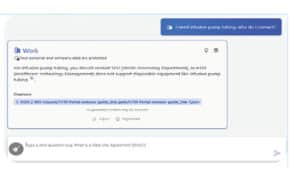
Do your customers have a hard time remembering where to submit a request for IT versus HTM versus Facilities? Do they submit requests to you for non-medical equipment that you are having to reroute? What if you could get ahead of the issue and train your customers to go to an HDO request LLM? The customer could state the issue such as, “I need infusion pump tubing. Who do I contact?” The documents this LLM is trained on would include information about each service, how to contact them, submit requests and what they support. If the documents have the appropriate level of breakdown of scope of service that are commonly confused, this will significantly reduce organizational sludge. Imagine the LLM responding “For infusion pump tubing, you should contact Sterile Processing Department (SPD), as HTM (Biomed) does not support disposable equipment, including infusion pump tubing.”
In addition, HDO request LLM could provide instant self-troubleshooting tips to customers. If customers are able to follow outlined steps, this would resolve simpler requests faster and reduce downtime.
 CONSIDERATIONS FOR TRAINING THE LLMS
The training prompts is as follows for conversations: your persona is an Assistant who helps answer questions about the agency’s data. Please provide a standard answer. This means that your answer should be no more than 2048 tokens long. Answer ONLY with the facts listed in the list of sources below in English with citations. If there isn’t enough information below, say you don’t know and do not give citations. For tabular information return it as an html table. Your goal is to provide answers based on the facts listed below in the provided source documents. Avoid making assumptions, generating speculative or generalized information or adding personal opinions. Do not combine sources; list each source URL separately.
The challenge with each of these use cases is keeping documentation current and accurate. This could not be stressed enough. Service manuals are revised by manufacturers and the LLM response may be inaccurate if the service manual provided is outdated. Before implementing HTM LLMs in production, the HDO should create a SOP outlining the roles and responsibilities and processes including updating the document repository for each specific use case, monitoring performance through quality assurance, tracking reporting inaccuracies and qualitative feedback and establishing stop the line protocols in instances of impact to patient care.
It is important to establish human-in-the-loop oversight practices. For example, HTM Manual LLM suggests tasks for preventative maintenance. An HTM professional reviews the recommendation, cross-checks with service manual citation and makes final determination.
The use cases described above aim to reduce administrative burden via improved efficiency and enhanced decision support. Consider how HTM LLMs can streamline workflows and automate documentation as well.
Lastly, weigh the risks of HTM LLMs such as over-reliance on AI reducing critical thinking, liabilities issues, bias and misinformation.