By Ravin Jani
The speed at which AI has enveloped our collective consciousness today is astounding, further compounded by the hype that it is the panacea for all that ails healthcare community. This has left patient-focused and financially strapped executives in a quandary.
Investments in enhancing and/or maintaining patient care continue to be the priority of the healthcare community. Allocating limited budgets for nascent back-office technology solutions that haven’t quite demonstrated ROI isn’t on their radar. To remain competitive and to attract and retain talents, these executives are challenged with evaluating the way forward.
Fortunately, the proposition isn’t “Nothing or All-in.” There are incremental steps requiring a fraction of total investment that can get the healthcare community started on building up their analytical information domains.
LAYING THE FOUNDATION
Data is the foundation on which information and intelligence is built, which in turn drive our decisions and actions. The healthcare community has access to a wide variety of data including:
• First-party data refers to internal data that is created through daily interactions and transactions, such as patient intake information.
• Second-party data refers to the data that is created in collaboration with trusted partners such as external service providers.
• Third-party data refers to the data that is acquired from external sources and agencies such as compliance and privacy standards.
Every provider in the healthcare community is on various stages of maturity with respect to how and how much they leverage the data they have access to, to complement their decision-making process.
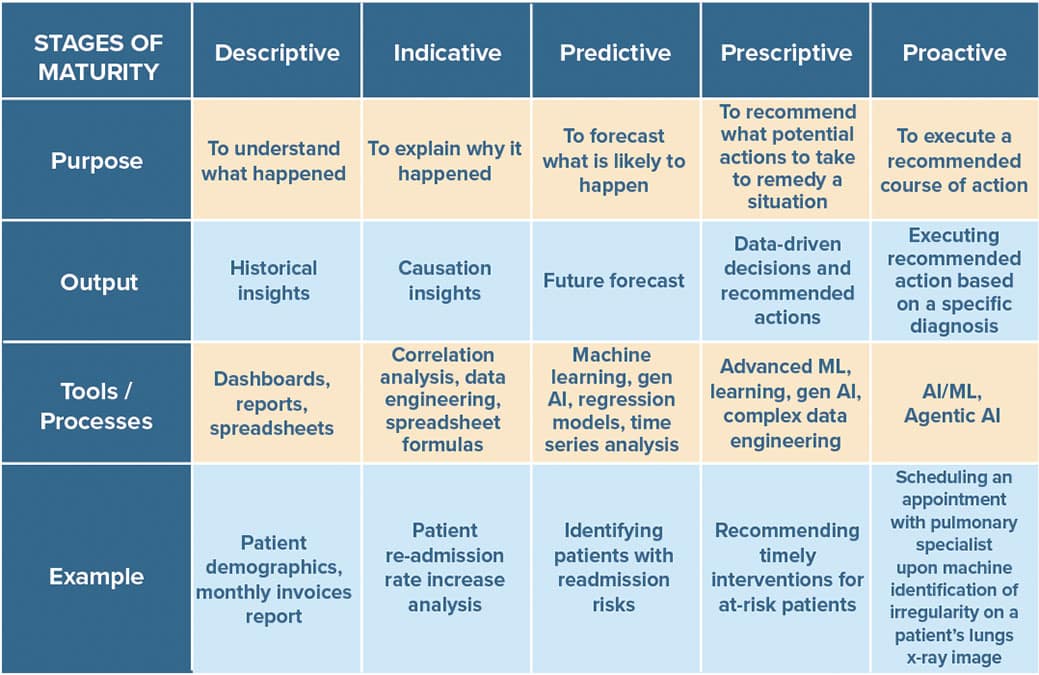
STAGES OF MATURITY
Usage of data to inform our decisions and actions has evolved from simply describing the past (descriptive) to anticipating future outcomes (predictive) to recommending a course of action (prescriptive) to executing the best course of action (proactive).
As we move from less mature to more mature evolution stages, each stage progressively enriches the information to enhance our decision making as well as providing better intelligence to drive our actions.
WHAT’S IMPORTANT?
Regardless of the stage, the reliability of the information output and therefore the intelligence gained is predicated on three critical elements for the underlying data:
• Comprehensive – access to only the first-party data is an information silo. It will provide an incomplete understanding of the situation or the challenge. To gain holistic intelligence, access to second-party and third-party data is also needed.
• Quality – the adage, “garbage-in/garbage-out” holds especially true in this situation. It is compounded by the fact that the healthcare community so far hasn’t had the imperative to refresh technology and data infrastructures.
• Security – given the sensitive and private nature of data healthcare community has access to, it is of paramount importance that any modernization journey undertaken has well-defined guardrails to safeguard all data.
WHAT’S NEXT?
Before making any significant investment to address the perceived or real gaps in your ability to gain intelligence from the data you have access to, I would recommend going back to the fundamentals and performing an assessment of what requirements you are trying to meet, what are the objectives and ROI of the investment you are making. It may turn out that descriptive and indicative stages are sufficient for what you need now and that the comprehensiveness, quality and security of the data is adequate.
An objective assessment of your requirements and infrastructures is a logical first step. This assessment can be performed internally by the appropriate teams within the healthcare system, their bandwidth and resources permitting. Alternatively, you can engage external independent consultants who have access to appropriate methodologies and toolsets to do so. Regardless of who does it, it is important to understand the baseline before embarking on the next step of the journey.