



There is one common element that unites the cathedrals of Europe with the tiniest churches across America. Stained glass windows catch the sunlight, adding a mood and reverence that often tells a wordless story.
The old-age craft, like many similar trades, has largely disappeared from the landscape. It is a time consuming art that must be practiced using age-old techniques and methods. Getting the cuts in the glass just perfect, as shapes emerge from glass, soldering carefully and even forming copper foil around various shapes are all a part of the art.
 “My wife was collecting carousels and there was a stained glass studio in a nearby city that was named Carousel Studios. We made a trip to see what carousels they had and found out that not only did they create stained glass art but they also taught classes,” remembers David Dalton, a BMET II with Tallahassee Memorial Healthcare (TMH).
“We ended up signing up for a class. There are two types of stained glass creation. The leaded method and the copper foil method. We decided to use both in our first pieces. The leaded method is usually used in larger pieces like windows, while the copper foil method is used in lamps, sun catchers and kaleidoscopes.”
The couple’s class and introduction to stained glass was back in the late 1980s or early 1990s.
Dalton learned early on that the hardest tool to perfect is the scoring tool. He says that there is a delicate balance in mastering it.
“Not enough pressure scoring the glass and it won’t break. Too much pressure, and it will shatter when you go to ‘break’ or separate the glass,” he says.
“You use several different pliers to help you break the glass. Runners help the break ‘run’ along the line that you scored. ‘Breakers’ help you snap the glass at the break and ‘nibblers’ help you take away tiny bits of glass with each pinch,” Dalton explains. “After choosing your project and the glass you want to use, you first use the scoring tool, runners, breakers and nibblers to get the rough shape of each pattern piece in your project.”
“Then each piece in your project is smoothed and the shape perfected by a wet grinder. After each piece is ground, you will either wrap these pieces with copper foil or lead came and then solder them together,” he adds. “There will be breakage and mistakes but with each piece you cut and grind and connect with solder, you gain the confidence in using each tool of the stained glass trade.”
Crafting a work of stained glass has to have some inspiration and that inspiration was often formed from real life experiences. Dalton says that there are patterns available for many shapes and then others are free hand.
“Inspiration comes from places I been and experienced in my life,” Dalton says. “You can see my work at the Masonic Lodge in Tallahassee, two very large stained glass windows for two different churches, a business logo and several private residents around town.”
He has also done some work with a builder. Most of Dalton’s clients come by word of mouth or because somebody has seen his work. Dalton says that good work can last for generations versus the mass produced versions often seen in retail stores.
Pounding on an Anvil
It may seem a little odd that someone who is used to working with something as delicate as cutting small pieces of glass would also spend time swinging a hammer and bending metal, but that is Dalton’s other pastime. He also has an interest in the blacksmith trade.
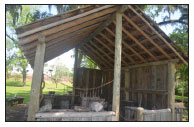 “After seeing several different blacksmiths growing up, I wanted to give it a try. I didn’t know where to start, but I found out that Mission San Luis in Tallahassee, Florida where I live offered beginning blacksmith classes,” he says. “I registered and took the class. The instructor, because this was a 1600 Spanish Mission, taught me how blacksmiths would have practiced their craft back then.”
The first project Dalton made would have been a lamp holder back in the 1600s. Today, the same design can be used as a flower pot holder. He has also worked on spoons and an S-hook.
He just starting trying his hand at blacksmithing earlier this year. Unlike the many years he has spent getting experience with stained glass work, he is still early in the learning curve with this hobby. He hasn’t moved on to the metal fabrication techniques that employ welders, which is the more modern incarnation of the trade.
Nurse Call to HTM
Like other HTM professionals, Dalton spends the bulk of his waking hours working on medical equipment. He has only been a biomed for a few years, but he spent more than eight years installing nurse call systems. His current boss saw his work ethic and invited him to join the team at TMH. He speaks highly of the department where he works.
“We are the true definition of a team at our hospital. Even though all of us have our specialties, we all try to cross train each other so no matter what piece of equipment has a problem; any one of us can fix it,” Dalton says. “I’m a certified installer and programmer on Rauland Responder 5 Nurse Call and I have a certificate from DITEC on steam sterilizers and boilers and also on Belimed sterilizers. I also have a certificate from Atlanta Biomedical Company for their syringe pumps.”
Dalton says there are some similarities between stained glass and blacksmithing. He says care is taken when working with glass because it is a fragile material, overheating a piece of metal can make it just as fragile. It takes skill and experience to know how to work with both, as this biomed knows well.
