



By K. Richard Douglas
President Calvin Coolidge once said, “Knowledge comes, but wisdom lingers. It may not be difficult to store up in the mind a vast quantity of facts within a comparatively short time, but the ability to form judgments requires the severe discipline of hard work and the tempering heat of experience and maturity.” With the eventual retirement of many seasoned HTM professionals, the tips and tricks, know-how and stratagems that came out of years of experience could be lost on their successors. Those things that are garnered through experience are not always taught in the classroom.
One of Coolidge’s wise sage predecessors was Benjamin Franklin who said, “Life’s tragedy is that we get old too soon and wise too late.” That reflects a similar Dutch proverb that recognizes that smarts often come with age and experience. The tricks learned by using a particular tool, following a certain procedure or fully utilizing their CMMS may all come out of experience for a biomed.
In many cases, an approach or idea occurs to one person that is unique or useful and is worthy of sharing. With that in mind, some of those good ideas are shared here thanks to the HTM professionals who use them.
Carpenters have tricks of the trade, auto mechanics have their own hacks and shortcuts, so it is no surprise that HTM professionals pick up a useful idea or two over the years. Sometimes those “tips” just come out of necessity or from learning what works best. Many of them can help more junior colleagues.
“Maybe a tip for a new biomed that I’ve learned in my experience, no matter what you’re getting called out for; take a cart and your tool bag, because inevitably you’ll be heading back for one or the other, it seems,” says Roger Streidl, CBET, biomedical equipment specialist at the Soin Medical Center in Beavercreek, Ohio.
“Always take pictures of the ID numbers of the item you worked on, while you are out there the first time, to save time trying to figure it out after the fact,” Streidl adds.
It’s in the Soft Skills
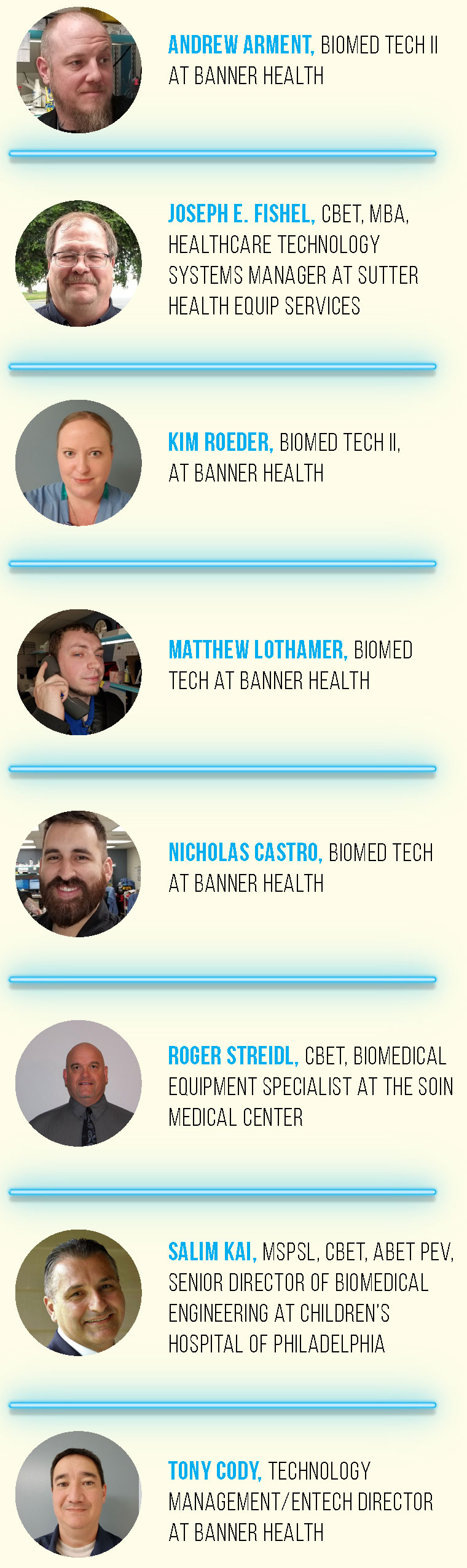 Some non-technical tips can be turned into daily habits as many biomeds observe what works in practice while interacting with colleagues.
“Be nice and courteous to whoever you are dealing with, develop relationships; this has helped me tremendously; also follow through on whatever you are committed to do,” says Derick Davis, BBA, CBET, senior biomedical equipment technician at Baylor University Medical Center in Dallas, Texas.
This kind of “soft skill” is often not taught alongside electrical or anatomy knowledge. It is a crucial element of working in HTM.
In a June 2018 edition of TechNation’s Biomed 101 feature, Connor Walsh, a clinical engineer at Southeast Louisiana Veterans Healthcare System, says that the soft skill of communication is a key to the HTM field. Part of this is showing appreciation.
“Giving appropriate recognition and expressing gratitude is so important when it comes to generating support and, unfortunately, all too often it is lost during day-to-day operations,” he says.
“A personal rule of thumb of mine is that you can never say ‘thank you’ or ‘good job’ too much. Although you may think it is an easy task, the individual assisting you may have jumped through numerous hoops to get it done for you. Coworkers or employees that feel underappreciated are far less likely to want to continue to assist you when something arises,” Walsh says.
“If you find it difficult to remember the last time you sent some appreciation to someone that helped you, take the time to let them know their work and effort is valued,” he adds.
“Make a friend in every department. They can help you find equipment from those little nooks and crannies you would have never found by yourself,” says Tony Cody, technology management/ENTECH director at Banner Health.
Davis says to show customers confidence and humility.
“Always have the ‘I’ll take care of it’ mentality when you are going on the floor to fix a problem. Have the confidence in your abilities to fix whatever it is; if it’s not your specialty, find who the right contact is,” he says.
Good Attitude and Utilizing Resources
That old adage about never assuming anything holds true for HTM. Don’t assume you know more than you do when you are new to a piece of equipment. Be organized and use every available resource.
“Don’t be afraid to try and fix something; if it’s already broken, you can’t do any worse,” Davis says.
“Learn about each piece of equipment you touch, what does it do? How is it used? Ask the person who called in a work order for a piece of equipment to show you how it works if you don’t know. Don’t be afraid to say that you don’t know, but be sure to follow that up with, ‘I’ll find the answer,’” Davis adds.
Davis drives home the point that a biomed should provide the highest level of service when he says to “treat each piece of equipment that you’re working on as if it would be used on your mother.”
To further illustrate the point about doing excellent work, Davis says to “take pride in your work and documentation; act as if it will be reviewed by your director [or] accrediting agency.”
“Be organized. Being a biomed, you are bombarded with a lot of information you need to keep track of; dates, meetings, contacts, etcetera, so use what’s available. I put all of this information on my Outlook calendar. That way, I don’t have to have Post-it notes all over my desk,” Davis adds.
Another tip for newer biomeds, as well as veterans, is to think outside the box and utilize every resource available, including the regulations of medical devices.
“Oftentimes, biomeds are so focused on servicing the equipment, that they are not aware there is a wealth of info available to the public on vendors at the FDA website. Also, there is a misconception that equipment is tested by FDA prior to going to market which is not true. Most are cleared based on ‘substantial equivalence, 510K,’ ” says Salim Kai, MSPSL, CBET, ABET PEV, senior director of biomedical engineering at Children’s Hospital of Philadelphia.
“Three items are worth looking into when you are having issues with a particular vendor or equipment,” he says. “One, whether the company is registered to market its product in the U.S. Two, MAUDE database on device experience. This is where hospitals and manufacturers report on issues experienced with devices. A wide spectrum of reports ranging from near misses to serious injury and death. Three, recalls; safety notices issued by manufacturers, or warning letters issued by FDA to manufacturer,” Kai adds.
“Vendor tech support can be a valuable tool when repairing equipment; they are well versed on the equipment you are working on and can provide helpful information,” Davis says.
He also says that HTM professionals should make sure they are getting the proper amount of rest and to show up to work on time with the right attitude.
Phone in Hand
Smartphones have proven to be a lot more than a means to place and receive calls. They can also replace your brain’s ability to memorize many details and are a source for information and keeping your ducks in a row.
James Swandol, BSM, CBET, manager, Healthcare Technology Management at Baylor Scott and White Health in McKinney, Texas says that conveniently available notes helped when he was a technician.
“Working in a hospital system, my on-call included covering multiple campuses; it was sometimes hard to remember where everything is on the different campuses, and even harder to remember passwords for systems you don’t work with every day. I created my on-call notes and stored them in my Notes app on my iPhone. My notes included vendor phone numbers for troubleshooting, biomed passwords for equipment and step-by-step instructions on how to do anything from programming a tele box to how to get a purchase order after hours,” Swandol says.
Besides the use of an app, the camera on a smartphone has proven to be very useful in its small form factor.
“Also, this is probably pretty common these days, but using your cellphone to take as many pictures of devices as you disassemble them to remember where connections go is a great tool. And also store photos to shared drives for future reference for PM procedures or repair procedures,” Streidl says.
“Your smartphone camera can save you hours of refiguring out which hose goes on where,” Cody says.
“It is a common tip today to take pictures of everything to have a reference for later. What most people forget to do is take a quick second and verify the picture came out clear and has everything in the frame that you want,” says Andrew Arment, biomed tech II with Banner Health.
Getting the Most from Data
There are more than a few tips and pieces of advice that relate to the use of your CMMS.
“The heart of any HTM program is the data that resides on the CMMS system. This needs to be kept up to date and accurate. Keeping your database clean will give you accurate reports,” says Joseph E. Fishel CBET, MBA, healthcare technology systems manager at Sutter Health eQuip Services.
“When running a report, know why you are running it. Often, we look at our achievements without looking at what were the drivers for your variances to make corrections,” he says.
Clean and comprehensive data input means useful results.
“Make sure your data is correct. How can you make recommendations for equipment replacements if you have no idea when it was purchased, how much it cost, and how much service time and money you have invested?” Cody asks. Cody also says to make sure you thoroughly document in your CMMS. He says that it can help your perceived productivity, future service and build credibility of your expertise.
“Your CMMS is powerful,” Cody says. “Get reports sent to you and have dashboards built. It helps make sure you don’t let anything slip through the cracks. Learn spreadsheets. Most CMMS exports data to spreadsheets. You can build powerful tools,” he adds.
Streidl agrees about that best-practices with CMMS are a sure-fire way to make efficient use of a great tool.
“Log your work into your CMMS as soon as you can so you’re not trying to remember things well after the fact. Get to know the shortcuts inside your CMMS that will save you time like cloning work orders for work that is identical, or quick closing PM work orders,” he says.
To make life easier, Swandol suggests keeping ahead of the curve.
“Stay ahead of schedule; midway through the month we run a report for the upcoming month’s preventive maintenance schedule. We go ahead and order parts and start prep for the upcoming month at that time; that way on the first day of the month, we are ready to get to work; we are not sitting around waiting on parts to come in,” he says.
Tips to Get the Job Done and Excel
From dealing with the boss to unseating a screw to testing X-ray equipment, there is a tip or trick to get it done.
“If you are in imagining or a biomed, who takes care of X-ray, get a piece of image intensifier screen and put it in your tool bag. If you feel an X-ray machine isn’t producing X-ray, put the film in the X-ray field and turn off the lights in the room. When you radiate the film, it will glow. This is a quick way of seeing that you are making radiation,” Fishel suggests.
Save some time in duplicating your previous work.
“For documentation, one trick I used to do was to keep templates saved on my computer to help cut time when typing up work order notes,” Swandol says.
“Since we always document what test equipment we used, I had templates for different equipment. These templates would include information on all the test equipment I would use to complete preventive maintenance on a particular piece of equipment,” he says.
He says that the only thing he would have to do when test equipment was calibrated was update his templates with the last calibration date and he was good for another year worth of documenting.
Cody says to never horde knowledge. Share and learn from fellow BMETS.
“Never waste time. If you literally have nothing to do then find something useful to do. If nothing else, pick up a service manual and invest in yourself,” he suggests.
Cody says that whenever possible, use the end of the day to prep for tomorrow.
“Help your shop develop PM templates. It saves you a ton of time. Learn alternate sources. Knowing many options on where to find a part or repair service besides the OEM can save time and money,” Cody says.
“Learn BMET regulatory requirements; it helps you understand why the ‘boss’ wants you to do things a certain way and it helps you make a transition to leadership. Communicate; do it before, during and after the event and if you go to your boss with a problem, always have a proposed solution,” Cody adds.
Other members of the team at Banner Health had a number of suggestions to help their HTM colleagues; both rookie and tenured.
“If you are trying to attach a hose to a connector – like a BP hose – use a heat gun to soften the plastic of the hose, for a better seal,” says Kim Roeder, biomed tech II, with Banner Health.
“If you have a stripped screw, use a Dremel to cut a line in the head of the screw. Then use a flat head screwdriver to remove the stripped screw. If that doesn’t work, use a ‘Grabbit’ bit,” Roeder adds.
And then, there are these tips.
“It has become a personal habit of mine to always have a note pad in my pocket and at least two pens with me no matter where I go. It is fast and easy to take a quick note rather than try to remember too many things at once,” Arment says.
A great habit to get into comes from Nicholas Castro, biomed tech at Banner Health.
“When possible, lay out screws/bolts/nuts in a similar layout to how they are removed from a device; it can save time when reassembling,” Castro says.
He also suggests that you keep a backup shirt and that you should always be polite to your local salesperson.
“Ask as many questions as you need to. When dealing with medical equipment, it is better to sound uninformed than to guess wrong on something,” suggests Matthew Lothamer, biomed tech with Banner Health.
“Make sure your documentation includes any information another tech might need if they were to pick up where you left off on a CM,” Lothamer says. “Do not delete important emails.”
“Always keep stuff you scan into the work order. Learn hospital policy, at the very least, know where to go to find it,” says Greg Pyle, biomed tech II, at Banner Health.
Some of these ideas may already be part of your portfolio of tips and tricks and some may qualify as new additions. Just as with forums, listservs, associations and conferences, one of the reasons to make contact with other HTM professionals is to share knowledge.
Every new idea can make for a more efficient, organized and productive day.
