By K. Richard Douglas
Those who require tools to do their job understand the accuracy of the old saying about the right tool for the job. There is almost always a tool designed and intended for a specific use. There is almost always a time when someone who depends on tools doesn’t have a tool handy that they need in that moment.
If we need to drive a nail into a board, do we use the handle of a screwdriver? Maybe the head of a pipe wrench would work better. The wrench might do the job, yet the head of a hammer works best.
Anybody who has worked extensively with hand tools or measuring instruments knows that there are times when a person runs into a space that is too tight to fit a particular tool or they need a coping saw when they only own a handsaw, or they need a multimeter when all they own is a voltmeter.
As these challenges increase, so does the extent of a person’s tool collection. Many people today have found that there are multi-use tools that fit their needs even better. The bottom line is that there are many projects or repairs that cannot be accomplished without the proper tool.
It’s interesting that the original meaning of the phrase; “the right tool for the job,” was meant to explain how to deal with problems, and tools were just an analogy. Today, just as many people in programming use the phrase with a much different meaning.
For those who work with tools of every stripe, from electronic devices to power tools to hand tools; there is only one meaning.
Most hand tools have reflected the same design and use for decades. A crescent wrench, a screwdriver, a box wrench or a claw hammer have all retained the same fundamental design. Some innovations, like ratcheting wrenches have become popular and screwdrivers and hex sets with driving recesses for Torx and square head have increased in use.
There are now some tools that have associated apps that can monitor usage and maintenance requirements. Even the once-mechanical torque wrench has been digitized and can provide feedback on torque levels, avoiding over-tightening through an audible tone and readout on an LCD display.
Among powered hand tools, one major innovation in recent years has been the ability to cut the cord. Rechargeable battery-powered hand tools have caught on like wildfire, meaning that a construction worker at a job site doesn’t have to worry about a cord when they are cutting lumber with a skill saw. An auto mechanic doesn’t have to be tethered down with a cord when they are using a power ratchet or screwdriver.
Another innovation in many tools is to design the tool using ergonomic considerations to reduce injuries caused by repetitive use. Some tools also incorporate composite materials to reduce weight.
Of course, one of the most useful tools that has come along in recent years is the smartphone camera. This may be the only tool that was never designed to supplement the tools in a tool box.
Wish-List Tools
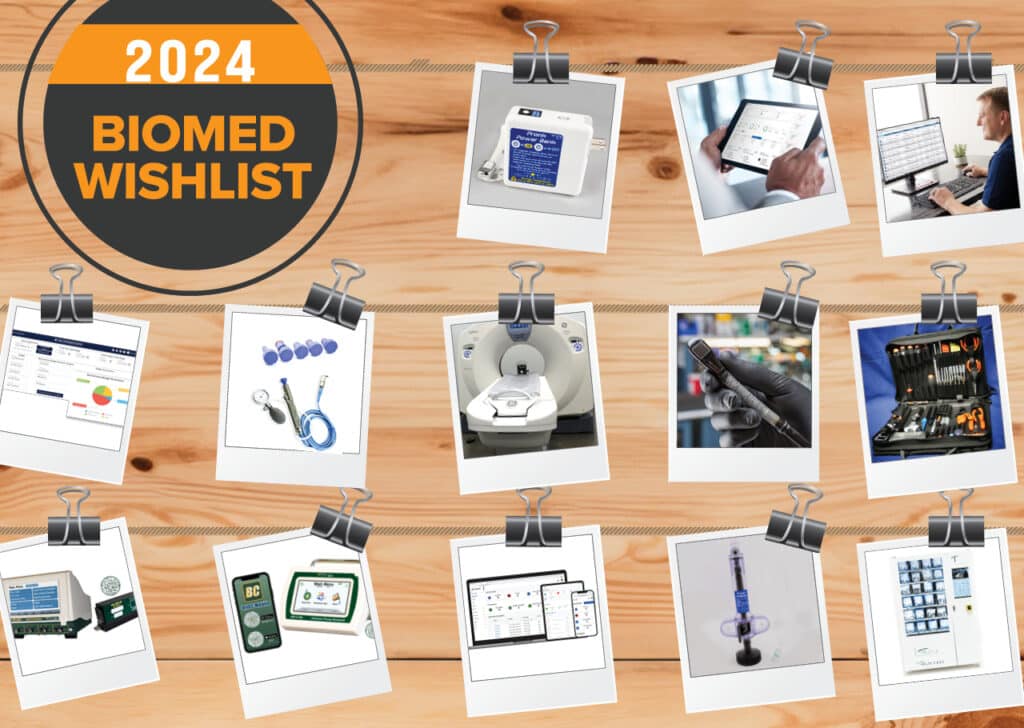
Biomeds require a spectrum of tools to do their jobs. Biomeds interviewed for this story stated that they like the convenience of multi-tools, portability and convenience.
Even the most experienced biomeds still have tools they would like to add to their collections. Those wish-list tools are varied and utilitarian.
“I think the top of my list would be for a clinical engineering cart; it would be nice to be able to take all of the tools that you possibly could need with any or all of the test equipment that you would like. I think this would save many trips, going back to the shop and then to the equipment if it was not able to be moved easily,” says Earl Morris Jr., BMET, at Harrison County Hospital in Corydon, Indiana.
He says that the second thing he would like to have would be an electrical safety analyzer as there’s always the need to check equipment for line leakage, high voltage, ground continuity test and insulation test.
“This would be great for ensuring the safety of patient and staff,” Morris says.
Francesca Fam, CBET, a biomedical equipment technician at Stanford Health Care-Tri-Valley in Pleasanton, California, says that she has three items on her wish list. Her choices also reflect portability and versatility.
“[The] ICON Locking Flex Head Ratchet and Bit Set; 35-Piece. It fits right in your back pocket. This set is very useful because it is small, lightweight, and extremely portable. It also has all the necessary bits for handling most service calls I receive without the need to lug around a giant tool bag,” Fam says.
She says that another pick would be the Knipex plier wrench because it comes in an assortment of sizes.
“I’ve been looking into multi-tools lately and consolidating. Not only is it handy at work, it’s useful for home projects as well,” Fam says.
Rounding out Fam’s choices is the Leatherman Multi-Tool MFR Model #832959, again reflecting the interest in multi-tools.
“This is a gas wrench that doubles as scissors,” she says.
A scope meter with X-ray Mas measurement tools is first on the list for Engineer Naveed Ahmed Khan, P.E., MBA.LSSBB. M.ACCE, assistant maintenance manager at Saudi German Hospital-Riyadh in Saudi Arabia.
Khan’s other two wish-list items are a “digital laser meter to test medical lasers and a dose meter for testing X-ray KV to determine X-ray function,” he says.
“Mini electric screwdrivers with multiple bit sizes for working inside the equipment on the boards,” says Donald Sims, BMET II in the healthcare technology management department at Baylor Scott & White in Texas.
Sim’s colleague, Damion Granado, BMET I, expands upon the universe of tools, and says: “A reliable RTLS system to help locate equipment for annual maintenance.”
Another Baylor colleague, Reginald Colemen, says “test equipment that integrates with our CMMS so we don’t have to manually enter results.”
Swandol says he would like a “Hidock H1E GPT-4o Powered Audio Dock with lifetime free AI transcript for creating minutes from board meetings and leadership meetings.”
The Tools that Work
For biomeds who have been turning a wrench for years, the tools that are favorites would also make good additions to the collections of recent biomed graduates or someone just starting their HTM career.
For that reason, some veteran biomeds share their favorites for the benefit of those just coming on board in the field. No need to engage in guesswork when the voices of experience can offer some sage advice.
“Icon Locking Flex Head Ratchet and Bit Set, Leatherman Charge Plus, Leatherman Raptor Response, Snap On Micro Magnetic Mat, Philips – Xperion 6000 Penlight,” were just a few of the suggestions from Derek Guingon, BMET, at Stanford Medicine in Pleasanton, California.
Guingon also suggested Knipex-Mini pliers and pliers wrench set, Triplett-Receptacle Tester, the Milwaukee 1/4 in drive SAE and Metric socket sets, the Milwaukee Drive Guide Set and the Piscifun tackle bag.
“These tools are my top choices. Having worked in various departments at two Stanford Hospitals, including operating rooms, the main hospital, and clinics, I have noticed that some of my colleagues carry tool bags weighing around 50 pounds. Despite also having a 50-pound tool bag, I found it necessary to assemble the best, versatile, on-the-go, first-call tool kit. My Icon set is meticulously chosen and is my ultimate go-to tool because it includes various common bit sizes, seven security bits, a reversible ratchet with a locking flex head, and a thumb wheel,” Guingon says.
He says that the Snap-on magnetic mat attaches securely to his Icon tool set, keeping all the screws easily accessible.
“The Milwaukee drive guides can function as extensions for various bits or as a cheater bar extension on my Icon set. Carrying different types of Leatherman multitools allows me to have a diverse range of tools at hand. The Philips penlight is equipped with LED and COB lights and features two different magnetic mounts, while my Knipex pliers wrench stands out as the smallest, slimmest, and most robust wrench I’ve ever owned,” Guingon says.
He says that this collection of tools is designed for mobility.
“Additionally, my Triplett tool is essential for ensuring that the outlet being tested has power for the device,” Guingon adds.
He points out that while tools have traditionally needed to be heavy for strength, he has noted recently that companies are using different materials to make tools more durable and lighter.
Morton Campbell, an imaging specialist in the clinical engineering department at Erlanger Health appreciates the portability tool sets offer.
“Best tool is the Wiha 32-piece drive-loc VI-wallet set, comes with almost everything you will need; cut down my toolbox in half and nice to just throw in a backpack for easy first looks,” Campbell says.
Uriel Vargas Jr., BSEE, A+ certified, healthcare technology regional manager at Baylor Scott & White Health in Texas has a list he describes as a “must-have for every HTM biomed tech; regardless the level.”
He suggests the WERA Multi-Bit Screwdriver: 33 Tips, 5 in overall Lg, quick change, ergonomic grip, single end.
“This can walk with you everywhere and it is and has been the most useful set,” Vargas says.
He says that for both big and small jobs, his go-to power drill is the Milwaukee ¼ inch drive, 0 in-lb to 325 in-lb, 1,700 RPM free speed, brushless motor, 12V screwdriver kit.
Vargas also suggests the FLUKE Digital Multimeter: CAT III 1000V/CAT IV 600V, TRMS, 1,000 V Max AC Volt Measurement.
“Your trusty Fluke DMM always comes in handy,” he says.
Again, a suggestion coming from the voice of experience, Vargas suggests the POWER FIRST cable tie kit: 650 Pieces, nylon 6/6, plastic pawl locking.
“You always need zip ties, and if they tell you otherwise, they are lying,” Vargas says.
Vargas still has a few suggestions beyond the need for zip ties. He also suggests the ESD Precision Nippers: 4 7/8 in overall as a good flush cutter.
Carrying a handy light around your head can be very useful. Vargas likes the Milwaukee headlamp with 4500 Im max brightness and a 25-hour max run time.
“Sometimes you need both your hands, and more light, so this is my go-to,” Vargas says.
To remove stickers, he likes the Scotty Peeler label and sticker remover SP-2.
Eye protection is always important when working with any type of tool, especially power tools. Vargas likes the Milwaukee anti-fog, anti-scratch, wraparound frame safety glasses.
Staying with the Milwaukee brand, he also likes to use the 48-22-8315 15” PACKOUT Tote. “My bag to carry everything,” Vargas says.
When it comes to more specialized tools for the biomed, Vargas likes the Pronk Technologies BMET Pack Pro.
“And to finish, the complete set the BMET Pack Pro can do all that you need for testing verification,” he says.
“Top used are probably electrical safety analyzer and vital signs simulators for everyday stuff. For repairs, the most helpful is a DMM for troubleshooting. For ultrasound, top for PM and troubleshooting artifacts would be a phantom,” says Bradley Erbe, BMET II at Baylor Scott & White in Texas.
Erbe’s colleague Sims says that useful tools are mini electric screwdrivers with multiple bit sizes for working inside the equipment on the boards.
Sims agrees with Vargas that Scotty peelers are the best tool for removing stickers.
“Cannot go anywhere without it to remove those stubborn stickers,” he says.
Sims likes Milwaukee drills and drivers and says that you can never have too many batteries and battery chargers for the Milwaukee tools.
Granado says that a useful tool is a Fluke multi-channel IV pump analyzer.
“With 2,500 IV pumps due every year, the multi-channel analyzer is a must have; two to four of them preferably,” he says.
The evolution in tools has made many lighter weight, more portable and often capable of multiple uses. As technology advances, the efficiency, accuracy and versatility of many electronic devices will increase. Sets of hand tools will continue to shrink and allow for carrying a greater variety of tools.