

By K. Richard Douglas
Cincinnati Children’s Hospital Medical Center states that it will pursue an “even greater future by elevating and accelerating our focus on Care, Cure, Community and Culture.” That is saying a lot for an institution that has been treating patients since 1883.
Through research and innovation, the medical center is one of the world’s premier children’s hospitals.
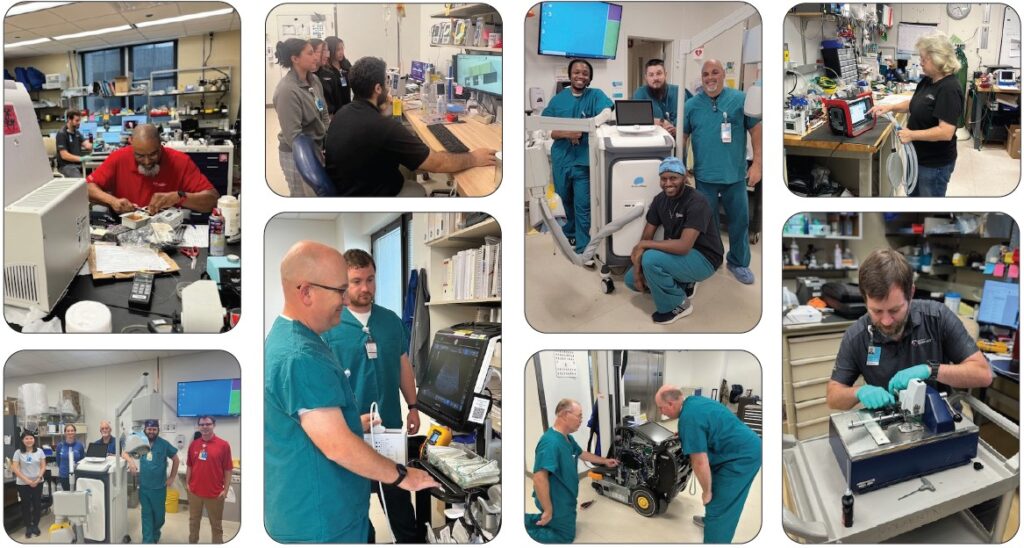
The large clinical engineering department, which supports the 762-bed medical center and more than 46 other locations, is made up of two directors, a coordinator and 30 biomeds.
Supporting more than 48,000 active clinical devices and nearly 25,000 active lab/research devices, the team also includes two outpatient techs, four members of its imaging team, two clinical engineers, two CMMS data analysts, five members of the clinical and research lab team, five supervisors and four to five co-op students.
The department’s directors are Salim Kai, MS, CBET, and Jackie Boyer, MBA.
“Data is collected and analyzed in our CMMS. We have custom built dashboards for the leadership team as well as the technicians to provide daily, monthly and quarterly visibility to tasks. Data is shared and reviewed with the various key partners and EOC. CMMS houses integrations to our RTLS, parts ordering, cybersecurity applications. We have adopted the AAMI White Paper FCC in our CMMS,” Boyer says.
The department’s mission statement is: “The Clinical Engineering department is dedicated to supporting the clinical, research, and educational instrumentation needs of the Cincinnati Children’s Hospital Medical Center by providing effective equipment planning, education, maintenance, and monitoring to ensure quality with cost effectiveness, reliability, safety, and promptness.”
Big Projects through Careful Planning
The CE team has tackled several large projects in addition to their more routine duties.
One of those projects was the opening of the 600,000-square-foot Critical Care Building, which opened in 2021. The team partnered with Clinical, Design Construction and Leadership to plan and support implementation of new technologies and equipment in addition to the patient move.
“Active participants in simulation and move day planning. Had dry runs of the patient move to time how long it would take for each piece to take place. These meetings took place starting a year prior to the move. Had a dedicated route for each team to ensure constant flow. Helped define what equipment is easy to move and what needs to be in place prior. We had multiple move teams assigned to the departments to coordinate with the clinical teams to know rooms needed to be ready in order of the patient move. We had an all hands-on-deck approach with all members onsite to contribute,” Boyer says.
The department also just kicked off a CMMS RFP, partnering with the Plant Engineering team.
“[We had a] meeting to align goals, priorities, budget, and timeline for the project. Created documentation as a team together and have ongoing open conversations to discuss the project and goals. Evaluation of vendors was done separate and then met to discuss which ones work best for both teams. Ensured all parties that we are a team and no one group has more weight than the other,” Boyer says.
She says that the team met initially and brainstormed over the current state of our CMMS.
“We needed to understand the strengths and weaknesses of our use cases and daily processes. There were things we liked and planned to keep in our future CMMS (for example: customized data reports already created for leadership, technicians, engineers, clients, etcetera; work order history, and the existing integrations with other systems such as ServiceNow) and things we did not care for that we would address and change,” Boyer says.
As an example, she says that there are some pain points around slowness of the system, service interruptions with downtime to upgrade, and the inability to incorporate best practice to keep up with the changes taking place in the biomed field.
“We have assembled a CMMS evaluation super user team that represents clinical engineering administrative, leadership, clinical engineers, HTM technicians, research, diagnostic imaging, data analytics. The goal is to perform a high level, as well as a granule assessment, of our requirements and what we need to successfully manage the HTM program at Cincinnati Children’s Hospital Medical Center,” Boyer says.
In addition to large projects, the CE team is on standby to help problem solve when called upon.
One instance of that was an RTLS initiative to improve capabilities of asset tracking and PAR level management.
“[We] have the multi- mode RFID/RTLS tags on over 5,000 devices. [We are] looking to expand the platform for a more robust RTLS system. Partnering with Operations and EVS,” Boyer says.
Another challenge the team tackled was that cleaning procedures were causing premature failure/breaking and they partnered with teams to evaluate options to address these concerns.
The group evaluated what cleaning materials they could standardize on, considering the manufacturer recommendations, but not compromising the cleaning of the device.
Outside of the work environment, the team remains active in the HTM community. They are involved with AAMI, ACCE and the Ohio HTMA and were recognized as Ohio HTMA Shop of the Quarter in May 2024.
The patients who visit the Cincinnati Children’s Hospital Medical Center can be assured that care, cure, community and culture are all reinforced through the efforts of the professional clinical engineering department supporting the efforts of world-class clinicians.