



By K. Richard Douglas
There are a handful of health care systems that have garnered national and international recognition, often because of their research, discoveries and innovation.
Some are household names that are frequently referenced in news segments as thought leaders and experts in the treatment of certain diseases.
One of those health systems, on a short list for name recognition, is the Cleveland Clinic. Already at the forefront of innovative medicine at its inception in 1921, the integrated international health system remains highly ranked today. U.S. News and World Report recognizes the Cleveland Clinic as the nation’s number one hospital for heart care.
Joining the Cleveland Clinic family in January of 2019, Cleveland Clinic Martin Health in Stuart, Florida, became a part of the legacy.
“We are the clinical engineering department part of the Cleveland Clinic enterprise. We service three of the five hospitals in the Florida region. The hospitals are Cleveland Clinic Tradition, Cleveland Clinic Martin North and Cleveland Clinic Martin South,” says Eric Baltazar, CBET, supervisor of Cleveland Clinic Clinical Engineering Martin.
The three hospitals have a total of 521 beds. The team also manages equipment at three surgery centers, two medical office buildings, one stand-alone emergency department, six physical rehabilitation centers and five ambulatory primary care sites.
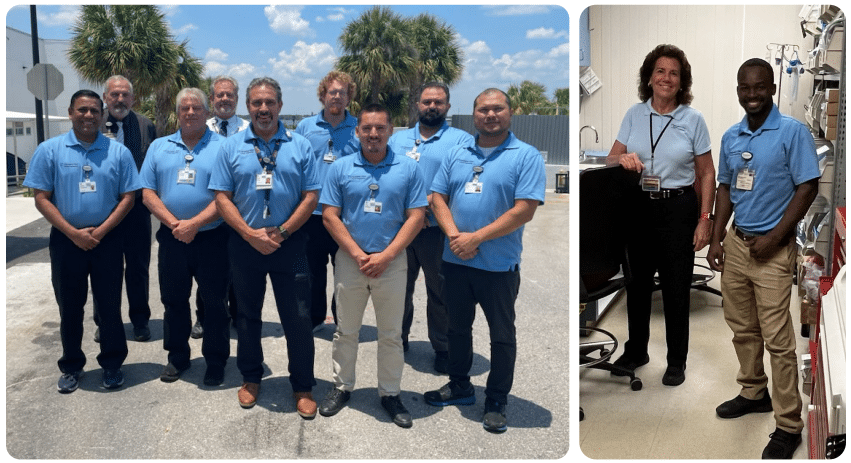
Staff includes eight BMETs, three equipment flow specialists, three CE imaging technicians and one data analyst. In addition to Baltazar, leadership includes CE Manager Richard Oakes and Regional Director Robert Morin.
“Service contracts are handled at the enterprise level and with our legal team. Our feedback is taken into consideration from a clinical engineering perspective. As all HTM professionals know, there are many variables to consider when taking on service contracts. Our goal is to ultimately do what is best for patient care and the organization,” Baltazar says.
He says that the department uses Nuvolo as the enterprise system for data collection and equipment tracking.
“Our technicians are responsible for documenting the work performed on devices and logging their time. We rely on our technicians to retrieve pertinent information from devices as they apply to new device entries. To ensure standard of enterprise nomenclature, that information is given to our data analyst, and she is responsible for entering device data into our CMMS,” Baltazar says.
The CE team has learned that having special insights into the workings of IT and its members’ responsibilities is instrumental to working together.
“As we continue to see more and more devices added to our network, we have sought innovative ways to bridge the gap between our IT team. We found that learning the different layers of the IT team were important to accomplishing tasks properly as well as being addressed by correct IT personnel. This led us to optimize our response time and overall efficiency when responding to requests requiring involvement from both teams,” Baltazar says.
Aligning with a Larger Enterprise
When a CE department becomes a part of a much larger system, there are inevitable changes that must occur to merge practices and protocols with the larger network. This kept the Martin team extra-busy as they made some necessary changes with the larger CE enterprise.
“We are involved in all aspects of cyclic replacements and capital purchases. As part of enterprise alignment, we were faced with having to merge our CMMS records to a new platform that would include tagging all our medical equipment with new asset and inspection tags,” Baltazar explains.
He says that the team received support from the extended clinical engineering team across the enterprise to accomplish this task on nearly 14,000 pieces of medical equipment.
“Although most of the task was covered over the course of a few weeks, corrections on our records would arise and were viewed as opportunities to evolve our practices to mirror those of the entire Cleveland Clinic Clinical Engineering team,” Baltazar adds.
Another step in the integration process involved the EHR. This called for some problem-solving skills and some additional time commitments to ascertain that everything would work correctly within the larger enterprise.
“Problem solving stories are a part of everyday life for HTM departments. Most recently, we integrated our EHR to align with the enterprise. During that process our involvement in making needed configuration changes to EKG machines and radiological equipment served of great value to our hospital and integration teams,” Baltazar says.
He says that in the early stage of the process, the team’s technicians would be faced with longer than usual work days, coordinating on-site vendor support and working around clinical work flows.
“We also keep records of all MAC addresses in our equipment database for assisting IT/Cybersecurity,” Baltazar adds.
The team’s involvement in the HTM community does not end with the end of the wok day.
“Manager Richard Oakes is a Florida Biomed Society member. We have technicians certified through AAMI,” Baltazar says.
For this south Florida team of CE professionals, joining a storied health care system required some adjustments and changes, but the end result benefits the local community. Cleveland Clinic Martin Health Clinical Engineering team members have proven that they are up to the task.
