



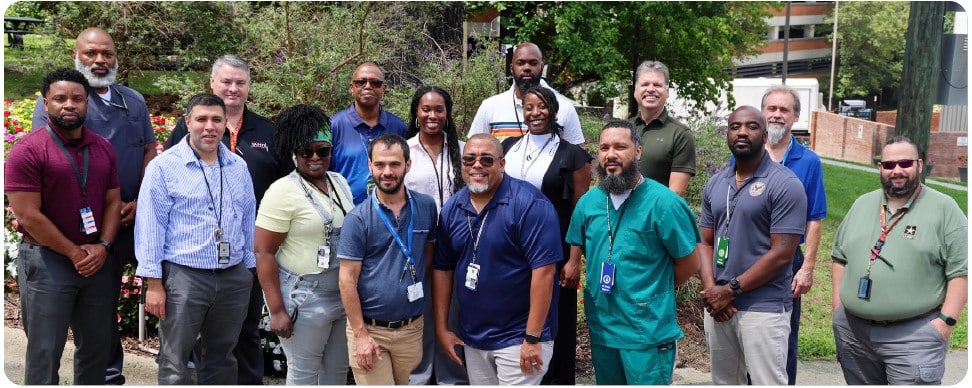
By K. Richard Douglas
The nomination for this month’s Department of the Month stated that the department is “a paragon of operational excellence.”
The nomination went on to say that the department had improved several “key performance indicators (KPI) that the shop and facility were monitoring.”
“The KPI metrics included improving customer satisfaction, preventative maintenance completion rates and reducing the turnaround time for corrective maintenance. The shop was able achieve a 100 percent overall composite score, making them one of the top VHA HTM departments in the nation. Meeting these KPIs ensures the safety, reliability, security and availability of medical equipment and medical systems across the Veterans Health Administration,” the nomination stated.
The department that garnered this impressive praise is the Durham VA Healthcare Technology Management Department.
“The Healthcare Technology Management Department at the Durham Veterans Healthcare Administration supports a comprehensive medical center supporting 151 operating beds and a 100-bed, five-star rated community living center, managing a wide range of specialized medical modalities including dialysis, laboratory services, pharmacy, surgery, patient monitoring, radiology [and] dental care,” says Bob Gunshefski, imaging equipment support specialist.
He says that the HTM team is made up of a total of 21 positions, structured with an HTM chief, biomedical engineering supervisor, two biomedical engineers, two imaging biomedical equipment support specialists, two biomedical information systems biomedical equipment support specialists, 12 biomedical equipment support specialists and a facility service assistant.
“Some key roles like the HTM chief, biomedical engineering supervisor and a biomedical engineer are currently vacant. In addition to their primary responsibilities, the team supports 11 off-site clinics across multiple counties, ensuring that their expertise reaches a wide geographic area. Many staff members are former military personnel, or have family members who are veterans, adding a unique depth of experience and dedication to the department. This background helps the team uphold their responsibility as efficient stewards of government resources, taking pride in their role of taking care of veterans,” Gunshefski says.
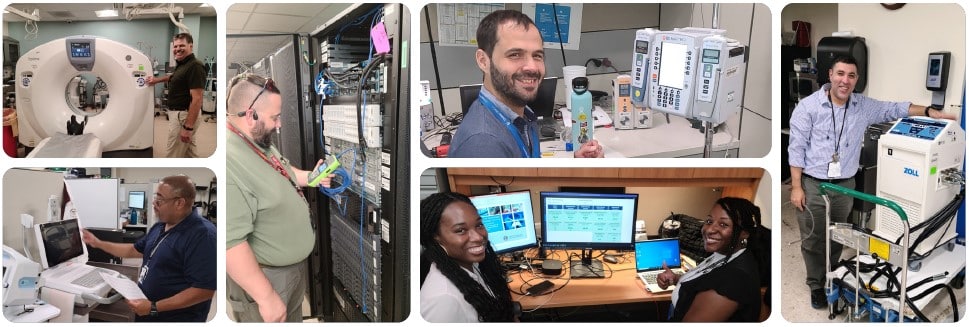
The department utilizes the (VA) CMMS system known as VISTA (Veterans Health Information System Technology Architecture) to document work orders, manage equipment inventory and track the entire life cycle of medical devices.
“The HTM department leverages the power of Power BI to monitor and manage key performance indicators (KPIs) effectively. By utilizing this advanced data analytics tool, the VA can aggregate, visualize and interpret vast amounts of data in real-time. The department has a dedicated Power BI dashboard to provide the biomedical engineering staff, as well as leadership, the ability to review various operational metrics, enabling the ability to track performance, identify trends and make data-driven decisions,” Gunshefski says.
He says that the department works closely with its IT colleagues to support the Vas Medical Device Protection Program, which is a comprehensive security initiative intended to better safeguard networked medical devices.
“The Durham HTM department integrates the Medical Device Protection Program throughout the entire life cycle of medical devices. During the procurement process, HTM reviews all equipment proposals to ensure that only devices with updated operating systems and robust encryption methods for data-at-rest and data-in-transit are purchased,” Gunshefski says.
He says that this ensures that procured devices comply with medical and technology requirements.
“Post-procurement, HTM assists with the implementation and deployment phases by securing Virtual Local Area Networks (VLANS), applying Access Control Lists (ACLs) to network interfaces, and integrating the modalities with the EHMR records. This exemplifies the seamless integration of HTM with IT in the hospital,” Gunshefski adds.
Projects and Problem-Solving
The team has kept busy with projects and has been successful at addressing a potential problem in a resourceful manner.
“Noteworthy projects include supporting the new cancer center to house two linear accelerators and a CT, installation of a new hybrid OR with integrated fluoroscopy system and the implementation of a new Wake County clinic. Moreover, the department has been instrumental in managing the Cherry Point Marine Corps Air Station Clinic,” Gunshefski says.
He says that the Cherry Point Marine Corps Air Station Clinic is the first VA clinic for Durham VAMC that has been located on Department of Defense property.
“Located approximately 160 miles from Durham’s main campus. The Veteran Patient Aligned Care Team (PACT) clinic poses specific problems with such distance. Remote interfacing with/among DOD personnel and multiple Durham clinical and engineering sections utilizing TEAMS for communication, sharing documentation and floor plans and even employing video chat walkthroughs,” Gunshefski says.
The team has also proven its mettle to solve problems.
“In the biomedical engineering department of the Durham VA Healthcare System, a team faced a critical challenge while planning the installation of telemetry cabling for real-time patient monitoring. The original plan involved routing the cables through existing conduits, but these were unexpectedly congested with old wiring and utilities, and an even more concerning issue arose: asbestos was found in the conduit space,” Gunshefski says.
He says that recognizing the need for an alternative solution to avoid delays and potential health hazards, the team proposed routing the new cables along the hallways’ ceilings, concealed by decorative molding. This approach bypassed the congested and hazardous conduits and allowed for easier access and maintenance.
“By identifying this alternative route, the team provided the contractor with the capability to develop a new design for implementation. This new plan not only mitigated the risks associated with the original conduits but also ensured that the installation could proceed without significant disruptions. The administration praised the team’s ingenuity and adaptability, seeing the revised design as a promising step forward. While the project has not yet been implemented, the groundwork laid by the team demonstrates a proactive and innovative approach to problem-solving in biomedical engineering,” Gunshefski adds.
When any group of employees can be described as “a paragon of operational excellence,” there is nothing more to say. The HTM team at the VA Durham is setting the standard.
