



By K. Richard Douglas
Massena, Gouverneur and Potsdam, New York, are in the northern portion of the state in the county of St. Lawrence, a stones-throw from Canada. Potsdam has a college presence and all three towns have hospitals.
The hospitals, Canton-Potsdam Hospital in Potsdam, Massena Hospital and Gouverneur Hospital are a part of the St. Lawrence Region of Rochester Regional Health.
The three St. Lawrence Region hospitals have their medical device inventories managed by one biomed department.
“Crothall Healthcare Technology Solutions leads the biomed department throughout Rochester Regional Health’s St. Lawrence Region (SLR), through a trusted partnership, delivering reliable support and ensuring quality care. This diverse and dedicated group of professionals, committed to excellence in healthcare technology management, includes experienced BMETs, ISEs, administrative staff, apprentices, and interns,” says Matthew Martin, the SLHS director of Biomedical Services.
In addition to Martin, the team is made up of nine members.
The department also includes a lead engineer and imaging service engineer II, an imaging service engineer I, a BMET II and three BMET Is. There is also a clinical engineering coordinator and a BMET intern, who is a fourth-year UVM biomedical engineering student, and two apprentices.
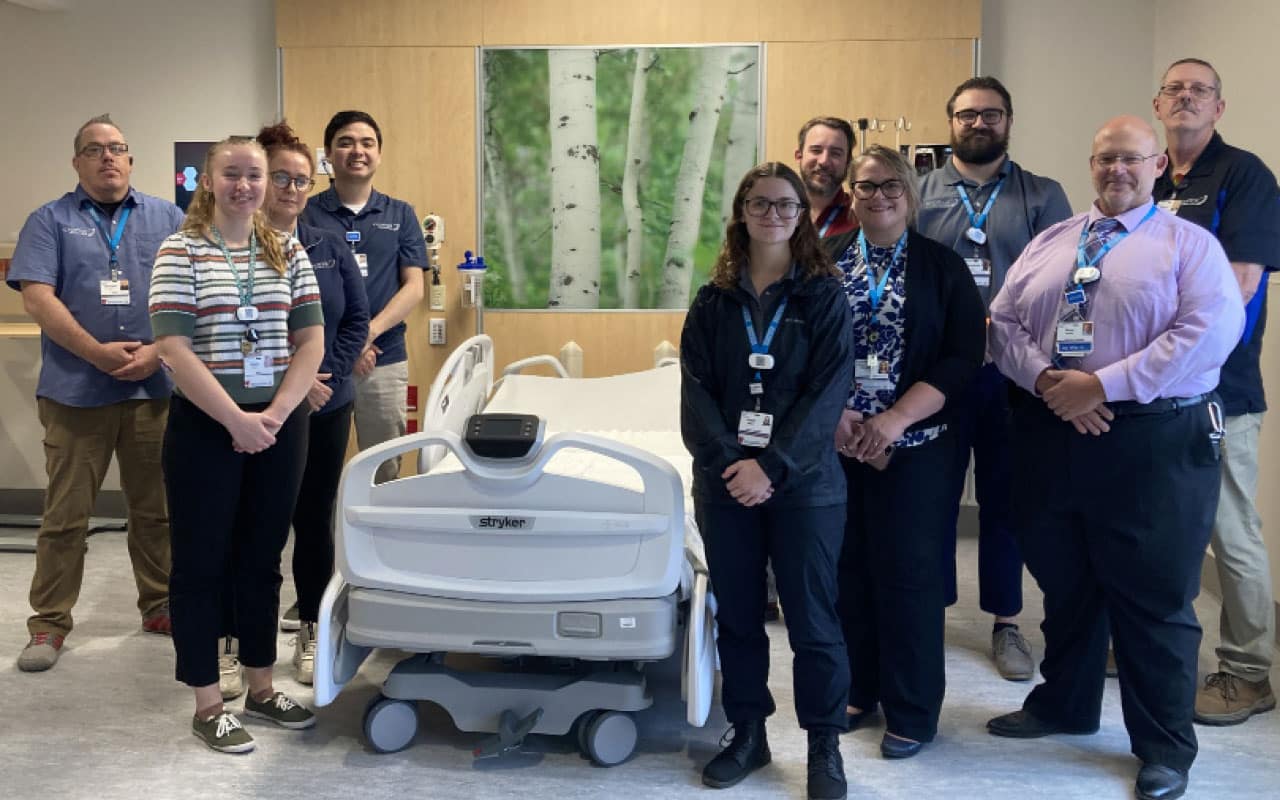
The biomed team supports three hospitals within the St. Lawrence Region and 37 outpatient clinics. The hospitals include: Canton-Potsdam Hospital (CPH), a 109-bed facility and level 3 trauma center, Massena Hospital (MH), a 25-bed critical access facility and Gouverneur Hospital (GH), a 25-bed critical access facility.
“Together, the team manages and maintains an inventory of 7,259 assets across SLR, ensuring the highest standards in medical equipment management and patient care,” Martin says.
He says that in January 2021, the SLR became an affiliate of Rochester Regional Health (RRH), a larger six-hospital system in Western New York. He says that the whole of the SLR is now fully integrated into RRH.
The team supplements their reach with two apprentices.
“Our department is proud to be part of AAMI’s Apprenticeship Program, which has allowed us to mentor two apprentices. Christopher T., a Year 2 paid apprentice, and Islan M., a Year 1 paid apprentice. Both Christopher and Islan are integral members of our team. Their primary focus is to learn fundamental biomedical skills through the apprenticeship program. When not in class, they assist with maintenance and repairs, contributing to the department’s overall efficiency,” Martin says.
The department has a high degree of interaction with its IT colleagues through reporting structure.
“The biomed department reports directly to the St. Lawrence Region Chief Information Officer (CIO), underscoring our high level of CE/IT integration. More than 50% of the medical devices are connected to hospital systems, including all patient monitoring equipment, which interfaces with the EPIC EMR across all three hospitals. Additionally, all imaging assets are integrated with both PACS and EPIC,” Martin says.
EQUIPPING A NEW EXPANSION
New construction and expansion projects can be some of the biggest projects for biomed departments, in addition to their more routine duties. The Crothall/St. Lawrence team has tackled this challenge in recent months.
“The biomed department is fortunate to contribute to a variety of special projects. Our most recent and largest project is the Regional Care Pavilion expansion at the Canton-Potsdam Hospital main campus. This expansion features a new 14-bed certified level 3 trauma center and emergency department, as well as two new med-surg floors, totaling 60 state-of-the-art private rooms with private bathrooms,” Martin says.
He says that these rooms are equipped with the latest Masimo Root monitoring systems with wireless VSM, Gen 2 smart beds from Stryker Medical and Procuity wireless secure connect beds, all integrated into the critical alert nurse call system.
“This integration assists with fall risk monitoring by reducing the height of the beds to minimize fall-related injuries and improves patient safety through visual and audible notifications. The Masimo technology allows patients to remain mobile while being continuously monitored, contributing toward moving along their recovery process,” Martin says.
He says that phase 2 of the project will integrate these systems with the EPIC EMR, further enhancing care for high-fall-risk patients.
“This integration will also eliminate the need for manual vital signs monitoring, as continuous monitoring data will feed directly into EPIC electronic medical record, improving nursing workflow,” Martin adds.
The Regional Care Pavillion at Canton-Potsdam Hospital had its ribbon-cutting ceremony and grand opening in October of 2024.
The team has also tackled some problem-solving challenges for their clinical counterparts.
“One notable example of our department’s problem-solving efforts came when we addressed a clinical nursing issue related to patient monitoring. The challenge involved the need for continuous cardiac monitoring for patients moving into the new facility, as the existing cardiac monitoring technology was confined to the current ICU,” Martin says.
He says that the solution involved creating a central monitoring unit (CMU) to consolidate patient monitoring from the new departments into a single location.
“This required relocating the Philips telemetry central stations from the ICU to the CMU. The new building is monitored by GE telemetry systems, with intermediate care rooms utilizing hardwired GE bedside monitors and med/surg rooms equipped with Masimo Root wireless monitoring,” Martin says.
He says that a significant challenge in this process was the distance – over 1,000 feet – between the legacy ICU and the new CMU.
“To address this, the team implemented POE video ethernet extenders and receivers using fiber optics, along with a dedicated VLAN on the hospital’s network, to transmit monitoring data to the new nursing stations. The new CMU will have the capacity to monitor up to 12 central stations across three hospitals, including a mix of Masimo, Philips and GE systems. The goal is to enhance patient safety through alarm monitoring to ensure timely response and resolution,” Martin adds.
Outside of the work place, two members of the team are currently participating in the AAMI Apprenticeship Program and most of the staff is preparing to take the Certified Biomedical Equipment Technician exam next fall.
The Crothall/SLHS team is handling every challenge as it arrives.
