



By K. Richard Douglas
The Allegheny Health Network (AHN) operates 14 hospitals in western Pennsylvania, serving counties in portions of New York, Ohio and West Virginia. One of those hospitals is the West Penn Hospital in Pittsburgh.
West Penn hospital is a 356-bed facility, primarily offering oncology and women’s health services. It was named the 30th best hospital in the nation for obstetrics and gynecology by U.S. News, according to Brad Klauss, clinical engineering manager in AHNs clinical engineering department.
“West Penn Hospital and Clinical Engineering are both part of Allegheny Health Network, a system of 14 hospitals and numerous offsite locations in Western Pennsylvania. Clinical Engineering is responsible for repairs and maintenance of medical equipment at all of these locations,” Klauss says.
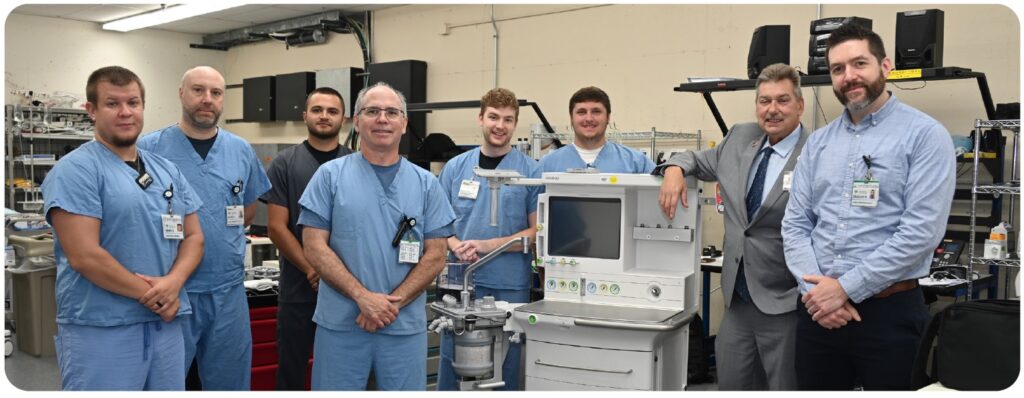
In addition to Klauss, the CE team is made up of Network Director Dave Petrosky, five biomeds and two rad techs.
“All our techs are assigned to special areas,” Klauss says.
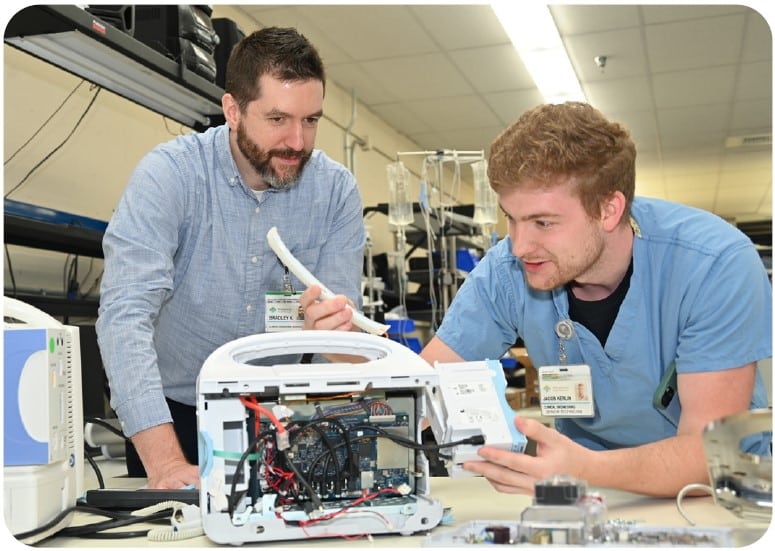
He says that Jake Kerlin primarily takes care of the NICU department and infant respiratory equipment.
“As one of the largest NICU departments in Pennsylvania, we have a substantial amount of specialty equipment. Everything from infant specific transport beds to multiple types of infant ventilators,” Klauss says.
Joe Shybloski is responsible for anesthesia.
“This involves PMs and repairs on 27 gas machines in addition to patient monitoring. He assists Glen with the OR PMs as well. He also has patient monitor floors that he is responsible for,” Klauss says.
He says that Dave Herron primarily takes care of vital signs machines and patient monitoring throughout the hospital. This year he will start working on our adult respiratory equipment.
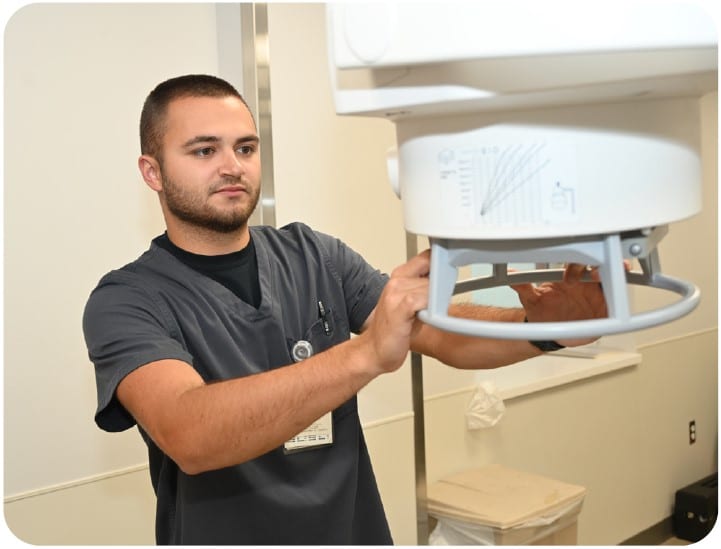
“Nick Hwostow is one of our rad techs. He has a hand in all our rad equipment repairs and will be specializing in angio equipment soon,” Klauss says.
Glen Sienko is responsible for the OR, which has 18 main rooms. He works on all the OR equipment such as ESUs, surgical towers, surgical tables, and surgical lights. He also assists Joe Shybloski with anesthesia machines.
“Dan Quast was a former biomed tech for us until earlier this year. He used to be responsible for respiratory and anesthesia equipment and has at some point worked on pretty much everything we have in the hospital,” Klauss says.
He says that the department also has one open clinical engineering technician position and that the team includes an intern from the PSU (Penn State University) biomed program, which started in August.
“Clinical Engineering and IT are separate departments but work closely with each other. Together, we are responsible for getting vitals to go from our devices to our EMR. With the increased importance of cyber security, we work together to identify and remediate any network vulnerabilities and reduce the risk of cyber-attacks,” Klauss explains.
He says that service contracts are reviewed on a system wide basis.
“As a cost saving initiative, AHN Clinical Engineering has determined the use of single service agreements are less cost efficient. We have determined that utilizing network wide master service agreements prove the greatest cost savings,” Klauss says.
He also states that the team collaborates with procurement to utilize the technology life cycle for all assets.
“We use our CMMS TruAsset to organize and analyze this data to decide capital equipment purchases,” Klauss adds.
REORGANIZATION EXPERTISE
The department plays an important role in capital purchases of the assets they manage along with reorganizing departments.
“West Penn Hospital is the oldest secular hospital in Pittsburgh, originally founded in 1848. With this comes a lot of old infrastructure. Our department plays a critical role in prioritizing updates to our equipment. We’ve recently been instrumental in deciding updates to equipment in our radiology department as well as updates to our OR surgical lights,” Klauss says.
He says that the team has become extremely good at reorganizing departments.
“As an example, during COVID, we were crucial in changing our unused pediatric department into a 16-bay expansion to our ICU and a 20-bay stepdown unit in an old, unused floor. This involved reconfiguring all patient monitors, work with IT to ensure all vitals are captured by our EMR, and guaranteeing each room is properly equipped to use ventilators,” Klauss says.
He says that now that the pandemic is past, they have used these skills to open and rearrange units throughout the hospital.
“When our NICU was at capacity, we were tasked with quickly converting the COVID ICU back into the peds unit. The same goes with other floors as well,” Klauss adds.
In addition to dealing effectively with equipment and infrastructure changes, the team has proven adept at problem solving.
“Jake identified an issue with the replacement fans we were receiving for our incubators. The fans being produced by the vendor were no longer compatible with the incubators. He worked with the vendor, who sent a design engineer on site to assess the issue. As a result, the vendor changed their design for all fans they were producing,” Klauss says.
He says that there have been issues with the wiring for the telemetry network.
“Dan, during his time as a biomed tech, poured over the schematics and traced the issue to a single splitter in one of our network closets. This is notable because our telemetry network covers approximately 150,000 square feet,” Klauss says.
“However, I believe since every tech works closely with their departments to help with equipment problems, purchases, or upgrades we avoid many ‘major’ issues. We do have our share of equipment malfunctions, but overall, because of the diligence of our technicians we do not run into many catastrophic issues. This includes maintaining regulatory compliance to meet the Joint Commission standards,” Klauss adds.
He says that the CE team works closely with local biomed educational programs.
“Staffing is an issue across the nation, and we’ve developed close relationships with both the PSU BMET and RMU biomedical programs. We regularly host interns as part of both programs,” Klauss says.
