



By K. Richard Douglas

When the leaves are changing in the fall, there are few places as beautiful as New England. A bike ride or walk along the Northern Rail Trail of New Hampshire is one way to see some of that beauty, and accessing it from Lebanon, New Hampshire is a good starting point. While in Lebanon, you might also want to see the Packard Bell Covered Bridge or the AVA Gallery and Art Center.
For those who call the city home, they can find medical care at the Dartmouth-Hitchcock Medical Center (DHMC). The medical center is part of Dartmouth-Hitchcock, which is a not-for-profit academic health system that serves a population of 1.9 million in New England.
The clinical engineering team that keeps the equipment working for the benefit of all of those New Englanders is the Dartmouth-Hitchcock Clinical Engineering team. It provides 24-hour coverage for all clinical areas.
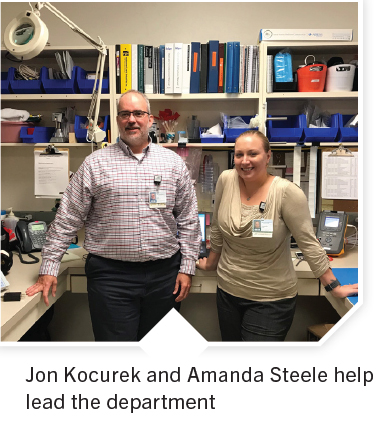
“We currently have 28 employees covering over 15 facilities throughout New Hampshire and Vermont, which includes one director, two supervisors, one clinical engineer, one parts-procurement person and an administrative assistant,” says Jon Kocurek, the department’s director.
In addition the team supports community outreach centers and municipalities such as schools and fire departments within a 100-mile radius of its main campus.
Because of the vast area covered by the team, getting together periodically helps with information exchange.
“Because our technicians are constantly in the field servicing hospitals throughout New Hampshire and Vermont, we hold a biweekly team meeting to share insights, news, and make sure communication is fluid throughout the department,” Kocurek says.
Along with its efforts to take a strategic approach to sharing information, the team applies practical criteria in its evaluation of service contracts.
“We determine if each service contract is a benefit to Dartmouth-Hitchcock by weighing the monetary cost of the contract over time with other factors such as timeliness of repair, cost of parts, convenience and customer service, age of the equipment, cost-of-service ratio reports, supportability from the vendor or third-party support entities, and overall cost of ownership,” Kocurek says.
“When a contract gets to a point where it is deemed to no longer be of value to Dartmouth-Hitchcock, the contract is either removed or modified and maintenance of that device or devices becomes maintained by the clinical engineering department,” Kocurek says.
“Our clinical engineering department monitors the quality of service provided with each repair and tracks vendor service, ensuring proper documentation and compliance with our standards. Additionally, the department has developed an excellent relationship with our supply chain department, which has resulted in a procurement model that allows the clinical engineering team to weigh in on all purchases regarding maintenance of a device or modality,” he adds.
 Saving Lives and Wireless Testing
The CE team has worked hard on certification, innovation and supporting patient well-being. One member has even helped those in a developing country.
“Our team has worked with a vendor as a beta-site for wireless patient monitoring products that transmit patient data directly from the patient to their electronic medical record. In many cases, this work has eliminated the need for patients to drag cables around with them, which can lead to falls and broken equipment. Ultimately, this has resulted in higher patient satisfaction scores regarding the delivery of care within the organization,” Kocurek says.
He says that the department has actively engaged in a goal to achieve 100 percent ICC certification of all technicians.
“In support of this goal, a three tiered BMET level structure has been adopted that fosters career progression through the promotion of further education and certification, which allows technicians to realize progression in their field that is meaningful not only to them, but the organization and the patients it serves as well,” he says.
Along with their patient safety officer and a vendor, the team was instrumental in establishing a program that sends alerts if any suspicious trends regarding patient deterioration are noticed by the equipment.
“With this program, every inpatient at Dartmouth-Hitchcock is monitored for the entire length of stay. This has eliminated unwitnessed events,” Kocurek says. “The department takes pride that this project has saved lives and will continue to do so in the future. This project has also been awarded by ECRI. Many other institutions have done site-visits in hopes to collaborate with, or incorporate, this type of project themselves.”
Kocurek also says that a team of Dartmouth-Hitchcock doctors and nurses travel to Rwanda to support hospital education and improvements there.
“This year, one of our technicians traveled with the team to teach proper PM procedures, share some of the latest technology and trends, help with repairs, and train some of their techs on equipment troubleshooting and use,” he explains.
With the team’s role within IT, they are focused on cybersecurity threats. This recognizes the evolving role of CE departments.
“As part of the IT/IS division, CE plays an important role in the integration of devices to the network and is currently working on a project to increase the cybersecurity of our medical devices. [The] clinical engineering team has evolved from being a separate department within DHMC, then merging with engineering and eventually becoming part of IT/IS as medical equipment became more reliant on computers, servers, and the hospital network,” Kocurek says.
Away from work, the department’s team members stay active in the HTM community and updated on their skills and knowledge.
“We have several techs who are active members of the New England Society of Clinical Engineering, AAMI and a few other medical device associations,” Kocurek says. “Our technicians frequently attend events such as AAMI, MD Expo, RSNA and HIMSS. We try to send multiple technicians every year so that they can network and learn from their peers in an effort to bring back information on the latest technology and trends as well as suggestions for improvement.”
If you are visiting New England, know you are in good hands if you seek medical attention at Dartmouth-Hitchcock Medical Center, where the medical devices are maintained by a knowledgeable CE team.
