



 By K. Richard Douglas
In the northwest, and the far-far northwest, many patients find their health care solutions in the form of an organization with a calming name; PeaceHealth. PeaceHealth is a not-for-profit Catholic health system offering care to communities in Washington, Oregon and Alaska. It is headquartered in Vancouver, Washington.
With 10 medical centers and more than 1,200 physicians and providers, the 128-year-old health care system supports over 392,000 unique patients annually.
One of the system’s facilities is the PeaceHealth St. John Medical Center in Longview, Washington. A small five-member clinical engineering team handles the medical equipment management for this 120-bed hospital along with nine local clinics.
Those clinics include a women’s health center, occupational health center, physical rehabilitation center, dialysis, ENT, two general family clinics, an infusion center and a cancer center.
The dedicated team of biomeds cover every area of equipment.
The clinical engineering staff is made up of Lead Biomed Kelley Galletti, CRES, CBET; Biomed III Josh Lindsey, CBET; Biomed I Bobby Oliver and Yevgeniy “Eugene” Sobovoy, CBET.

“He’s the ‘guru’ of our shop. We turn to him for an advice or with any question regarding general biomed issues as well as imaging issues,” says Sobovoy, speaking about Galletti.
Sobovoy says that Lindsey “is our OR/anesthesia biomed. Besides OR, he takes care of ventilators and general biomed equipment.” Oliver is “dialysis/general biomed. He is the newest member on our team,” Sobovoy says.
“I take care of imaging equipment (C-arms, general radiology rooms, ultrasound, etcetera) and general biomed equipment,” Sobovoy adds.
David Smith is the department’s manager. Smith also manages the biomeds at Southwest Medical Center in Vancouver, Washington.
The department takes care of first call imaging, 24/7 on-call for emergency issues, as well as nurse call. They support imaging, OR, acute care, dialysis, GI, sleep center, RT, BHI, emergency department, cath lab and PACU.
“We provide full service to patient care equipment, including repairs and PMs to our nine off-site clinics. We also maintain, repair, and PM, 28 Fresenius dialysis machines along with the reverse osmosis room, treated water distribution system/equipment, at our offsite hemodialysis clinic. Our inpatient dialysis comprises five stations on the acute care floor and 18 stations in our ICU department,” Sobovoy says.
Sobovoy says that the department has a “close and friendly relationship with our IT and networking guys. We help them, they help us,” he says.
Data collection has seen a recent change.
“We had been using TMS as our database, but recently switched over to RSQ due to our management change,” Sobovoy says.
Projects and Troubleshooting
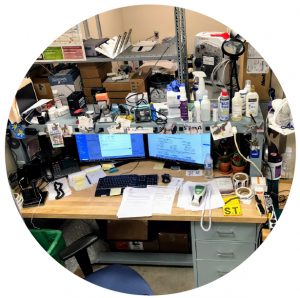 The small department has taken on some projects in addition to its more routine daily activities. The resourcefulness of the team has also been on display as members have figured out ways to correct problems and keep everything functional.
“Recently we have been involved in implementing AvaSure tele-sitter in our hospital. Since this wasn’t a biomed-managed project, we volunteered to assemble and label them, IT took over after that,” Sobovoy says.
He says that they also performed a recent Philips telemetry install and upgraded areas of the hospital that were not covered by the old system.
“This required hospital maps to be re-examined for AP inclusions and to verify areas of coverage utilizing existing heat maps. Areas added were our OB/labor and delivery floor, ICU, CT and a corridor providing transportation of cardio patients from hospital care to treatment areas within the hospital,” Sobovoy says.
Sobovoy adds that this allows for patient coverage while in transport.
“Additionally, our emergency department required installation of portable tele monitors to cover overflow when census became elevated. This was completed by us. We assembled, programmed the portable tele monitors, re-programmed the Piicix to account for the new sectors,” he says.
“We have recently had the OR booms replaced along with the surgical lighting and the monitoring equipment. This required many meetings to ensure the video outputs and voltage requirements along with proper cabling were to be met prior to implementation and installation,” Sobovoy adds.
Sobovoy recounts a time that illustrates how additional training for HTM professionals comes in handy. In this case, they were able to help out their IT partners.
“Our dental X-ray unit in OR has its software on a laptop. One day, [an] IT tech decided to upgrade it with a new one, but he wasn’t aware of proprietary software on it. He wiped the old laptop and left a blank new one for OR staff. That’s when we got a call,” he says.
“I had to install the dental X-ray software from scratch, configure PACS and networking information with IT’s help,” Sobovoy adds.
Another problem-solving effort that the biomed crew handled illustrates the importance of biomed’s role in the purchasing process.
“Most recently, [the] ultrasound department had purchased new machines (again without consulting or even including us in purchase meetings). The next day, they discovered that the new machines were not compatible with old video cabling and monitors,” he says.
“I troubleshot and found the correct video cable type, and correct resolution monitors, that would need to be purchased and pulled/installed,” he adds.
Away from the work environment, Sobovoy says that “most of us are members of the Washington State and Oregon State Biomed associations. I’m also a member of AAMI.”
The four-man biomed shop at PeaceHealth St. John Medical Center proves that a small biomed contingent, with specialized knowledge, can get the job done. The patients in Longview, Washington are the benefactors of their expertise.
