



By K. Richard Douglas
The Woodlands is a special-purpose district and census-designated place located north of Houston, Texas. The area spans two counties; Montgomery and Harris. It is governed by The Woodlands Township and administered by an elected board of directors, making it unique. It began as a bedroom community of Houston but attracted some large corporate residents as well. The area is subdivided into eight villages and many urban parks.
Three of the affiliated hospitals that serve The Woodlands and surrounding communities are: CHI St. Luke’s-The Woodlands Hospital, 237 beds; CHI St. Luke’s-Lakeside Hospital, 28 beds; and CHI St. Luke’s-Springwoods Village Hospital, four beds.
CHI St. Luke’s Health has a number of hospitals in the region.
“There are a total of 269 licensed beds covering over a 20-mile radius. The system has a total of over 7,000 hospital-owned devices with a total asset value of over $100 million. Each location contains all imaging modalities including three MRIs, seven CTs, one linear accelerator, mammography, cancer and comprehensive stroke centers. [There is] a community emergency center containing a CT, X-ray and ultrasound,” says Eugene Watkins, a manager in the system’s clinical engineering department.
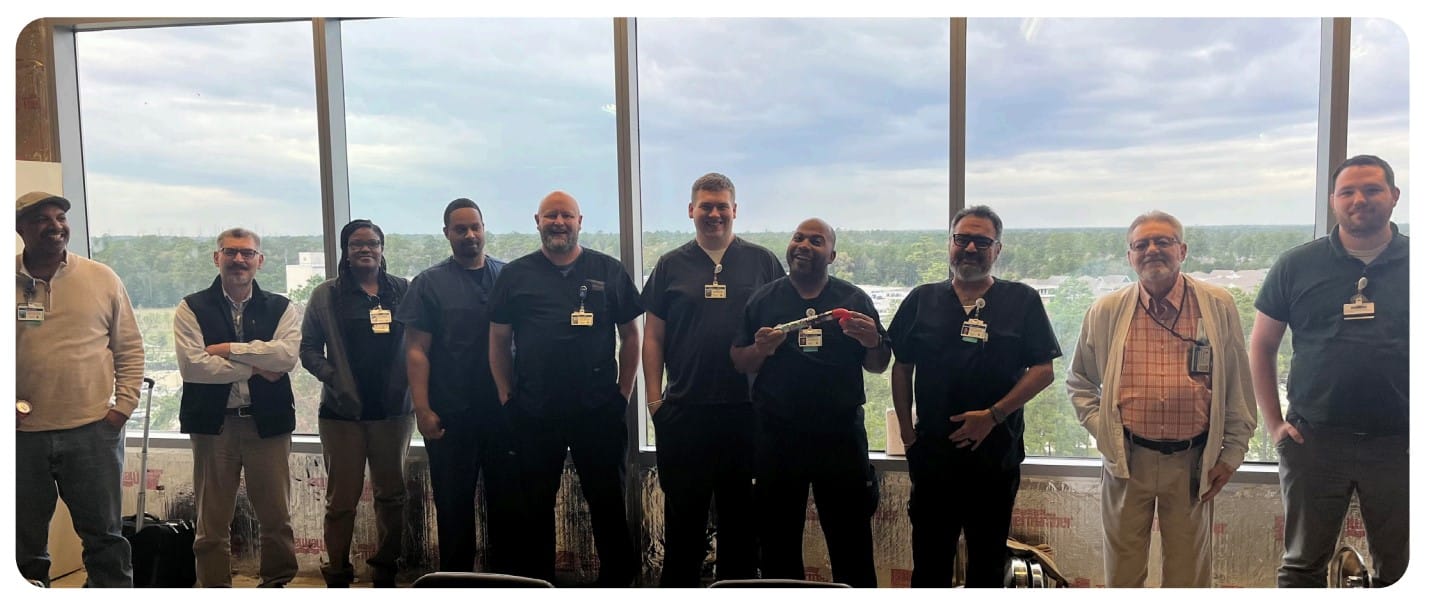
The CE team is composed of five techs and a manager, along with a regional manager.
St. Luke’s Health is part of CommonSpirit Health, a nonprofit, Catholic health system.
Service contracts go through a review process that sends the contract up through the ranks.
“Contracts are reviewed and submitted by the CE manager to the regional director. The quote along with justification of the cost and 12-month history are submitted together. The document is reviewed by the regional director before being submitted to the national office for final review and approval, before a P.O. is created to be paid and the final contract signed,” Watkins says.
Data collection is dependent on the team’s astute techs.
“The collection of data is heavily dependent on what the tech inputs in the Team Net database system. This process starts with the techs entering the series of equipment our team manages including model, department, and warranty or contract coverage. Data collection continues as the tech performs preventative maintenance, corrective maintenance, recalls and other services. The Team Net database system allows biomed to input various data and attachments to help support the equipment we service. The Team Net data system also allows the customers (nurses/hospital staff) to submit requests for repairs on systems or equipment needing service,” Watkins says.
Integration with IT is achieved through regional resources, available when the need arises.
“CE does not have a station/in-house IT person. However, CommonSpirit Health as a company has identified the need and created a CE/IT regional team. This team works with biomed to maintain direct network-related integrations with medical equipment,” Watkins says.
He says that the department encourages all techs to be knowledgeable and well-rounded on as many modalities [as possible] in order to provide the best service to its customers.
Investigating a Boot Loop
Technology has enabled a number of tasks that were not possible before. It also can present problems and challenges and diagnostic investigations that test the meddle of biomed departments and OEMs.
“Biomed participated in many different projects throughout the year as the hospital continues to grow. Some of the most recent projects biomed has participated in are the Philips telemetry monitors installation, anesthesia installation, infusion pump software upgrades and the installation of the new MRI room,” Watkins says.
He says that problem-solving is a daily task for the department.
“One of the biggest situations biomed has been involved in would be with the Philips telemetry monitoring system. This is because biomed has to work with multiple departments to get a task accomplished, including networking. Updates pushed from networking can often cause our system to lose patient monitoring. When this happens, we often have to troubleshoot across several modalities or other department specialties in order to correct the problem. Many times, industry-specific terminology can create a barrier to resolving the problem,” Watkins says.
The Philips telemetry systems project has been a recent focus of problem-solving.
“Recent updates completed on the system caused it to go into what is called a boot loop. This is when the machine tries to restart but can’t complete the restart process and continues trying. While this issue occurs, the department loses patient monitoring. After CE worked through multiple troubleshooting steps, Philips had to be contacted and it was determined that the cause was a conflict between the Philips application and an anti-virus virus installed on the system,” Watkins says.
He says that the CE department scheduled a meeting between the CE/IT and Philips on steps to correct and resolve the issue.
“CE consulted with Philips and determined the best plan of action. Unfortunately, CE and Philips were not successful and we had to take the system down in sections to completely reimage each section. The process took about 20 minutes to an hour per section to completely reimage. CE often has to collaborate with multiple departments to resolve situations like these and prevent patient incidents,” Watkins adds.
He says that away from work, techs frequently attend Houston HTMA (Healthcare Technology Management Association) meetings.
“The department also has several techs that maintain AAMI biomed certification,” Watkins says.
In one of the nicest areas of the country to live in, the quality of health care cannot come up short. The Woodlands CE team makes certain that medical equipment is not compromised either.
