




By K. Richard Douglas
Whether talking about college sports or the institution’s storied history, the University of Connecticut (UConn) is a stand-out among institutions of higher learning. With its roots going back to the late 1800s, the university is a leader in research and boasts a student population of 32,000.
The affiliated UConn Health includes schools of medicine and dentistry, graduate programs, clinics and hospitals.
“UConn Health’s Clinical Engineering Department is composed of 18 employees. This does not include third-party full-time engineering and service support techs,” says Ken Blier, director of clinical engineering at UConn Health’s Clinical Engineering Department.
Other members of CE leadership include Vice President Eric A. Kruger and Chief Clinical Engineer Sam Elsemany. Located in Farmington, Connecticut, UConn Health’s campus comprises two towers – the University Tower and the Connecticut Tower – which collectively offer over 400,000 square feet of clinical space and 224 beds.
“As a teaching academic health center, UConn Health is home to students from the UConn School of Medicine, UConn School of Dental Medicine and affiliations with UConn School of Nursing and Allied Health Services. Moreover, the hospital houses a full research facility that collaborates with the Jackson Laboratory for Genomic Medicine, located on campus,” Blier says.
There are also several offsite clinics across the Hartford, Connecticut area.
“To provide support to these locations, the clinical engineering department operates an equipped hospital vehicle to service medical devices. This innovative approach ensures that UConn Health can provide efficient and comprehensive care to patients, regardless of their location. With this extensive network of facilities and resources, UConn Health is well-positioned to deliver cutting-edge medical care and research that advances the field of medicine,” Blier says.

The CE department also includes a procurement specialist, a medical device cybersecurity engineer, two imaging specialists, six BMET IIs and two BMET Is, as well as interns and student workers.
The group provides myriad services including capital purchase reviews, managing vendor medical device repairs, contract management and renewals and PMs, participation on committees such as EOC and medical device incident investigations.
There is a close collaboration with IT.
“Our clinical engineers and BMETs work very closely with IT to work on all medical technology-related projects. All medical device capital purchases must be reviewed and approved by both IT and CE, and integration assignments are given to teams within both departments to complete,” Blier says.
The group has been innovative with how it manages service contracts.
“We implemented a major project linking all medical device contracts to our CMMS system. Our contracts team in the finance department now has access to this tool, allowing them to streamline the repair process and set reminders to get quotes and reinitiate contracts. This innovative solution helps identify any devices that slip through the cracks without a service contract while other models have contracts,” Blier says.

Streamlining Infusion Pump Availability
The team has been involved in special projects, including a thorough review of inventory and its accurate inclusion in CMMS.
“In 2021, the UConn Health CE management team conducted a gap analysis against regulatory requirements and identified several opportunities. One major opportunity was to review the CMMS device inventory and ensure all in-use medical devices are captured in our database and has the correct device information such as serial number, model, manufacturer, PM frequency and maintenance checklists,” Blier says.
He says that although this challenge exists to some degree in almost all HTM departments, the UConn Health CE team decided to address the issue and create a process to maintain inventory accuracy going forward to ensure patient safety and department regulatory compliance.
“The first phase of project was to touch every in-service medical device and ensure it was included in the CMMS inventory, and the second phase was to complete an in-depth device review of each device’s OEM maintenance requirements, and the accuracy of all device-related data in CMMS. The project will not only help us ensure the accuracy of the medical device inventory, but it will also help in other regulatory and compliance-related tasks such as device recalls and capital purchases planning,” Blier says.

Problems that come up in the health care setting often call upon the skill sets of HTM professionals. The department’s resources and problem-solving skills were tested during the COVID-19 pandemic.
“The COVID-19 pandemic has caused unprecedented pressure on health care systems worldwide, with hospitals facing surging patient numbers. At UConn Health, this surge also created an increased demand for infusion pumps, resulting in a shortage on clinical floors. To address this challenge, the clinical engineering department collaborated with the third-party company responsible for managing the IV pumps disinfection and distribution,” Blier says.
Together, they identified some opportunities to optimize the pumps’ cleaning and distribution process.
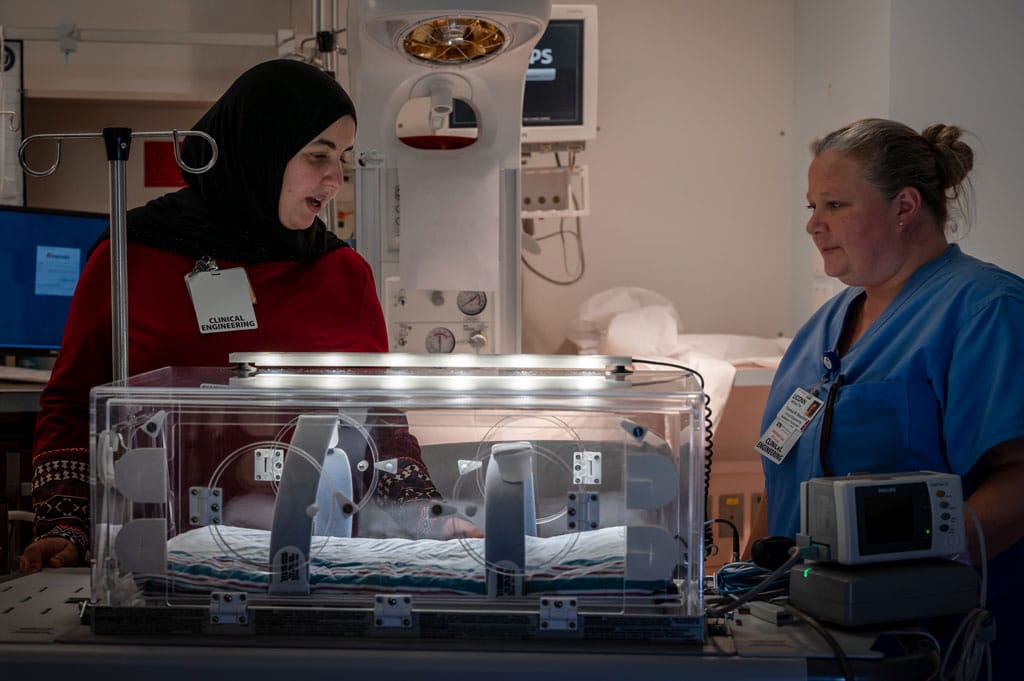
“As part of the project, clinical engineering developed a new distribution process assigning a specific number of IV pumps to each clinical department. After undergoing the cleaning process, the pumps were then returned to the same department to ensure efficient use. The team also purchased additional pumps that could be provided to different clinical departments if needed, serving as ‘floater pumps.’ The clinical engineering team thoroughly tested and reviewed the condition of every pump during the project, ensuring proper operation and accurate information in the CMMS,” Blier adds.
He says that the project’s success was evident as it eliminated a major daily issue that the clinical team had been struggling with.
“By optimizing the distribution of infusion pumps, the clinical engineering department was able to provide critical support to their colleagues on the clinical floors during the COVID-19 surge. The solution helped ensure that patients received the necessary care and resources, even during the most challenging of times,” Blier says.
Beyond showing its value with important projects like this, that meet a critical need, the UConn Health Clinical Engineering Department provides specialized equipment repair and maintenance throughout the year and throughout each device’s life cycle.
Through innovation, they reflect the reputation of a university that has made medicine a central focus.

