



 Once a year, golf fans are treated to one of the most storied events in golf history. Played at the Augusta National Golf Club, The Masters brings together some of the greatest golfers for an invitation-only event. Since the first tournament in 1934, the event has focused attention on the beauty of Augusta, Georgia, with its towering pine trees, azaleas and dogwoods.
The county of Richmond is served by the University Health Care System, anchored by University Hospital in Augusta. The hospital opened its doors originally in 1818 before going through several incarnations that led to its current location in 1970. Today, the hospital campus includes the Heart and Vascular Institute and office buildings that house more than 600 private practice physicians. It is one of the city’s top five employers.
Maintaining and repairing University Health’s 10,000 pieces of medical equipment is the Novant Clinical Engineering Department. The department, using a shared service model, provides this service to the 581-bed University Hospital of Augusta, 25-bed University Hospital of McDuffie as well as multiple ancillary clinics.
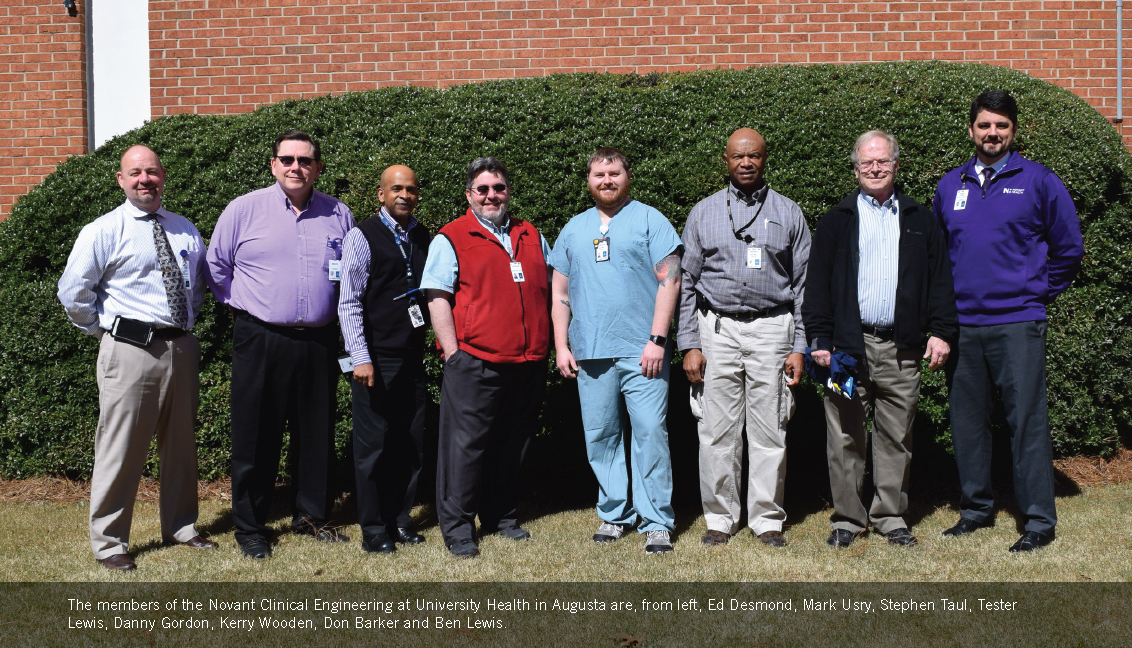
The clinical engineering team includes Ben Lewis, MBA, CHTM, Director of the Clinical Engineering Management Program (CEMP) for Georgia and Florida for Novant Health; Ed Desmond, MPA, CRES, Manager of the Clinical Engineering Management Program at University Health; Kerry Wooden, BMET I; Danny Gordon, BMET II; Tester Lewis, BMET II; Stephen Taul, BMET II; Mark Usry, BMET II; and Don Barker, Senior Imaging Engineer.
“University Health and Novant Health have partnered in Clinical Engineering through a program called Novant Health Shared Services,” Lewis explains. “This has been a great partnership and has allowed us to find savings through contract reduction because of Novant Health’s large clinical engineering talent pool.”
According to Novant Health, in the search for more efficiency, the benefits gleaned from a shared service model include access to “best practices, economies of scale, operational efficiencies and key learnings.”
“We have in-house specialists at University Health for modalities such as imaging, dialysis, ventilators, and more,” Lewis says. “We also have specialists that are shared within Novant Health CEMP network that fill the gaps by training them in specialties that do not require full-time positions at every facility, like sterilizers, injectors, nuclear medicine, imaging, and anesthesia, which allows these team members to keep a full-time focus on their specialized modality. This lets us make the most of our education dollars and keeps our specialists very experienced in their respective areas.”
Novant Health is a not-for-profit integrated system of 13 medical centers and 1,200 physicians in 500 locations, according to their website. Based in Winston-Salem, North Carolina, the health system includes 25,000 team members. In addition to clinical equipment management, other shared service offerings include supply chain and purchasing, hospital management, service line management, revenue cycle, and consulting.
This shared service model focuses on bringing more maintenance in-house. Lewis says that their specialists travel throughout the Southeast so that they can be shared among facilities to reduce costs.
“What I like about our program is that you don’t have a biomed who works on injectors 20 percent of the time. You have a biomed who works on injectors 100 percent of the time,” Lewis explains. “For anesthesia, it’s the same way. Often, when you have a modality specialist like an in-house anesthesia engineer, it might not be 100 percent of his or her job. Whereas with our specialists, who travel throughout the region, that’s 100 percent of their job and I believe that puts their engineering skill set on a par with any OEM.”
“Novant Health CEMP, headed up by Alan Koreneff, Vice President of Clinical Engineering Management Program, believes in investing in model-specific education, allowing us to bring many repairs and maintenance contracts in-house, without compromising quality of service,” Lewis adds.
A Focus on Competency
Inter-departmental cooperation is high on the list with the Novant/University Health CE team. The realities of a networked hospital are fully embraced.
“IT and Clinical Engineering have an increasing amount of cross-over work. We have begun working with the IT departments an increasing amount as time goes by,” Lewis says. “Nurse call, patient monitoring, and even IV pumps all run off of the IT network, so the collaboration between the two departments is constantly increasing. We work with IT as new networked medical devices come on board and throughout its life cycle to ensure that we have operational and secure devices that are ready for patient care.”
“The department has kept busy with many projects, including a large IV pump upgrade, a new nurse call upgrade, consultation of equipment needs for construction projects, patient monitoring expansions, and the list goes on. I’ve never felt like we didn’t have enough to do,” Lewis explains.
The nurse call upgrade is an ongoing project.
“We take care of the nurse call, but it’s a partnership with IT and Plant Engineering as well,” Lewis says. “We sit in on implementation meetings as a committee and gather information for the hospital’s upcoming needs. We work with the nurse call provider and with IT as we de-install our outgoing system to make sure that other areas of the facility are not affected. In the networked world that use work in today, the times of departments working in silos is over. Communication and teamwork with other clinical support departments like IT is not going to go away. It is important that we recognize that we must be able to keep up with the extremely fast changes in technology, and that is going to take creating a focused partnership approach with other departments.”
Finding and Nurturing Talent
As with so many other HTM departments, one of the biggest challenges for this team is finding the right new members to fill a specific need. The department is interested in getting the most skilled professionals to leverage those skill sets to their best advantage.
Lewis says that the shared service model is working well at University Health. Keeping more service in-house and training the existing HTM professionals has been a winning approach.
Much of that activity is because of the ability of team members to tackle a wide array of repairs.
“We have a generous annual training budget. We train with both OEM and third-party sources and courses are selected based on both the financial and customer impact that they can make,” Lewis says.
“It is a tremendous opportunity and pleasure to be a team member of Novant Health CEMP. The leadership invests in the people, often promotes from within, and believes in the program and people of Novant CEMP,” he says.
“Throughout my career, I have seen systems that were afraid to spend money on education for their engineers for fear that it would create turnover by way of the engineers leaving for other jobs after their training,” Lewis adds. “I have found that not to be true at all. I believe that we have a very good retention rate because we invest in our team members, not in spite of it. I am quite proud to be a part of Novant Health CEMP.”
