

For years, it has felt as if healthcare technology management (HTM) is a best-kept secret. A rewarding occupation, ideal for building one’s technical skills and job security, is tucked away in the basement of health systems across the United States. Now, however, HTM pros in California are eager to share this secret with the next generation of prospective technicians.
“The current shortage of qualified HTM professionals makes early outreach especially important,” said Jason Velick, chair of the California Medical Instrumentation Association.
CMIA, a member of AAMI’s HTM Association Leaders group, has launched a new initiative specifically aimed at introducing career paths of the HTM profession as early as possible to students entering the U.S. workforce.
Members of CMIA will be traveling around the state of California, visiting classrooms and career fairs with portable devices, hands-on presentations and information pamphlets developed by CMIA and AAMI. Each of CMIA’s nine chapters throughout California will conduct at least two student outreach events per year, for a statewide goal of 18 events annually.
“By introducing students to the field while they are still considering education and career options, we hope to build greater awareness and attract a new generation of professionals to the industry,” Velick explained.
EARNING STUDENT INTEREST
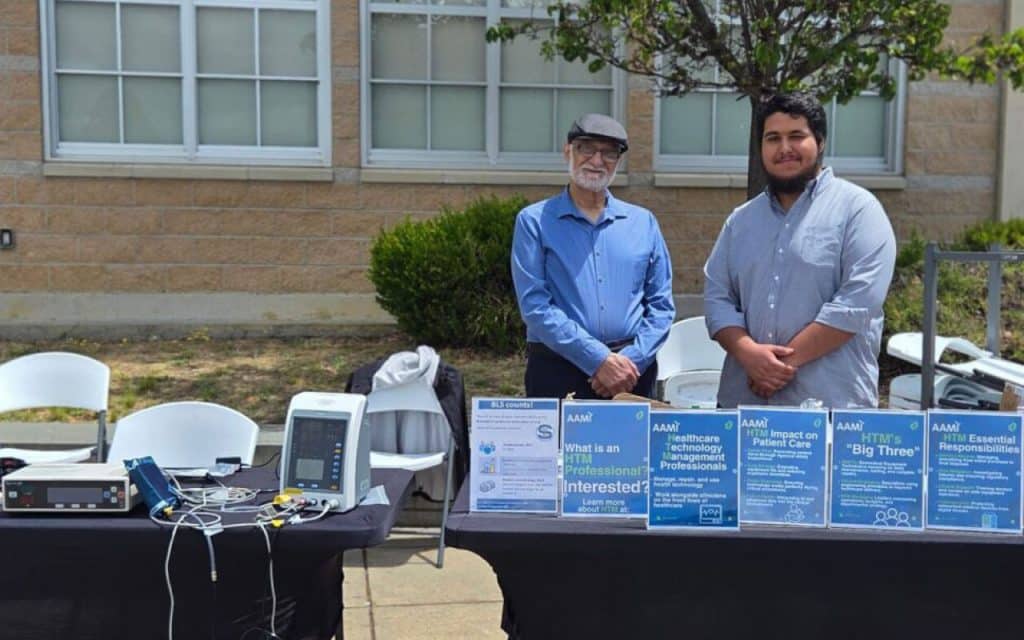
The effort is already underway, with representatives from the CMIA Silicon Valley Chapter having visited El Cerrito High School, located in El Cerrito, California, in July. There, HTM consultant and DeVry University Biomedical Engineering Technology Professor Najib Azhar joined with Sayed Sayedi, a student at Chabot College, to show students the kinds of devices HTM professionals will regularly maintain for hospitals and clinics. The pair demonstrated how troubleshooting test equipment is used to maintain the accuracy and efficacy of the devices and instruments used for patient care.
“A great deal of interest was generated as students checked their heart rate, blood pressure, blood oxygen and temperature. The use of test and calibration equipment – a patient simulator and defibrillator analyzer – was also demonstrated,” Azhar explained. “We had several engaging conversations and encouraged students to explore what AAMI.org and CMIA.org have to offer.”
The students were also given an opportunity to peruse several books that have proven important to Azhar’s own career path as both an HTM expert and educator of the next generation:
1. Introduction to the Medical Device Industry: A Career in Medical Devices
2. Career as a Biomedical Equipment Technician
3. Biomedical Engineering Made Understandable: A Teen’s Introduction to Biomedical Engineering
4. Bio-Medical Engineering: Principles, Technologies, and Clinical Applications
5. Artificial Intelligence in Healthcare
“The first three books were relevant to the high school attendees, but the last two gave them a taste of exciting things to come,” Azhar said.
“What drives us to introduce students to HTM is the growing need to develop the profession’s future workforce,” Velick added. “Ultimately, patient safety is at stake. We are working to ensure that our hospitals are able to function continuously and without interruption of workflow demands.”
WHAT COMES NEXT
Of course, student interest alone isn’t going to create a new generation of HTM professionals. Fortunately for the students Azhar spoke with, CMIA has created an online portal listing California HTM programs and AAMI student resources, outlining clear next steps for students looking to dive into the HTM field.
Unfortunately, not all U.S. regions are as well-resourced as the Golden State.
AAMI Vice President of HTM Danielle McGeary said the HTM field faces a steep challenge in its dwindling U.S. education and training pipeline. Around the U.S., two-year biomedical equipment technician (BMET) programs are closing their doors. With 23 programs lost since 2020, many states no longer have an educational institution offering a two-year degree in the HTM field. Hospitals are also under stress. As health system budgets and reimbursements shrink, the prospect of training new HTM professionals to replace retiring HTM gurus has become increasingly daunting.
“We need HTM associations across the U.S. to step up – just as CMIA has – to drive a new wave of student interest in the HTM field,” McGeary noted. “Whether you plan to attend a career fair, give a classroom presentation, or even tour students around your department, AAMI can provide resources to share why the HTM profession is so rewarding.”
Interested parties are encouraged to visit aami.org’s HTM Resources page.