



Sponsored by Crothall Healthcare
By Richard Eliason, Senior Director of Quality & Compliance, Crothall Healthcare
Few words strike fear in the hearts of hospital employees like “Surveyors are in the building.” Unannounced, a group of strangers just entered your place of work to evaluate your operation, they will probably be there several days, and everybody’s stress level is high. Vacations may be canceled, meetings put on hold, and general day-to-day operations are upended.
As an Independent Service Organization, Crothall’s Healthcare Technology Solutions (HTS) team has participated in and helped hundreds of hospitals successfully prepare for these accreditation surveys. In 8 years, 2016-2023, our HTS division supported over 220 successful surveys and 14 already in 2024. Our team of Quality & Compliance specialists is well-versed in the complexities of the hospital accreditation process. Drawing on a wealth of knowledge from each successful survey, they gather and analyze extensive data, providing crucial insights that greatly benefit our hospital partners. This expertise enables these hospitals to understand precisely what is required to prepare effectively for accreditation surveys. By tapping into this resource, facilities can enhance their readiness and compliance, ensuring they meet the rigorous standards set by accreditation organizations (AOs).
Some hospitals may not have the resources to maintain a large technology staff like an ISO; however, this should not hinder their ability to successfully pass accreditation surveys. It’s crucial to recognize and utilize all available tools and support systems, perhaps including external expertise and streamlined processes, to ensure thorough preparation. By leveraging these resources, even hospitals with small in-house teams can navigate the complexities of AO compliance effectively and ensure they meet the high standards required for accreditation.
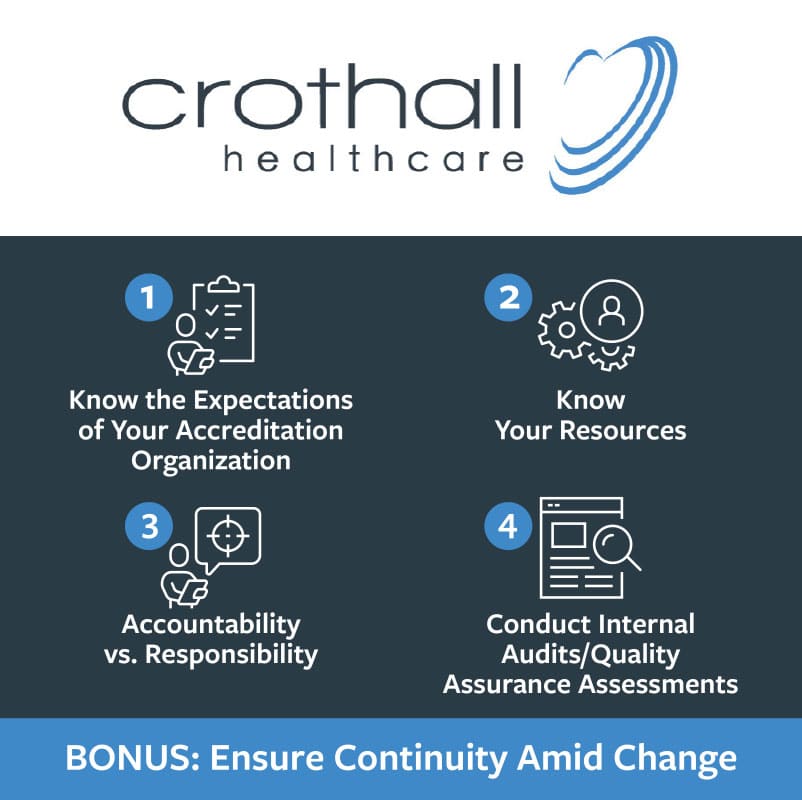
Here are four recommendations that can help you prepare for your next accreditation survey:
Know the Expectations of Your Accreditation Organization
It is essential not only to identify the key Accreditation Organizations governing your Medical Equipment Management program but also to understand the emphases and expectations of each accrediting body and its surveyors. Deemed status organizations such as DNV and The Joint Commission (TJC), in addition to addressing CMS “conditions of participation” also have unique focal points and criteria that they use to measure compliance.
The Joint Commission, which accredits over 4,000 hospitals, has emphasized infection control in recent years, closely linking it to the environment of care and the quality of medical equipment performance and maintenance. This highlights the importance of not just meeting the baseline requirements, but also prioritizing areas of heightened scrutiny.
Understanding an AO’s expectations enables you to proactively address areas of concern. This involves tailoring your internal audits and compliance checks to anticipate these areas of interest, thereby enhancing your preparedness, and ensuring that your facilities meet both the letter and the spirit of the standards. This strategic approach allows you to prepare thoroughly for inspections and address issues before they arise during accreditation surveys. Ultimately, this leads to better compliance outcomes and smoother accreditation processes, ensuring that your facility meets the highest standards of care and safety.
We’ve found in recent surveys that they also focus on the accuracy of the medical equipment inventory including the number and percentage of medical devices designated as “Unable to Locate.” They also focused on scheduled maintenance completion rates for High-Risk devices, Alternate Equipment Management (AEM) devices, Alternate Equipment Management Exempt (AEM-E) devices, and the qualifications and competency of HTM personnel.
Know Your Resources
HTM departments need to understand and be able to interpret all the information in their Computerized Maintenance Management System (CMMS). Surveyors will ask HTM staff to run reports covering a wide variety of topics, such as their inventory of key pieces of medical equipment.
Staff must be ready to discuss the details of their Medical Equipment Management Program (MEMP) and the related policies, procedures, work instructions, and program processes. We have found surveyors will ask HTM staff to explain the details of specific program processes, such as AEM methodology risk assessment and even the cybersecurity measures used to protect key medical equipment.
Just as important as providing documentation, hospitals need to demonstrate the safety and effectiveness of their MEMP. The surveyors will want to know an HTM department’s goals, objectives, and performance improvement initiatives; whether they are meeting those criteria, and how they measure success. In effect, you will need to provide a comprehensive explanation with objective evidence of the entire Medical Equipment Management Program.
Accountability vs. Responsibility
Do you know the difference? Hospital staff must also work with their healthcare technology management partners before the survey to delineate certain responsibilities for key elements of the MEMP. Some AO medical equipment management standards may be out of the HTM department’s direct control and managed and documented by other departments.
For example, some HTM departments may be responsible for maintaining dialysis equipment while not necessarily responsible for managing the RO system and conducting the requisite biological/chemical water testing. However, they are still held accountable for these tests being performed under the medical equipment management standard. Therefore, it is important to know who and which entity within the facility is ultimately responsible for managing, conducting, and documenting these tests to remain compliant.
To ensure a smooth survey process, both the hospital and the HTM department need to collaborate and clearly understand which party is responsible for each activity under the medical equipment management standards. Knowing who your resources are and where they can be found enables you to provide accurate and confident responses to surveyor questions. Instead of saying “I’m not sure,” you can confidently state, “I will consult with [name] in our [department] and provide you with an answer promptly.”
Conduct Internal Audits/Quality Assurance Assessments
The best way to prepare for a survey is to never stop preparing for a survey. Be survey-ready every day. There’s no better way to prepare than by conducting an honest assessment of your medical equipment management program and identifying any potential gaps. As part of this exercise, an HTM department should assess the following Medical Equipment Management Program elements (among others):
- Inventory accuracy including the ability to readily identify HR, AEM, AEM-E equipment
- Staff qualifications and technical competency
- Properly documented maintenance activities
- Staff understanding of the MEMP
- All AO-specific MEMP standards and requirements have been addressed in your MEMP and associated policies/procedures
- Routine evaluation of MEMP safety and effectiveness
- Monitor and communicate AO standard changes
After your assessment, it is essential to review the results and create an action plan that details the key focus areas scrutinized during the assessment. This action plan should offer an evaluation of the findings, identify areas where compliance was achieved as well as where it fell short, and propose actionable recommendations for improvement. By systematically addressing each critical aspect of the survey, the action plan serves as a valuable tool for ongoing quality assurance and helps to ensure continuous alignment with accreditation standards.
BONUS: Ensure Continuity Amid Change
To effectively prepare for an inspection in the HTM department, especially considering the anticipated retirement of seasoned staff, it’s essential to implement a comprehensive knowledge transfer and succession planning program. By pairing experienced engineers with emerging talents through mentorship or formal training initiatives, your HTM department can preserve invaluable institutional knowledge and technical expertise. This strategy not only facilitates a smooth transition of responsibilities but also signals to TJC and other deemed status AOs your commitment to maintaining excellence and operational stability, regardless of staff turnover. This proactive approach ensures that the department remains well-equipped to meet rigorous standards, safeguarding its readiness for any AO scrutiny.
Effectively preparing for an accreditation survey requires a multifaceted approach that encompasses understanding the expectations of your accreditation organization, being aware of your resources, clearly delineating accountability from responsibility, conducting Quality Assurance Assessments, and ensuring continuity amid change. By integrating these strategies, organizations can navigate the complexities of accreditation compliance with confidence and precision. This comprehensive preparation not only enhances the likelihood of a successful accreditation outcome but also strengthens the overall operational integrity and resilience of the organization in the face of ongoing changes and challenges.
For those seeking additional support, feel free to contact me at Richard.Eliason@Crothall.com. For more information about Crothall Healthcare, visit our website at Crothall.com.
