



By K. Richard Douglas
People often decide early that they want to be a biologist, a teacher, a nurse, a firefighter or enter the military. This is a decision that many make in high school and the occupation is one they are familiar with.
But how many young people think; “I’m going to be a biomedical technician?” or “I’m going to be a clinical engineer?” Very few consider these options because few high school students have heard of these careers.
As a procession of aging biomeds exit the field, the need to fill vacancies requires a proactive approach. The need for experienced and well-trained HTM professionals is a constant.
It’s not just that high school students aren’t asking the question “What is a biomed?” They don’t even know to ask the question. Unless the field enters their tangential knowledge at some point, they remain as unaware as the general public. This presents a challenge to those tasked with staffing biomed departments and independent service organizations as well as OEM service teams.
The same challenge goes for introducing the field to those who have completed some core requirements in a junior or community college. At the point of making a career decision, how do these students know to consider HTM? For those in the most advanced HTM educational programs; how do they learn networking and soft skills?
Thankfully, there are those within HTM who are working to promote and grow the field and expand its visibility to potential future candidates. Also, there are individuals providing the newer biomeds and biomed students a leg up by teaching them valuable skills to ensure success.
Packaging the Perfect Message
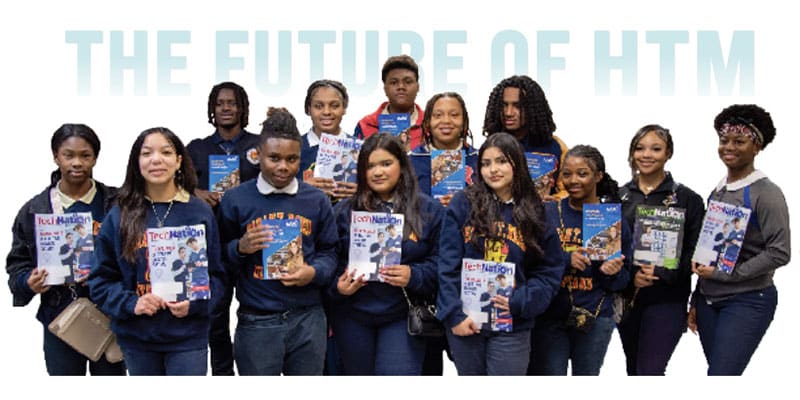
With future biomeds scattered among thousands of high schools, technical schools and colleges, the opportunity for those in HTM to reach out and influence someone is great. This may be easier said than done. However, AAMI created a tool to assist biomeds in spreading the word.
“HTM in a Box was developed as a strategic response to the growing workforce shortage in the HTM field, especially as a large portion of the current workforce nears retirement. As part of AAMI’s broader goal to support the HTM personnel pipeline, this initiative was created to make it easier for HTM professionals to actively promote their field without the added burden of building their own presentation materials,” says Danielle McGeary, CHTM, PMP, vice president, HTM at AAMI.
The idea behind HTM in a Box is to offer a pre-packaged presentation to allow HTM professionals, and others, to present the field in a concise and positive way. It provides the choice of three HTM career presentations, designed around the age group of the audience.
“The concept was designed in collaboration with a small project team from the Technology Management Council (TMC). The goal was to create a virtual, easy-to-access set of tools that would empower HTM professionals to conduct outreach across multiple age groups – whether at a local middle school career day or a college fair for students exploring health technology careers,” McGeary says.
She says that the Prezi-based presentation is segmented into three distinct tracts: middle school, high school and college and beyond (which also covers adults and career changers). Each track conveys the same core message: what HTM is, why it matters, and what a career in the field looks like. Each presentation is customized in tone, language and visual design to match the audience:
“Middle school presentations are simple, visually engaging, and designed to spark curiosity. They emphasize the cool factor of technology and the idea of helping others. High school presentations are more focused on career paths, education options, and job stability – providing a more concrete vision of how to enter the field. College and beyond presentations are built for technical audiences (like biomedical engineering or IT students) and adult learners. These presentations include information on certifications, career ladders and real-world roles like BMETs and clinical engineers,” McGeary says.
She says that each section is flexible as presenters can adapt talking points and choose to spend more time on slides that resonate with their specific audience (e.g., BMETs for community college students, clinical engineering for biomedical engineering majors).
McGeary says that the tool is particularly effective for career days at schools, community or STEM events, college classroom presentations and career fairs and community organizations.
 Utilizing YouTube to Reach a Bigger Audience
For more than six years, HTM professional Justin Barbour, CBET, has produced content for “The Better Biomed Channel,” a YouTube channel with more than 1,100 videos that promote the biomed profession, technical skills, events, tools and many other topics.
When creating biomed content over the Internet, the content creator doesn’t always know who their content is reaching. Yet, through Barbour’s efforts, he has heard back from prospective biomed students considering the field and others.
“I receive one to two emails weekly from people sharing their stories. I love hearing stories because everyone’s story is different. I met a guy in San Antonio who used to repair cellphones in Chicago. He watched a video I did with Louis Rossmann and became curious about this career. He moved to San Antonio and became a biomed. He’s doing pretty good now,” Barbour says.
He says that another story sticks with him on this topic.
“A person wrote me when they were graduating with their four-year degree in biomedical engineering. They heard about the career in one of my videos and wanted to reach out to thank me for the introduction. The completion of a four-year degree made me realize how long I’ve been doing videos,” Barbour adds.
Barbour is aware of the various audiences his videos reach.
“The coolest thing about Google owning YouTube is that they keep stats on everything. I can see viewer age, gender, geographic location, etcetera, and I can see trends over time. Since the start of the Better Biomed channel, I’ve had a majority of viewership of younger people. It makes sense. They relate directly to technology and are most likely to be invested into tech careers. I always meetup with younger techs at events, and they’ll always have my time,” he says.
Barbour says that one of the demographics he was not expecting was the female technician audience.
“Over the years, I’ve seen an upward trend from 1.5 percent to now almost 10 percent viewership, which tracks directly with attendance that I’ve witnessed at biomed training programs around the country,” he says.
Barbour truly believes that “people buy into what they relate to.”
“If younger people relate to technology, then they are certainly going to use tech to help them make decisions on critical life choices like careers. We need to meet the new audience on their terms. I have even changed some of my content to relate more directly to the new viewers: short form content being recorded in portrait mode rather than long form in landscape,” he says.
He says that there are many technical people around the world who might be in dead-end jobs – like an electrical engineering graduate repairing cellphones for $28/hour.
“We need to continue to be ambassadors for this career to all potential candidates,” Barbour adds.
When not producing content, Barbour is the director of business development for BC Group International.
Reaching the Next Generation
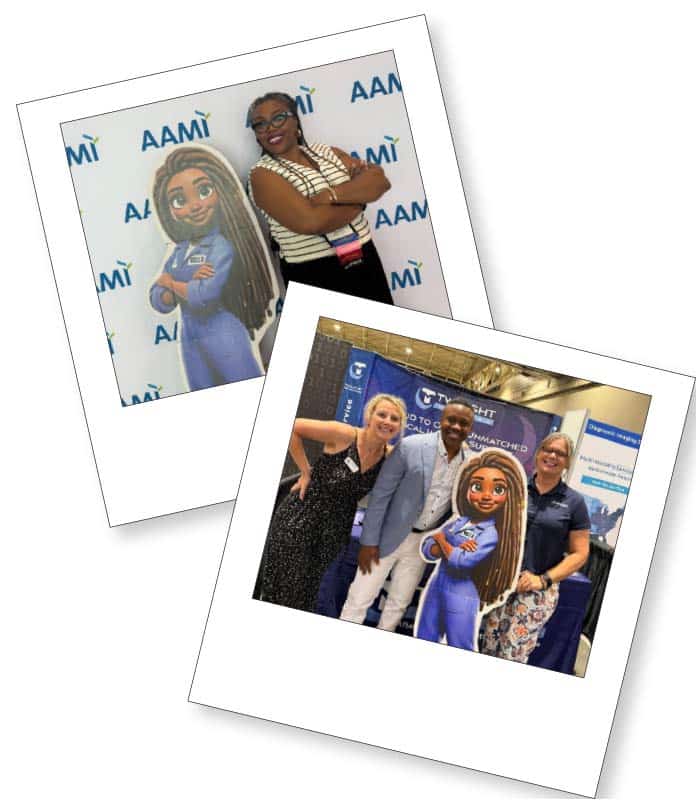
A kid’s book about a fictional biomed has reached an even wider audience of teens and adults who have learned about the HTM profession. That has been the experience of author; Jennifer Chester, BMET III. Chester wrote the book “Bella and the Big Fix Biomeds: Wired for Greatness.” She is also the author of “Bella the BMET’s Adventure in Healthcare Technology,” “Bella’s Big Fix: The Story of a Smart Girl and Her Tools” and “Big Ben and the Heart of New Orleans.”
“Storytelling is one of the most powerful tools we have, especially when it comes to educating and inspiring the next generation. With Bella the BMET, I’ve found a way to make the world of healthcare technology management (HTM) approachable, fun, and relatable. Bella allows us to tell real stories from our field in a way that resonates with children and adults. It’s not just about fixing equipment; it’s about showing the heart behind the work we do,” Chester says.
Chester’s Bella character has gained traction in several age groups beyond grade schoolers.
“What’s been most surprising, and incredibly rewarding, is how many adults have shared that they learned about the biomed field for the first time through Bella. Parents, educators, and even clinicians have told me, ‘I had no idea what a biomed was until I read this book to my child.’ That ripple effect has extended into high schools and colleges too, sparking conversations about career paths in HTM that wouldn’t have happened otherwise. The reach has gone far beyond what I ever imagined,” she says.
In addition to her books, Chester takes the HTM profession directly to the public in an engaging way.
“Promoting HTM is at the heart of everything I do with my Mobile Discovery Museum. Bella and the Big Fix Biomeds have become the official mascots of the experience. We’ve taken the museum into schools, summer camps, and even onto the expo floor at AAMI, where kids and adults alike get hands-on with the tools and tech that keep hospitals running,” she says.
She says that while she is not necessarily adding more medical devices, she has started weaving BMET storytelling into the exhibits to reinforce problem-solving and critical thinking.
“For example, I redesigned our Indi robot game to mirror the way a biomed might travel through a hospital to troubleshoot equipment, turning coding and decision-making into a narrative kids can understand and apply. This fall, I’ll also be giving a keynote and book reading at the LEAD Girls event in North Carolina. Just one of many opportunities to share the magic of biomed through storytelling,” Chester adds.
 HTM Advocate Launches Nonprofit
Site Manager Bryant Hawkins Sr., not to be confused with TechNation 40 Under 40 honoree Bryant Hawkins Jr., is an advocate for HTM via his LinkedIn page, HTM on the Line podcasts and the Elevate HTM program.
Hawkins said the official mission statement for is: “Elevate HTM exists to educate, inspire, and empower the next generation of HTM professionals. We introduce students, especially in underserved communities, to careers in healthcare technology management through classroom visits, media, mentorship and hands-on exposure. At the same time, we uplift HTM professionals by reminding them that their work matters.”
“Elevate HTM’s vision is bold, it’s to ensure that every young person, especially those in underserved communities, is aware of healthcare technology management and sees it as a pathway to purpose, stability and impact,” he adds. “The organization’s work goes far beyond just exposing kids to the HTM industry, it’s about transforming lives through exposure, opportunity and mentorship. Every classroom visit, career day and conversation is a chance to spark curiosity, plant seeds of possibility and help the next generation discover a career they can be proud of.”
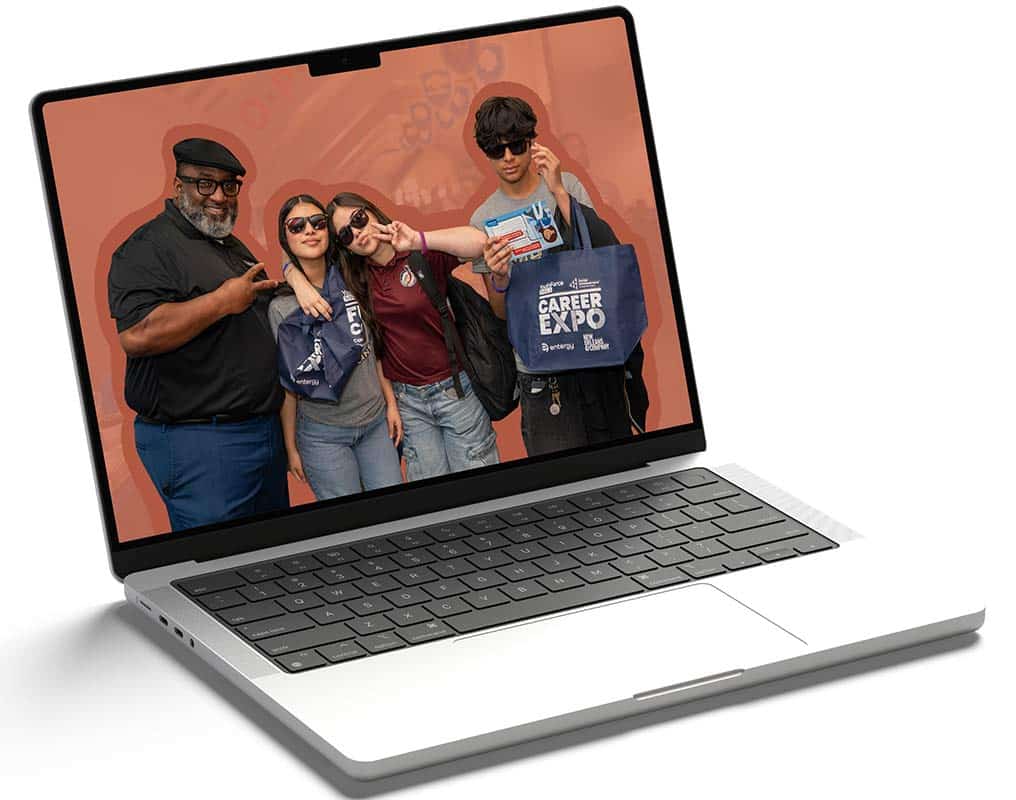
This mission is already moving nationwide. Elevate HTM has reached students in Florida, North Carolina, New York and California, with a goal of impacting 3,000 students in Louisiana and another 1,000 across the country. The team has grown from one person to 12 members in seven different states, making it the only nonprofit in the United States specifically targeting young people to bring awareness to the HTM industry.
The expansion plans are ambitious. In October 2025, Elevate HTM will launch NextGen Pathways, a podcast designed for youth, co-hosted by an HTM professional and a schoolteacher. It will highlight lesser-known healthcare careers, with HTM leading the conversation. Spring 2026 will see the release of the Elevate HTM app, connecting students, parents and teachers to career exploration resources. In fall 2026, though possibly sooner, the Elevate HTM Online Academy will launch as a virtual career exploration platform, delivering engaging, real-world HTM content to middle and high school students nationwide. Monthly motivational videos will also be produced to inspire and encourage students to envision a brighter future.
“Elevate HTM exists to not only create awareness but to build a lasting pipeline of leaders who will protect patients, advance healthcare, and carry this profession forward. The work is growing louder, bigger and farther than ever, and it’s only just getting started,” Hawkins says.
The mission reflects how a chance decision continues to provide positive impact.
“After graduating high school in 1990, I didn’t have a plan. No blueprint. No clear next step. I just knew I needed to do something. I grabbed a college catalog from Delgado Community College in New Orleans, closed my eyes, and pointed. My finger landed on ‘Biomedical Equipment Technology.’ No big strategy. No dream I’d been chasing since childhood. So, I actually happened upon the biomed industry,” Hawkins explains.
His career inspires him to be an advocate for the HTM field.
“It’s simple, this work changes lives. Early in my career, I was repairing dialysis machines when it hit me, this wasn’t just about fixing equipment. This was about keeping people alive,” Hawkins says. “That moment flipped a switch for me.”
“Over the years, I’ve seen how critical HTM professionals are to healthcare, yet most people don’t even know we exist,” he says. “We’re the invisible force that makes patient care possible, and I’ve made it my mission to change that. I know firsthand that young people, especially in communities like the one I grew up in, rarely hear about this career. I found it by chance, and I want the next generation to find it on purpose.”
When asked if he wanted to add anything, Hawkins said, “I’ve met so many great people in this industry and I keep meeting more. I’m far from a perfect HTM professional, but I love what I do, despite the ups and downs that come with it. I found HTM by accident, and now my life’s work is making sure the next generation finds it on purpose. This field gave me a career, a mission and a legacy. HTM is a gift that keeps on giving, and it can do the same for thousands of young people who’ve never even heard of it. Elevate HTM isn’t just about me or my team, it’s about every student who is one introduction away from discovering a career that changes their life and the lives of the patients they’ll one day serve. Together, we can make HTM impossible to ignore.”
For information or to volunteer, email info@elevatehtm.com. Elevate HTM is also interested adding corporate sponsors to support this one-of-a-kind mission to bring nationwide awareness to the HTM industry.
Guidance for Master’s Level HTM
Once students are beyond the orientation process and have committed to the HTM profession as a career, there is still much to know, even at the graduate level. Internships are an integral component for those entering the field to get hands-on knowledge while picking up key traits for a successful career. This includes getting the most out of HTM conferences.
At the University of Connecticut, interns receive pointers that go beyond their textbooks and labs via a program for students enrolled in the Master of Science in Biomedical Engineering (MSBME) degree program.
“The internships are integral to the UCONN CE Internship program. This program is 40-plus years old and was designed by hospital clinical engineering leaders who wanted/needed to develop a pipeline of clinical engineering talent. The original design assumed that students would augment their academic studies with related work assignments at the founding hospitals. Therefore, all interns accepted into the program are assigned to a hospital for the four academic semesters and the intervening summer as a condition of completion,” says Carol Davis-Smith, MS, CCE, FACCE, AAMIF, operations director of the Clinical Engineering Internship Program at the University of Connecticut’s College of Engineering and president of Carol Davis-Smith & Associates LLC.
She says that the interns obtain real world experience since they are assigned to real world problems with real world responsibilities at their host health system.
“The UCONN adjunct faculty – all of whom are still working in the field – have gone to great efforts to ensure the course content aligns well with the typical internship experience, so interns learn the theory and then ‘do it’ at the hospitals,” Davis-Smith says.
Students also get a leg-up by way of some guidance Davis-Smith has provided taking advantage of opportunities through professional conferences.
“Each academic semester, I convene the University of Connecticut Clinical Engineering (UCONN CE) interns for CE Week. During this time together, I provide the interns with extracurricular learning – i.e., concepts that are not covered in their academic courses and not likely explained during their working internship,” she says.
Davis-Smith says that last fall, she had the opportunity to align CE Week with the MD Expo New England conference.
“We only had one day together as a group before the conference, so I decided the extracurricular learning should focus on how to get the most out of attending the conference. The first component required the interns to register for the conference, which included selecting the educational sessions they wanted to attend. During CE Week, I lined the meeting room with posters with the title of each session and the interns indicated their choices with sticky dots,” Davis-Smith says.
She then facilitated a discussion where the interns described what they thought each session would be about – because the descriptions aren’t always clear – and why the interns made their choices.
“In the end, several interns changed their choices based on the discussions. I explained that this happens frequently in real-time at conferences when we engage in conversations with other attendees – aka, a networking benefit,” Davis-Smith adds.
She says that the second component required the interns to participate in the MD Expo exhibit hall BINGO game.
“This resulted in them visiting most, if not all the vendor booths, and learning about the products and services. I know they participated because several of the interns won prizes! The New England-based interns may have derived the most benefit from this exercise because many vendors staff their booths with local sales and service representatives. Consequently, the New England-based interns had the opportunity to meet their local vendors and begin building relationships. Other interns benefited from the exercise because I saw them interacting in the exhibit hall of the MD Expo SoCal conference,” Davis-Smith says.
She also provides the students with the resources and opportunities to enrich their soft skills.
“One of their first assignments is a LinkedIn learning module about critical thinking. The objective is to learn what questions to ask, when to ask them, and who they should be asking before drawing conclusions. This prepares them for the 40 clinical rotations they will complete over their four academic semesters,” Davis-Smith says.
She says that the rotations require them to schedule time away from their internship work with clinical users to observe them using the medical devices and systems with patients.
“The interns are expected to ask questions, so they understand the clinical workflows, why and how the technology is used, what the clinical user likes/dislikes about the technology, etcetera. Each month, the interns submit their logbooks with their observations. I grade not only the content but also spelling and grammar,” Davis-Smith adds.
From grade school through graduate programs, the message of the HTM profession, as well as skills to succeed in the profession, are communicated in resourceful ways to inform the youngest future biomeds to the most advanced masters-level recruits. The platforms and methods used all benefit the profession and those entering the field. Thankfully, there are those who have taken the initiative to take on this mission.
