



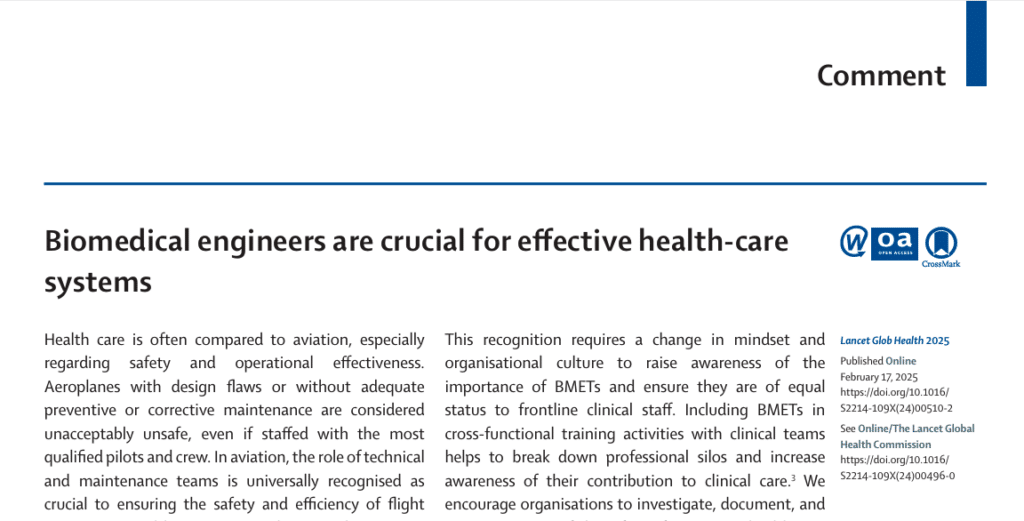
A new report on The Lancet Global Health webpage states that “Biomedical engineers are crucial for effective health-care systems.”
The Show Outline states:
“Health care is often compared to aviation, especially regarding safety and operational effectiveness. Aeroplanes with design flaws or without adequate preventive or corrective maintenance are considered unacceptably unsafe, even if staffed with the most qualified pilots and crew. In aviation, the role of technical and maintenance teams is universally recognised as crucial to ensuring the safety and efficiency of flight operations. Health-care systems, however, have yet to fully appreciate the pivotal contributions of biomedical engineering professionals towards delivering high-quality and safe patient care.
We agree with the Lancet Global Health Commission on medical oxygen security1 that there is a crucial shortage of qualified biomedical engineers and technicians (BMETs) and that these professionals often do not have the necessary status, tools, and resources required to perform effectively. Although the COVID-19 pandemic exposed the severe consequences of this oversight on the reliability of global oxygen systems, the impact extends to all health-care areas that depend on technology. We argue that there can be no truly effective health-care system without BMETs, who have a crucial role in every part of the lifecycle of medical technologies. We urge WHO, governments, ministries of health, and funders to implement our five recommendations that will strengthen the biomedical engineering profession to enable better preparedness for anticipated and unforeseen global health emergencies, among other benefits (panel): (1) recognise BMETs for their expertise in the effective provision of health-care services, including their role in each essential phase of the medical technology lifecycle; (2) ensure professional development of BMETs to meet the global shortage; (3) ensure representation of BMETs at the highest level of decision making (eg, ministries of health and health-care facilities); (4) develop and implement strong national health technology management policies that include human resource ratios for BMETs; and (5) commit to donation policies that require sufficient resources to sustain operation of medical equipment.”
Read more here.
