



Registered nurse, public speaker and author Donna Wilk Cardillo once said: “Nursing is not for everyone. It takes a very strong, intelligent, and compassionate person to take on the ills of the world with passion and purpose and work to maintain the health and well being of the planet. No wonder we’re exhausted at the end of the day.”
There are 2.9 million registered nurses nationwide and nursing makes up the largest health care profession in the U.S. Nursing is a profession that also requires critical thinking skills and the role of the nurse has evolved with the changing face of health care.
 From Joyce Slinsky to Mary Todd Lincoln to Florence Nightingale, nurses have been a part of American and world history, offering caring and compassionate treatment to patients in diverse settings. As one of the primary users of medical equipment, nurses inherit a unique dynamic with HTM professionals. The two occupations are vastly different but share the same common goal of providing good outcomes for patients. The primary touch point though is the equipment that biomeds fix and maintain and that nurses rely on to do their jobs.
Because of the mandatory interaction and the close proximity that the two professions work in, it is critical that they respect and cooperate with each other, with continuous dialogue as a goal and necessity. Cultivating a close working relation with all clinical staff demonstrates to those colleagues the value of the biomeds as more than repair people.
Just as HTM professionals have faced an environment that has moved toward more complex technology, nursing has evolved within an increasingly complex health care environment to require more education. As reported in the Wall Street Journal, nurses are finding that more education is a requirement of employment. The WSJ reports that part of this is because the number of “nursing programs of all kinds jumped 41 percent” between 2002 and 2012 in response to an anticipated shortfall of nurses.
Still, many hospitals have patient-to-nurse ratios that reflect understaffing in an era of belt-tightening. This impacts quality of care and makes each nurse’s job more difficult. The profession seems to be cyclical in the numbers of graduating nurses and a shortage of instructors is a recurring problem.
In this environment, where nurses are entering the profession with more education and skills, it becomes incumbent upon HTM professionals to continue that education as it relates to the proper handling and use of medical devices.
One problem that vexes nurses and the HTM profession is quickly advancing technology. This includes more complex medical instrumentation and the reality that full interoperability is a ways off yet. When devices can’t talk to the EHR, nurses are faced with more work. Nurses report that they already spend at least an hour of each shift dealing with medical devices, according to a Harris Poll. Alarm fatigue and troubleshooting make the nurse’s job more difficult and frequently requires the intervention of a biomed.
Two-way Street
Rounding is an important way for biomeds and nurses to share information. Communication and the ability to listen to the nurses’ needs was revealed in an AAMI News article as the quality that nurses look for most in an HTM professional.

According to the article, there are several ways that the HTM department can build stronger relationships with nurses. Some of the suggestions included publicizing your team, listening first, speaking the same language, attending clinical meetings and involving the nursing staff in purchasing decisions. Another suggestion was to do rounds.
“One of the most important tasks biomeds have is daily rounding. Rounding provides biomeds the ability to interact with nurses and other clinicians without entirely focusing on broken equipment,” says Jason Misner, CBET, biomedical supervisor for ARAMARK Healthcare Technologies in Albany, Georgia.
“Daily rounding allows the building [of] personal relationships with nurses and other clinicians, which helps everyone when dealing with medical equipment related problems,” Misner says. “When patients and family members see strong relationships between nursing, clinicians and biomeds, the patient and family members feel more at ease and have better satisfaction.”
Nurses agree that this is a beneficial activity, although they may see it from a more “welcome to my world” vantage point.
“Biomeds rounding with nurses allows them to see the equipment they work with in real world, patient situations. It’s easier for the biomed to then understand the abundance of technology nurses deal with daily; the distraction that occurs from nuisance alarms; the frustration staff deal with when equipment doesn’t function as expected, etcetera,” says Maria Cvach DNP, RN, FAAN, Assistant Director of Nursing, Clinical Standards, at The Johns Hopkins Hospital.
“Biomeds make rounds and check in daily with the charge nurse to see if there are issues that need to be addressed,” she adds.
Biomeds Empower Nurses
HTM professionals know that they can aid their nurse colleagues, but it requires a regular dialogue.
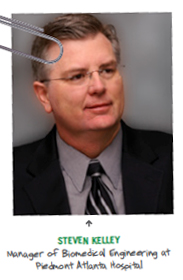
“We hold safety huddles every day. Biomed is a part of this and discusses issues each day. I listen to issues in the patient care areas and jump in to assist when appropriate,” says Steven Kelley, manager of biomedical engineering at Piedmont Atlanta Hospital.
“One big issue is that the nurses do not always know what Biomed does and what we can assist with. Rounding on each unit on a regular basis allows us to communicate this to the nurses and gives them a way to share what is not working back with us. This is a very important process,” Kelley says.
Misner says that rounding allows for the expression of concerns by nurses that the nurse may not think rises to the importance of a service call.
“These concerns are perfect opportunities to teach and bond. It is the greatest compliment when a department requests you by name for their equipment issues,” he says.
“I have been on rounds and found that there was an intermittent signal coverage in telemetry,” Misner says. “I found that one of the floors communication closet UPS was powered off. I also was told that this issue had been going on for about 12 hours. I used this opportunity to train the telemetry staff. They understand now [that] even if they are having an intermittent issue, it is better to call biomed than not.”
The working relationship that biomeds and nurses can express through rounding may play out to a bigger audience as well. From the nurses’ perspective, knowing what their world looks like is a recurring and important theme.
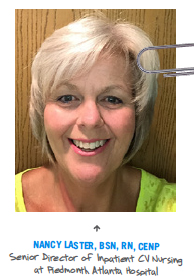
“By rounding together, a unified front is presented to the staff and patients. This promotes a culture of collaboration,” says Nancy Laster, BSN, RN, CENP, senior director of Inpatient CV Nursing at Piedmont Atlanta Hospital.
“The rounding also helps to understand that perspective of the staff that are actually using the processes that are put into place. A couple of weeks ago, I rounded with the head of our Biomed Department to assess the equipment needs and process of the units,” Laster says.
“Both of our perceptions were different from what the staff actually did in the clinical areas. This rounding revealed areas for education and improvement of processes. If the clinicians are able to spend more time with patients, and less time looking for equipment that is needed everyone is happier and safer,” she adds.
There are times when interactions between HTM and nurses benefit the biomed and others where the nurses glean some important information.
“We have a demo lab which includes the basic equipment that is used on units such as monitors, ventilators, and the nurse call system,” Cvach says.
She explains that nurses benefit from testing patient scenarios in the demo lab. Recently, some changes were made to the monitors which caused an unintended change in the display screen.
“Working in the demo lab, we were able to play with default settings until we got the monitor screens to function most effectively,” she says. “Our biomed used this opportunity to teach us about the different options for the display screen and explained some of the default settings. This is much more effective than trying to read the operators manual which is not user friendly for nurses.”
Open Lines of Communication
Using the right approach with nurses and other clinicians may include the way things are said. Also, making time for shared in-service training can be helpful.
“Anytime I repair or determine why equipment is not working the way it should be working, I make sure I communicate with as many users as possible,” Misner says. “What I found and what may have been done different is anything to prevent the issue again. I have found that the majority of people appreciate any information to prevent downtime of equipment. It is very important not to blame or embarrass the end user, if it is found out it is a user error.”
“We have identified common issues with beds and sent out a troubleshooting guide for them to check before they send the bed down for repair,” Kelley says. “We do continuous training in OR to make them aware of common issues like putting items on the base of the OR tables and then they get crushed when the table is lowered. We worked with the OR staff to identify a better process of where to put the equipment and to do a stop and check before lowering the table.”
Structured training time benefits both groups on many levels, according to Misner.
“Another way I have found we can empower nurses with troubleshooting information to reduce down-time is sitting in on as many in-service training side-by-side with nurses,” he says. “This provides relationship building and mutual respect for all. I have found during in-service training you can learn so much from one another. You can learn what concerns nursing has with new technology and what they need help with to do their jobs. You also have the ability to ask questions that nurses may not ask and will help them use and treat the equipment better.”
Kelley points out that biomeds need to be more than just the fix-it guys for the equipment.
“We need to show that we can assist in a lot of other areas around patient care support by taking on concerns and issues they are having that we can assist with,” he says.
“It might be an issue with power cables from the equipment causing a trip hazard. Or mounting a vital signs monitor on a workstation on wheels so they only have to push one device into a room instead of two,” Kelley says.
Kelley also says that biomeds might conduct training on equipment tracking systems so they can better manage and find their equipment and save time.
Nurses appreciate having the troubleshooting knowledge.
“Knowledge is power. If a nurse or clinician, at the point of care can troubleshoot equipment, it gives them the power to move on with the task at hand,” Laster says. “Clinicians at the bedside do not want to take on the duties of a biomed tech, but troubleshooting allows them to see if there is a simple fix. If it is a simple fix, it allows the flow of work to continue.”
The gist of every insight on this topic leads back to communication and mutual respect. As is the case in every profession, there is a need for cooperation and coexistence between people with widely varying backgrounds and skill sets. Listening and learning benefit both groups.
Misner says HTM professionals can benefit from good relationships with their nursing colleagues.
“Every interaction with nursing is an opportunity to learn. Even if we learn terminology, protocols or just their expectations. Knowing nurses’ terminology helps communication between biomed and nursing. Understanding nursing protocols and expectations allows the biomed department to be more efficient in supporting the nursing and clinical staff,” Misner says.
Kelley agrees that both professions and patients benefit from a quality working relationship.
“As biomed better understands the needs and issues of the nurse’s daily routine, we can make adjustments to our process to make everyone’s day better,” Kelley adds.
And therein lies the two-way street that benefits each professions. Walking a mile in the shoes of a colleague in a very different occupation can prove to be mutually beneficial. While nurses are the customers of biomeds; biomeds and nurses have the same mutual customers.
“I believe we are at the beginning of working together to define processes and structure in our hospital. It is very important to learn from other disciplines. It is very surprising to see what someone has observed from a different perspective,” Laster says.
“Hospitals across the country are moving from a culture of silos to an integrated machine that works for the common goal of patient outcomes,” Laster adds. “We have always worked toward patient outcomes, but not always in unison.”
