



By K. Richard Douglas
Some brands have become so famous for their products or services that they invite additional scrutiny. Apple is expected to offer something newer and better every year at their Worldwide Developers Conference (WWDC) event. Bentley and Porsche are always expected to wow auto enthusiasts with their latest models. Anything less would invite criticism.
Being very good at what you do can be a double-edged sword. HTM is known as a service-focused department. Customers can be certain that the biomed department will make things right. The other impact of that service-focus is that the biomed department can become a dumping ground for equipment that is not always its responsibility.
Many gray area devices or pieces of equipment may end up getting routed to the biomed department that aren’t necessarily within the department’s purview. Often, the determining factor is staffing. Who has the resources to handle the equipment in question may be enough to funnel it to HTM.
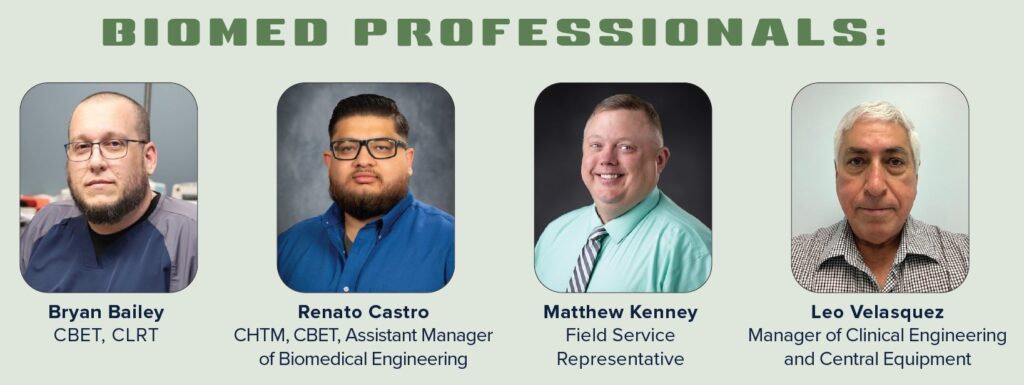
“Throughout the country there is equipment that is [in] gray areas on whether they are managed by the HTM department or not. Some examples are nurse-call, beds/stretchers, sterilizers, software, lab equipment and imaging. These items are [in] gray areas since some organizations have this equipment managed by the HTM department or other departments (Engineering, Facilities, Sterile Processing, IT, Imaging, Lab). As with the non-medical devices, when an HTM department proves efficacy, they may be asked to take over the management of these gray area items from another department,” says Renato Castro, CHTM, CBET, assistant manager of biomedical engineering at Stanford Health Care Tri-Valley in Pleasanton, California.
He says that this is great news in that the HTM department is being looked at to provide great service. This should, however, be taken cautiously. Occasionally these extra responsibilities are added slowly without extra resources being provided to the department, which increases the load on each member of the HTM department.
“During my time with third-party organizations, this is referred to as ‘scope creep,’” Castro says.
Leo Velasquez, manager of clinical engineering and central equipment at Cook Children’s in Fort Worth, Texas says that when he first started at Cook Children’s Medical Center, he was a little surprised to see some of the non-traditional equipment that had fallen under the purview of the biomed equipment techs there.
“Not only were they taking care of the gray area items of nurse calls, hospital cribs, stretchers and beds, but also non-traditional items of microwaves, video games, VR and 3D printing. These items did seem to gravitate towards the HTM department because we had a group that had an electro-mechanical aptitude that could be adapted to these jobs,” Velasquez says.
He says that the department’s director, Sal Cruz, came from a military background where a great deal of emphasis was placed on self-sufficiency, so doing whatever was necessary, came naturally.
“Our director, was also never one to miss an opportunity to advocate for the team so he would not only tackle these untraditional jobs but would fully embrace them to bring them to a high level of service,” Velasquez says.
He adds that, generally, with this accomplished, the necessary resources needed to absorb these activities would become available. The functioning benefits of smooth operation are apparent to our C-suite and clinical staff.
“Over the long term, this has resulted in a culture here that recognized the department as a key ingredient to smother operation and has helped the department go from eight techs to 18 now, and climbing,” Velasquez adds.
The emphasis on pleasing customers appears to be universal among HTM as the feedback on why biomed receives more than its share is consistent.
“Departments will call on the biomed department because they know that we are big on customer service and will try to assist wherever possible even if it is out of our scope,” Allison Woolford, CBET, biomedical equipment specialist in clinical engineering and periop team lead at Duke University Health System says.
She explains that biomed wants to minimize the impact on patient care. Sometimes, biomed departments are called to manage or repair these out-of-scope devices because the previous owning department encountered problems managing it (i.e. budget cuts, employees leaving the department).
She cites the nurse call system, replacing TVs in patient rooms (because the TV is controlled by the pillow speaker for the nurse call system), repairing the pneumatic tube system, replacing motors in the transfer units or blowers or repairing OR table patient positioners/stirrups/armboards, as just a few examples.
“Regulators for medical gas tanks – some devices need to use the big medical gas tanks when there is no pipeline gas hookups in the room. Normally these tanks are managed by Airgas or some similar company that delivers the medical gas tanks and when there is an issue with the regulator or the tank is empty, that company would replace the regulator and/or tank,” Woolford says.
She says that sometimes departments will call the biomed department even though they know that biomed doesn’t manage that device, but they know that they can get in contact with someone. She points to several examples of this: computers that the nurses use to access EPIC, digital clocks not working, room is either too hot or too cold, telephone is not working, door handle came off the door or someone is unable to open a file cabinet or a Pyxis machine because it is jammed.
“With biomed, we are tasked with the repair and maintenance of equipment used for diagnosis, treatment and care of patients. If we follow this, then technically everything in a hospital would fall under us, but we narrow it down even more than that because that’s a broad definition. Clearly defined roles are what is needed and all departments need to sit down and actually discuss what should go to each department,” says Bryan Bailey, CBET, CLRT.
Matthew Kenney, field service representative with Southeastern Biomedical Associates says that it’s always about showing your worth to the C-suite.
“Have open conversations with your senior leaders about the consequences of taking on more ‘additional items.’ Sometimes this could lead to more FTEs being allocated. Having these important conversations upfront will help lead to fewer headaches later,” he says.
Pushing Back
While it may be a compliment of sorts to have more devices entrusted to the biomed department, it can also create an unintentional burden or take time away from devices that are unarguably within biomed’s domain. How can the HTM department avoid being the dumping ground for these additional devices?
That answer can fall into two groups; medical and non-medical devices. For medical devices, there are some questions to ask.
“Before an HTM department accepts adding into their scope of work, a thorough evaluation of the resource drain and requirements of that ask should be completed. Is their team currently trained/qualified to work on that equipment? Do we need to purchase any licenses to work on the equipment? How many labor hours will be needed to be spent on this extra ask? Are there extra regulatory bodies that will need to be considered? How will funding work for support? Would this extra work stretch the current staff too thin?” Castro explains.
He says that all this information needs to be metricized to determine the required funding and FTEs to be successful.
“It is hard to say who should be owning some of these items because they could be considered grey area due to how they are viewed. The newer stretchers have scales on them and some will consider that device needs to be managed by biomed because that information may be added to the patient’s medical chart,” Woolford points out.
She says that sometimes biomed tries to clear the grey areas by saying that if the information for replacing an item can be found in the user/operator’s manual, then that part should be managed by the user.
“If it requires a tool, service password, or the information is found in the service manual, then those items are managed by the biomed department. An example of this would be the EKG leads for the EKG machine. EKG leads are plug and play cables that do not require a tool to replace. Staff maintaining this inventory and being able to replace these cables as they break will reduce down time,” Woolford says.
Kenney says that HTM leaders need to do their homework.
“Show the cost of maintaining the equipment. Include [the] costs of contracts, parts, labor and training. Sometimes it’s OK to tell the C-suite no. Don’t set your department up for failure. You need to make sure you get the buy-in from the techs too. Get their perspective. Make them part of the solution. Ultimately no one will fight for your department more than you. Come prepared. Another key is to ask fellow HTM colleagues for their advice with a particular piece of equipment maintenance. They may have experiences that you haven’t thought of yet,” he says.
Adequate staff & Funding
How does HTM obtain additional funding and resources to take on the repairs/maintenance of extra equipment?
“As far as funding and resources go, the people that determine if we need additional funding and resources need to understand the roles of those areas to make an informed decision. There needs to be a standard of equipment per tech and we need to make sure we are also hiring technicians with integrity. We need to make quality repairs and not quick repairs just to get the device back into service,” Bailey says.
For medical devices, Castro says that adding one extra modality to your department may only add a third of an full-time employee (FTE) worth of labor, but if this happens multiple times, your department may inadvertently add on multiple FTEs worth of labor without obtaining extra resources.
“This is how scope creep will affect a department’s workload. To avoid this, an HTM department needs to establish a baseline budget for their current scope of work. This includes, operational funds, FTE labor requirements and a capital budget to run. From here, whenever scope of work changes (either increased or decreased), the necessary budget needs to be documented and reported to upper leadership. This will help explain why extra staffing or budget may be required to finance,” he says.
Bailey adds that it’s hard for biomed to avoid being a dumping ground for additional maintenance items.
“What I feel is the best tactic is to work with Plant/Engineering and IT to define roles more clearly within a hospital or health system. This tends to be a problem because each department suffers the same problems of manpower and the proper equipment to do the job needed,” he says.
Drawing a Clear Line
Biomed must also draw a clear line when more non-medical devices are added to their inventory of equipment.
“When an HTM/biomed department develops a good rapport with their clinical counterparts, the departments start to see biomed as a one-stop shop solution center. This is great in that you have built confidence with the clinical teams, but it does occasionally come with out-of-scope requests,” Castro says.
He says that he has been in a couple shops where the biomed shop has been requested to work on more consumer-level electronics (i.e. TVs, microwaves, phones, radios, laptops).
“I find that most biomed techs love to help when possible. This leads to them assisting with these requests. Unfortunately, this will sometimes become a case of a favor becoming an obligation. Once certain staff are aware that biomed has helped with these, it will become their expectation that biomed continues to help,” Castro says.
He says that while it may go against the helpful nature of biomed teams, they must draw a clear line as to what we support and what we don’t.
“This usually starts with written language in the MEMP (Medical Equipment Management Plan) or general policy stating what equipment the HTM department supports. This will empower all members of the team to deny requests for out-of-scope equipment and allow management to backup this choice,” Castro adds.
The HTM department can be counted on to repair anything that is broken. That good reputation has to be tempered with some parameters when necessary to prevent HTM from reaching burn-out because it is stretched too thin with equipment it should not be responsible for. With some respectful push-back, funding and staffing requests and a clear delineation of responsibilities; everything can get fixed in a timely manner.
