



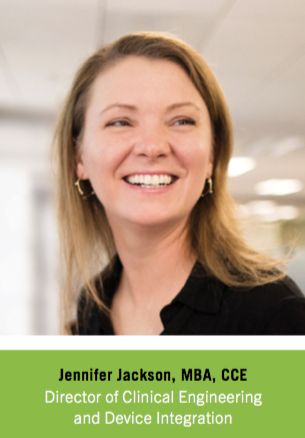
 The Professional of the Month for September is an award-winning biomed. Her work spans the IT and clinical engineering departments. Jennifer Jackson, MBA, CCE, is the director of Clinical Engineering and Device Integration within the department of Enterprise Information Services (EIS) at Cedars-Sinai Health System in Los Angeles.
Jackson was recognized with both the ACCE-HIMSS Excellence in Clinical Engineering and Information Technology Synergies Award for 2015 and the ACCE 2015 Professional Achievement in Technology Award.
“The recognition received from both awards, mostly for achievements in device integration, makes me incredibly proud of my team because they are awesome, smart, creative, and just great people to have in one’s life,” Jackson says. “It was also a great ‘win’ for Cedars-Sinai and our CIO, Darren Dworkin, who took a chance in not only bringing Clinical Engineering into the IT organization, but also adding the Device Integration component to it.”
“That combination has made us extremely efficient and led to the successful integration of several medical devices. It has also given the Clinical Engineering staff a unique professional growth path now that we do more IT-like application management and development, which few departments have yet,” Jackson says.
Before heading off to school, Jackson thought her course of study would lead to a medical degree. As she puts it; “I wanted to heal the sick, cure diseases, and otherwise make that positive contribution to society.”

A letter from Boston University redirected her path a bit by suggesting that, with her high scores in math and science on college entrance exams, combined with her interest in pursuing a career in medicine, she would be well served to choose biomedical engineering as a course of study.
“Most importantly, for a premed student looking to distinguish myself from the others, it noted how my medical school application would be that much more competitive because biomedical engineering was one of the hardest degrees to complete with high marks; so, do well in biomedical engineering and my medical school application process would be a breeze,” Jackson says.
Although the degree wasn’t yet very well known, Jackson liked the line of reasoning, and she liked the academic scholarship that made it all the more intriguing.
She ended up liking the engineering aspects of the program and abandoned the medical school dreams to move toward her new career aspirations.
“After graduation, I took a job as a research engineer for the sleep lab at Brigham and Women’s hospital in Boston,” Jackson says. Because of limitations on funding in the program, the team “built ad hoc physiological monitoring, environmental control, and lab information systems; the commercially available products were far beyond our financial reach,” Jackson remembers.
Because of the ad hoc nature of the equipment, Jackson’s technical expertise meant that support fell on her and one other colleague.
“I was always running around fixing something or replacing something, regardless of the time of day, day of the week, or if it was a holiday,” she says.
After a couple of years, she left the position.
“I went off to work in the medical device industry for a few years, doing field service at the beginning, but then transitioned to software development. I enjoyed software development but missed working in a hospital. An opportunity came up to join the biomedical engineering department at Brigham and Women’s and I took it. It was like I was being invited to come back home,” Jackson says.
Career Progression
Jackson started out as a clinical engineer before taking on the role of assistant director for the Brigham’s biomedical engineering department. A move out of the country resulted in a short hiatus.
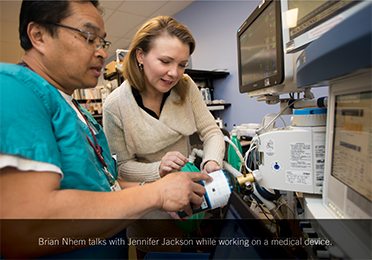
“When I took a small pause in my life to move to Rome, Italy with my now-husband, I stepped down from that role, but agreed to stay on as a project manager,” Jackson says. “Thankfully, Skype and other web-based tools made communication and collaboration possible across the world.”
“At the same time, I was also president-elect of ACCE. I did bring it to the board of directors and we discussed if I should continue on and put myself up as a candidate for president. With Skype, email, and Google docs, we thought I could continue to serve, even though I was across an ocean. So, I ran and was elected as president of ACCE,” Jackson adds.
When she returned stateside, Jackson interviewed and was offered her current position as the director of clinical engineering and device integration at Cedars Sinai.
Getting back to those awards, the efforts she has made, along with her team, are leading the way in the developing relation between IT and clinical engineering.
“That I am still trying to figure out this integration between clinical engineering and IT and what it might mean for the future of the department. We’ve done some awesome projects and continue to grow as a team, tweaking job descriptions and duties when necessary, but I can’t say that we completely understand now where that line between traditional IT application management and clinical engineering is anymore,” Jackson says.
“There are some great talks about this, and at the 35,000 feet level, and from that view, it all makes sense. But we are into the details now,” she adds.
Even after the work Jackson and her team have accomplished in the IT/biomed equation, she asks the question that will become more commonplace.
“Is it OK to say that I’m IT now or do I continue to separate myself as Clinical Engineering? I report to the CIO, and work as a member of the IT leadership in my institution, though I still have to further define my role because few of my IT or CE colleagues, outside of Cedars, seem to quite get it yet,” she says.
Away from work, Jackson enjoys spending time with her 5-year-old daughter. She and her husband, Sergio, have been married for nine years.
