



The Indiana Biomedical Society (IBS) picks a biomed of the year each year at their annual meeting. For 2015, they chose a veteran biomed, with 45 years of experience who reflects the best of biomed in many ways.
Jerry Schauss, CBET, started working for St. Mary’s Medical Center in Evansville, Indiana, in the fall of 1977. His primary 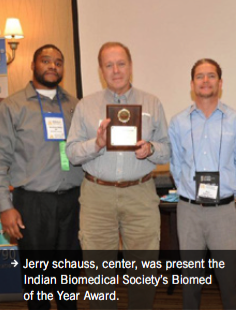 assignments there include laboratory, cardiology, ultrasound and surgery. ThehonorfromIBSwasacomplete surprise to Schauss. He had no idea that he had won until they began talking about the background of the winner at the organization’s conference. His friends, who knew he had won, kept quiet for months to make sure it was a complete surprise.
“It was a total surprise to me. I had no idea I had even been nominated,” Schauss says. Like many biomeds, Schauss entered the profession through happenstance. “I actually stumbled onto this profession 45 years ago while I was in the Army,” he remembers. “The Army had an exit program called Project Transition when you were getting out of the service. This was a six-week program to work with a company outside of the Army. The job was to work on medical equipment and it was with Bendix Field Engineering.”
“I found this to be interesting, as I like working on equipment. I was offered a full time job with good pay of about five dollars per hour, not bad pay for the early ’70s,” he says.
After leaving the U.S. Army in 1973, as a radio electronics instructor and radio transmitter operator, where he also performed repairs, he went to work for Raycomm Industries in Freehold, New Jersey, as a biomedical field service engineer. He performed repairs and preventive maintenance of equipment at hospitals in New Jersey, New York, Pennsylvania, IllinoisandToronto, Canada.
He has seen a lot in his 45 years as a biomed, including monumental changes in technology.
“When I started in the field, the guy who was doing it before me ran a TV repair shop. He had no experience in biomed,” Schauss says. “Everything was tubes back then. New devices were going to Nuvistors, which was a hybrid metal tube, to transistors, and finally to IC. So, eventually, you saw a change in how things were made and in the quality of the circuit boards as they became, not wired together, but made as a circuit board. The quality of equipment has changed a lot and so has the quality of the test equipment.”
EXPERIENCE AND TRAINING
A CBET since 1978, Schauss has been through dozens of OEM classes and other training opportunities to fine tune his skills. He received his A.S. from ITT Technical Institute in Evansville, Illinois, and took electronics and computer repair through CREI.
 “With my electronics training at Sam’s Electronic School (now ITT) and in the military,teaching electronics in the military, being the only equipment service tech at a remote island location called Matsu, I felt ready for the challenge,” he says.
“I was lucky to work with two talented guys that were willing to train me on medical equipment. One had a lab background and the other had medical equipment background. Between the two, it was like you were doing clinical training from a college,” he adds. “One of the guys had many degrees from various colleges; he was a brain.”
The training paid off. Schauss has held the position of field service engineer with two companies, site manager for an ISO, has owned his own biomedical service company and continues today as an in-house biomed.
“For the last 16 years, I have serviced equipment in cardiology, ultrasound, lab, and surgery,” he says.
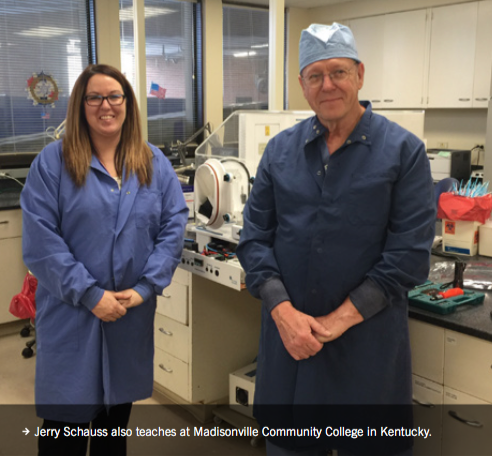
He has also been a clinical instructor for students at Madisonville Community College in Kentucky. In this capacity, he has been described as the best clinical instructor by the program’s coordinator. He meets with prospective students before the clinical period to alleviate any anxiety they may be experiencing prior to the actual clinical training.
Schauss is also on the program’s advisory board and is highly respected by his peers on the committee.
His accumulated experience has come in handy with some projects that go beyond the typical job description for a biomed. Back in the ’80s and ’90s, Schauss wrote “a few computer programs that were used for years at the hospital.” He also built some interface equipment to interface various equipment to be used for sleep studies.
“I did take some courses in machine language programming at two of the local colleges. They were different languages than I was programming in, but it gave me an idea and background on programming.”
“Actually, I would write them in a basic language and use an interpreter that would convert them over to machine language,” he explains.
RECOGNITION AND REFLECTION
In terms of recognition, he has been Employee of the Month and Employee of the Year at St. Mary’s Medical Center.
Away from work, he enjoys electronics and gardening.
“I had done Heath Kits in the past and built my own test equipment, that I used for general electronics,” Schauss says. “I repaired computers in the past and other various equipment. I didn’t limit myself just to medical equipment; I repaired TVs or anything electronic that ran across my desk.”
He also enjoys being an active member of his church where he sings in the choir. He has been married for 40 years and has twoadult children and one grandson. “The career has changed a lot in the last 45 years. I feel as far as somebody getting into this field, it is a very good field. There’s a lot to learn. In the 45 years, I would say that there is something that I’ve always learned,” Schauss reflects. “You are always learning something because the field is always evolving and new equipment is coming out and new procedures. It keeps me interested. I really enjoy working with the equipment and the people who use the equipment.”
Retirement is in Schauss’s future, but he hasn’t set an exact date.
Until he retires he will continue to make certain that the students who enter the clinical period under his guidance have their priorities straight.
“It takes 15 minutes to learn how the break room works. Once you have your 15 minute break, don’t think you’re going to take a lot of 15 minute breaks throughout the day. You’re here to learn and that’s what you’re going to do, you’re going to learn,” he says.
Lucky for them, they are starting their biomed careers on the right foot with an experienced mentor.
