



By K. Richard Douglas
Pleasanton, California sits east of the San Francisco Bay in Alameda County in northern California. It is northeast of the city of San Jose. Pleasanton is headquarters to several major corporations. It is also the location for Stanford Health Care Tri-Valley.
Stanford Health Care Tri-Valley is a part of Stanford Medicine and has locations in the cities of Dublin, Pleasanton and Livermore, California.
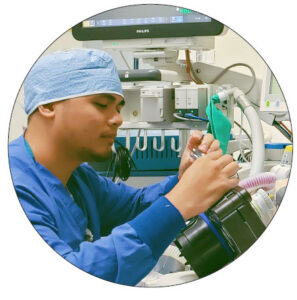
The health system’s biomedical engineering department includes Assistant Manager of Biomed and IT Brian Inphouva, CBET, CHTM.
Like many successful members of the HTM community, Inphouva got his start in the military.
“Before separating from the military in 2013, I found an article talking about the trajectory and demand for more HTM professionals. It was the perfect field for me to translate my aviation electronics experience into, given that I acquire the supplemental education and certifications,” he says.
Inphouva attended the military’s Aviation Electronics Intermediate Level Training and Calibration school, which provided the foundation for his technology/electronics knowledge.
“From there, I attended DeVry’s Biomedical Engineering Technology program in Fremont, California, where we topped it off with a six-month internship to really witness the day-to-day of HTM operations,” he says.
Inphouva worked his way up from starting out as an intern to a lead biomed, supervisor and into his current position as an assistant manager. His area of specialty is managing service contracts.
Staying in the Technician’s Shoes
It is managing service contracts that Inphouva says can present some challenges. He says that managing every specialty device’s service contract in the hospital can be daunting at first.
“But, with the strategic approach of consolidating with a multi-year master service agreement, has helped reduce the itemization of each task and eased the hassle of adding devices in the future. Tracking these contracts via Smartsheets has been a tremendous hack for me. I am able to create intake forms for vendor quotes, track the life cycle of a contract from beginning to end and create rollup spreads for my leadership to see firsthand live the data they need, i.e., aggregates, number of contracts, lapses in service and savings,” Inphouva says.
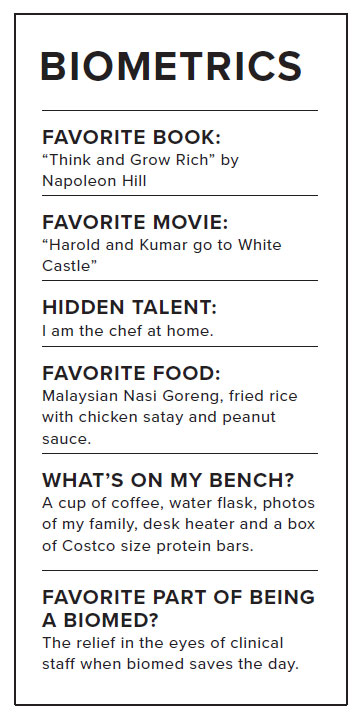 Although he has an experienced team of HTM professionals, there are times when putting everyone’s head together can help with problem-solving.
“My team is a pretty veteran team with five-plus years of experience now, especially at our extension of Stanford. And seldom do they request for any technical assistance. I also respect their knack as natural problem solvers and love to encourage empowerment at the front lines. Most of the time nowadays, the team is educating me on technical issues and resolutions for our newest and updated medical systems,” Inphouva says.
He recalls one day, the team was tasked with assisting the cath lab, along with collaborating with many other vendors, to set up the room for different EP configurations.
“Two of our most technical biomeds were assisting the cath team for almost four hours, running mock setups for upcoming cases. They did great! They even drew a diagram and explained how the room was configured for the rest of our team,” Inphouva explains.
He says that midway through the day, they ran into an issue where they were unable to get the video on the boom monitor even though they were able to bridge the connection with adapters.
“I hadn’t stepped out of the office all day, and due to the high visibility of this mock setup for the upcoming EP case, I decided to scrub up and peek my head into the room to see if I could be of any assistance of my team. After getting fully briefed, and seeing with my own eyes the adapters used, I can see that we were going from digital to analog, and if anyone has ever had experience with audio/video, that would not be possible without some kind of converter. Luckily, we had ordered five of these and had them stored in the shop from a few years back,” Inphouva says.
He says that once the DVI to VGA converter was installed, they were able to get a clean and crisp live feed from the source.
“Thinking I was out of my element for some time, I was glad I could still be of some technical use to my team and still tell them about a scenario I encountered years ago. Which just proves that a biomed’s experience will always be an accumulation of problem-solving scenarios along with the decisions and steps to remediate those issues. Thus, the importance of sharing our wealth of knowledge amongst colleagues and peers,” Inphouva adds.
When not on the job, Inphouva enjoys fitness activities.
“I occasionally go snowboarding when there are good deals, partake in the bowling summer league, pickup basketball at the local 24 Hour Fitness and ride my road bike in the really tight suits,” he jokes.
“I have an amazing wife that has blessed us with two wonderful children,” he adds.
Many people from Southeast Asia, who left to escape communism, have worked hard and discovered success in the U.S. Inphouva’s parents were among those immigrants.
“I am second generation Asian-American, born to Laotian refugees who arrived during the Vietnam war,” he says.
Inphouva says that one of the things he likes best about work is the people.
“I honestly care and look out for their well-being. I need to know that I did my best to make sure you are loving what you do, feel safe and are always supported, even outside of the workplace. Whatever I can do in my power to make work worth looking forward to everyday, will always pay itself back ten-fold,” he says.
Some of that life-view may have come out of Inphouva’s background. He is a U.S. Navy veteran who served a five-year term overseas on the USS George Washington at the time homebased in Yokosuka, Japan.
It is an attitude that helped him earn the attention of others to be nominated as a professional of the month.
