



 By K. Richard Douglas
Sometimes the influence of family members and a general sense for what you want to do with your life is just enough to get pointed in a general direction. That was the case for Taylor Dunbar, a clinical engineering specialist at the Ohio State University Wexner Medical Center in Columbus, Ohio.
“My major when I first started undergrad was ‘Engineering-Undecided.’ I knew that I wanted to do some kind of engineering, but I wasn’t sure which one. I was always interested in math and science, and I was very crafty, and I enjoyed tinkering with things – understanding why and how things worked (or didn’t work) – so deciding on pursuing an engineering degree was the easy part,” Dunbar says.
She says that both of her grandparents – Alice and Derwood – worked in health care for many years.
“I remember hearing so many stories from them – their favorite memories, their hardest days, coworkers and patients that left an everlasting impact on them. I always thought it would be cool to work in health care, but I just wasn’t sure how. I could tell from their stories that they were making a difference every day throughout their careers, and they inspired me to want to do the same. I wanted to find a way to use my skills to create a positive impact like they did,” Dunbar says.
She says that when she learned about Ohio State’s biomedical engineering program, it felt like the perfect blend of engineering and health care.
“I didn’t learn about clinical engineering specifically until I was about halfway through undergrad. I was browsing the student positions available at the Wexner Medical Center and just so happened to stumble upon a posting for a clinical engineering student assistant,” Dunbar says.
“The description was a little vague and it was a department I had never heard of before, but I took a chance and applied. During my interview, the biomed director at the time, Tony McCabe, took me on a little tour around the hospital. I honestly don’t remember much of the interview, because I was mesmerized by the size and complexity of the building we were walking through. After working for clinical engineering for two years as a student assistant, I was very excited when I was offered a full-time position to join the team after graduation,” Dunbar adds.
After the work as a student assistant, and then joining the CE team full time after graduating in the spring of 2018, Dunbar was promoted to clinical engineering specialist in January of 2021, and is now a specialist 2. Beyond her formal training, Dunbar has also attended several OEM training classes. Some of that training has allowed her to specialize in apheresis equipment.
Managing Projects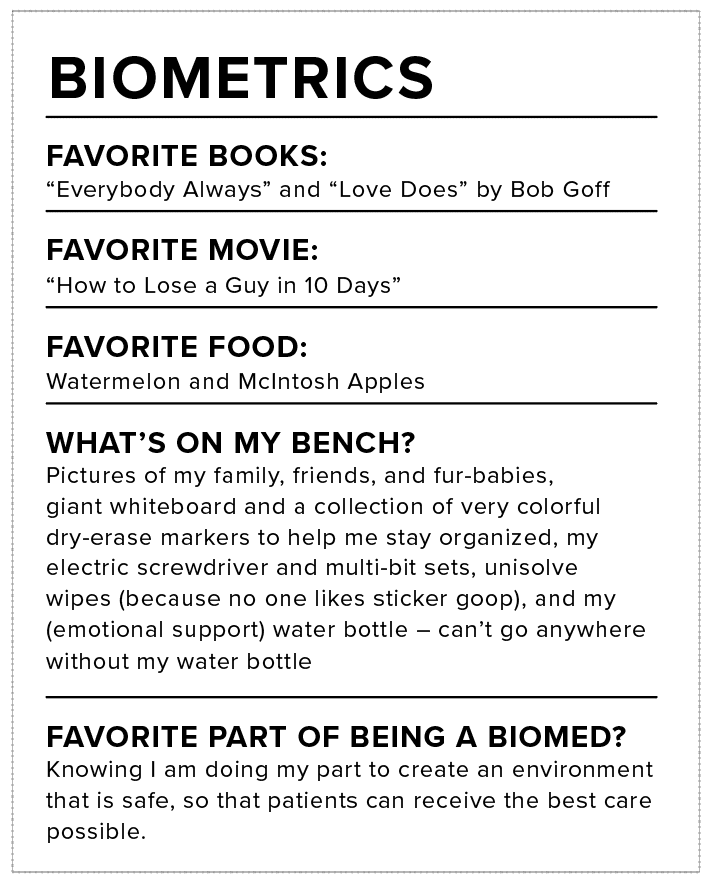
Dunbar’s interest in project management has been an academic pursuit and she also has an interest in women’s opportunities in engineering fields.
Challenges are a part of the HTM profession and instilling confidence in clinical colleagues may be one of them. Yet, overcoming some of those challenges results from proving capability. Dunbar has taken on the challenge.
“One challenge I have encountered is being a young woman in a field that is male dominated. I would receive tickets for broken equipment from our dispatcher, and when I would show up on the floor, the users would be shocked that a young woman was there to fix their equipment. I think there were even some people that doubted me because of my age, or gender or both. I had to work extra hard to gain their respect and trust,” she says.
Dunbar says that she has a strong interest in project management. She recently went back to school part time for her MBA and her management has granted her many opportunities to be part of various projects throughout the medical center.
“One of my favorite projects, that I am currently a part of, is a Go-Live Initiative for 12-lead at the bedside. I am super excited about this project because I can see how it will improve patient care,” she says.
“Another project I have really enjoyed being a part of, was an inventory audit in preparation for our new hospital building, which is in the construction phase. As part of the audit, we created a scorecard which would allow us to determine what equipment can and should be moved to the new tower and which equipment would need to be replaced,” Dunbar says.
“I have also recently become more involved with the DOI (diversity, outreach and inclusion) office at Ohio State, specifically with Women in Engineering. I sat on my first engineering alumnae panel during National Engineers Week for an event called ‘EmpowHERing the Future,’” Dunbar adds.
Asked about what people should know about her, Dunbar says that she strongly believes in the work biomeds are doing.
“It is certainly behind the scenes work – and many times thankless – but I don’t let that discourage me. My mom is a two-time cancer survivor, so the fact that I work in the James Cancer Hospital makes my job that much more meaningful,” she says.
On the home front, family is important.
“I have the most supportive family – they push me every day to challenge myself and to be the best version of myself possible. I would not be where I am today without my parents, Brian and Jane, grandparents, Derwood and Alice, and my sister, Sydney,” Dunbar says.
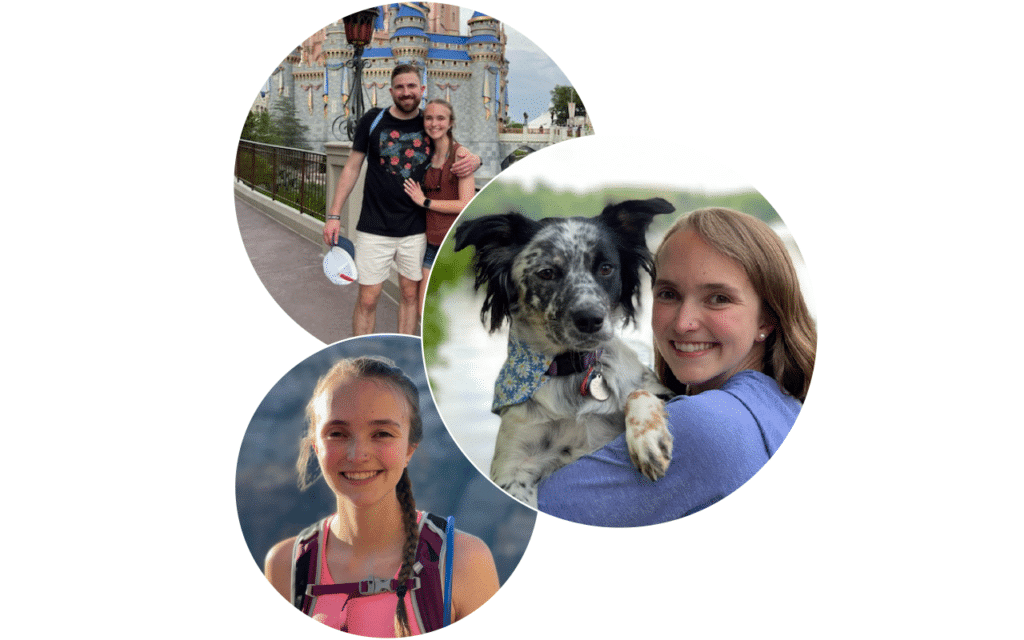
In her free time, she enjoys trail running and hiking, teaching herself DIY home projects, gardening and snuggling with her fur-babies (Hallie Rae and Harold Brown).
For patients and clinicians in Columbus, Ohio, they can be grateful that they have a project-management-minded clinical engineer watching out for them.
