



By K. Richard Douglas
Traversing Military and Civilian Skill Sets
When a boss nominates an employee for the professional of the month honors, that says it all.
“Tyler is professional and I consistently get positive feedback from the hospital employees he serves. Tyler is a very smart person and has a bright future in this field,” says Tyler Tryon’s boss.
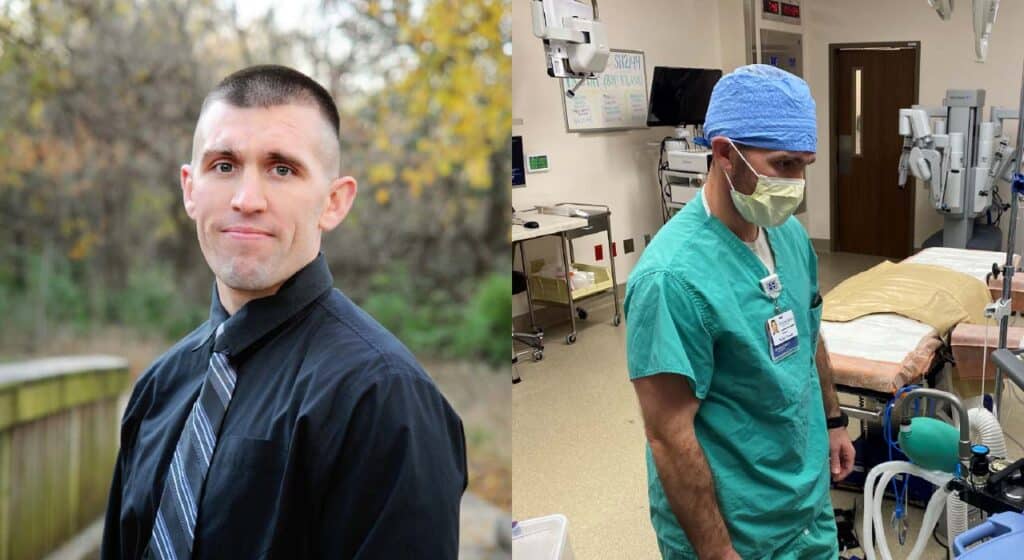
Tryon, CBET, is a TRIMEDX BMET 3 at Saint Luke’s Health Systems in Lee’s Summit, Missouri. He has been both a civilian and military biomed and leader.
“I initially found out about the profession when rejoining the military. I wanted a military job that had applicability in the civilian sector with good future job growth. The Army offered me biomed, and after doing some research, it looked like a job that I would really enjoy,” Tryon says.
He says that he spent 10 months at Shephard Air Force Base in Wichita Falls, Texas in military biomed training.
“It was 12 blocks of instruction with a theory portion in the classroom followed up by a ‘lab’ portion where you got hands on the various pieces of equipment,” Tryon says.
“On the civilian side I have been a Biomed 1-3, interim supervisor for a year and lead tech responsible for 41 surgical suites,” he adds.
Tryon says that on the military side, he worked as a technician, nightshift supervisor, Non-Commissioned Officer (NCO) in charge — which is similar to a supervisor, Section NCO — similar to an entry-level manager or senior supervisor, Company Maintenance Officer as a Warrant Officer 1 and Chief Warrant Officer 2.
More recently, he served as the maintenance officer responsible for all U.S. Military Medical Equipment Maintenance in Afghanistan, while deployed with the Army Reserves from June 2020 to April 2021.
Developing Expertise through Experience
Of the many projects that Tryon has been a part of, there is one in particular that he says was instrumental in his growth as a biomed.
“In 2012, I was the project lead for the installation of all medical equipment in a new intensive care unit (ICU) that was being built. The hospital was looking into using a new vendor for patient monitoring and was installing it in this new construction as a pilot to see how well it would work. This created many challenges as many people are reluctant to change and this system was going to result in drastic changes to staff workflow,” he says.
Tryon says that he worked closely with the installation team taking the time to learn as much about the system as possible. He says that, luckily, the lead installer was willing to teach him.
“My intimate knowledge of how the system functioned, its limitations and how to navigate through the screens allowed me to help develop workflows with staff. While the vendor was onsite to train staff and help develop workflows, my expertise became the defining factor in success of the system,” Tryon says.
He says that an individual can only learn so much at one time, and with staff focused on patient care, he was called on many times to show them how to do something, pull patient history or answer questions regarding the capabilities of the system.
“This project taught me the importance of learning more than just the requirements of your job. There were many times that staff needed my help for what would traditionally not be within my scope of work. If they had to call the vendor clinical support line every time for help, the project would not have been successful. It also allowed me to cross train my co-workers, increasing the knowledge of our entire department. As any experienced biomed knows, your knowledge of a system determines how quickly you can get it back up and running when there is a problem,” Tryon says.
As a member of biomed leadership in the military, Tryon has also faced the challenge of integrating the skill sets of civilian and military biomeds.
“In June 2020, I deployed to Afghanistan with the Army Reserves. I was the Medical Maintenance Officer in charge of the biomed team that maintained all of the medical equipment in the country with the exception of one hospital maintained by Air Force biomeds. While we all went to the same training, each branch of the military does things differently resulting in different strengths and weaknesses,” he says.
Tryon says that the Air Force individuals were active duty and had only ever worked on military equipment, while all of the Army soldiers were reservists and worked in the civilian world working on a larger variety of equipment.
“Active duty and reservists generally do not work well together due to their differing views on what is ‘right’ due to the differing ways military and civilians do things. The military tends to follow what the OEM says, and only uses OEM parts, while the civilian sector will use third-party parts and tends to use alternative maintenance programs when doing scheduled services. I was able to integrate our two teams together bringing the 11 individual biomeds, with differing skills sets and knowledge, into a single team,” Tryon says.
Tryon was recognized as the Distinguished Honor Graduate from his military biomed school in November 2009.
He is married and has an 11-year-old daughter. In his spare time, he enjoys spending time with his daughter, lifting weights and watching the Seattle Seahawks.
“I am very passionate about my job and the impact we have on patient care,” Tryon says.
Whether working as a Chief Warrant Officer 2 or BMET 3, Tyler Tryon brings a diverse skill set to the work he does to the benefit of the military and civilian health care systems that depend on him.
