



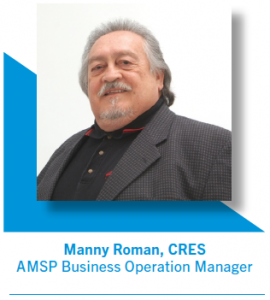
By Manny Roman, CRES
 I recently heard the often-repeated adage “Either you’re growing or you’re dying.” I always had a little difficulty with this statement, not because of the inherent truth, but because of the skewed urgency applied to it.
This statement is mostly true of many things such as trees, businesses and even human beings. Once you stop growing you generally are on a long path toward your demise. However, I feel that in business, it places so much emphasis on the continuous addition of income to the bottom and all lines that a possibly more important statement is mostly ignored.
In my opinion, for business and many other things, a better statement to follow is “Either you’re changing or you’re dying.” This places the focus on looking for improvements. This does not rule out acquisition of a complementary organization, expanding into other markets, mergers, etc. The focus is on changing to better meet customer and employee needs while ensuring to not lose sight of the core competencies of the organization.
These improvements can be in numerous areas such as products, operational efficiencies, marketing and advertising. In my opinion, the most fruitful improvements are in enhancing relationships. By enhancing the relationships, both within the organization and with customers, suppliers and even competitors, can generate a big payoff in change and growth. Joining appropriate industry associations and attending industry conferences and expos are ideal for enhancing relationships. Continuous internal communication and conducting one-on-ones with employees are invaluable tools for change and growth.
As the organization changes and grows, it is important that the employees have a sense of ownership in the processes to ensure their understanding and compliance with the requisite actions. People don’t resist change. They resist being changed. People change all the time. They change phone service providers and TV channels and restaurants and houses and cars, even partners, etc. They make the choice to change things in their lives quite often and if they don’t like that change, they change again.
What people resist is being changed. The resistance is to other people, or outside forces, pushing them to change. When this happens, people tend to become immovable objects and may even push back. They don’t really object to the change, they object to the process. Mostly the resistance is due to not understanding the reasons for the requested change. When people are not provided with the what, the why, and what to expect as a result of the change, it is very difficult to gain their acceptance. Good leaders understand this and will take steps to ensure their people are well informed.
It is a great leader indeed who effects changes with the consent of the people. They frame the changes to each individual’s need, wants and desires. They provide the expectations to be had by those being asked to change. Proper framing is the key. The presentation must make sense to each individual within a framework they can understand. Essentially, this is how we cause the individuals to want to change. This is the key to good leadership: To influence others to want to comply. Regularly scheduled one-on-ones will allow for this to happen.
I love change. Change makes life interesting. Change causes us to grow. Even if the change is unwelcome, dealing with it makes us stronger and teaches us things we would otherwise not know. Change is the enemy of complacency. Complacency does not mean contentment with your situation. You can be content in a changing environment. However, to me, complacency is a stagnant condition. This is what the grow-or-die statement is attempting to address.
Don’t ignore personal changes that will add personal value to you as an individual. Although I complain each time this column is due, it is part of my personal plan for adding value to myself. The process of research, both externally and internally, for this column adds personal value to me. My other enhancement plan of being a good poker player is not working out well. I am changing, however, for the poorer.
