



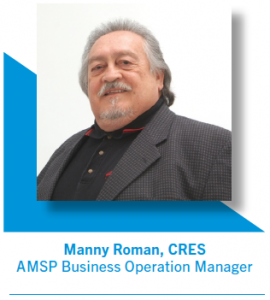
 By Manny Roman, CRES
If you have ever attended my presentation on customer relations, you know that I rely heavily on personality identification. I contend that having a good concept of the varying personalities goes a long way to establishing good relationships both in business and personally. This begins with knowing your own personality type well enough to facilitate the communication process.
Well, I recently explored a couple of interesting articles and received the “news” that personality testing is mostly meaningless. Could I possibly have been wrong all these years? I always have said that, “I may not always be right but I’m never wrong. I thought I was once but I wasn’t.” Let me explain this apparent dichotomy.
In the article “Goodbye to MTBI, the Fad That Won’t Die” (psychologytoday.com) the author states: ”There’s just no evidence behind it,” says Adam Grant, an organizational psychologist at the University of Pennsylvania who’s written about the shortcomings of the Myers-Briggs previously. “The characteristics measured by the test have almost no predictive power on how happy you’ll be in a situation, how you’ll perform at your job, or how happy you’ll be in your marriage.” According to the article the MBTI (Myers-Briggs Type Indicator) is taken by more that 2.5 million people a year and is used by 89 of the Fortune 100 companies.
In the article “Why one popular personality test is ‘pseudoscientific at best’” (inverse.com) by Sarah Sloat, she quotes Luke Smillie, the director of the Personality Processes at the University of Melbourne: “Frankly, the enneagram is probably at the top of the list of tests I would not recommend. It is pseudoscientific at best.” The #enneagram is associated with more than 50 million views on TikTok.
The need to more deeply explore the tendencies and predispositions of personalities is evident by the above numbers. I, however, disagree with the process.
My objection has always been that the questions or statements tend to place people in situations to which they are asked to respond. How we actually respond to a situation is dependent on too many variables such as who is involved, their reactions, our present state of mind, etc. It is difficult to not use multiple past experiences to influence the response. Add to that the reason you are taking the “test,” such as HR requires it, who will see the results, how will others view you differently, etc. I know of one instance where an entire department took MTBI and had to wear color-coded badges on their chest indicating who they were determined to “really” be. I believe that this would not help relationships because of the inherent preconceptions when people are involved. We all carry around multiple personalities to display at the appropriate times to the appropriate people. Completely removing these outer personalities is not a good idea, in my modest opinion.
I get that the attempt is to improve relationships by allowing people to act with each other as they actually are. I propose in my presentations that the best way to determine who you really are is to perform you own self evaluation. Look at the descriptions of the different personalities and then do this: imagine that there are no situations or people involved. How do you feel then? Example: Are you most comfortable with confrontations, facts and figures, people, getting the job done, etc. I call this defining how you feel when you are “home” where you should be the most comfortable.
We know the golden rule is a great way to morally live. The platinum rule, treat others as they wish to be treated, is the way to go when dealing with others – especially in business. If you can determine the real home personality of others, you will be able to change your outer personality to match their home no matter what outer personality they show up with.
An example: I ask attendees what personality nurses are likely to be? Most immediately say they are pragmatic (the one concerned with the job and tasks) and just want their equipment repaired and they normally are upset when the service professional shows up. I then ask what personality would want to take care of people who may be sick and contagious and may need their butt wiped? Immediately the response changes to the amiable personality which is the one concerned with people. So, no matter what outer personality the nurse displays, we can gently say and do things that match the amiable personality. “I will get the unit repaired as soon as I can so you can get back to taking care of your patients” instead of “so you can continue making money from your services.”
Relationships are complex and difficult enough without having some questionable test define us without a good and honest self evaluation. I took The Big Five Project Personality Test for this column. I was apprehensive and had difficulty honestly answering between the Agree and the Strongly Agree, etc. My mind kept bouncing around all the past situations and people that kept changing the answer. Number 8 “Tends to be lazy” was a no brainer as my lovely wife, Ruth, will testify. See, the answer is influenced by people and situations.
The views expressed here are those of the author and do not necessarily represent or reflect the views of TechNation or MD Publishing.
