



By K. Richard Douglas
Detroit produced many great cars in the 1960 and 1970s. Many of those cars are regarded today as “muscle cars” and “classics.” Some are legendary. The raw horsepower, unique styling and iconic reputation of many of those cars is the reason so many are found at car shows and classic auto auctions today.
One of those classic muscle cars from the 1960s is the 1966 Ford Mustang. It was one of the earliest “pony cars” and had a design, as a coupe, that included a longer hood and longer doors and a shorter trunk section. The car is a prized “project car” for auto enthusiasts today.
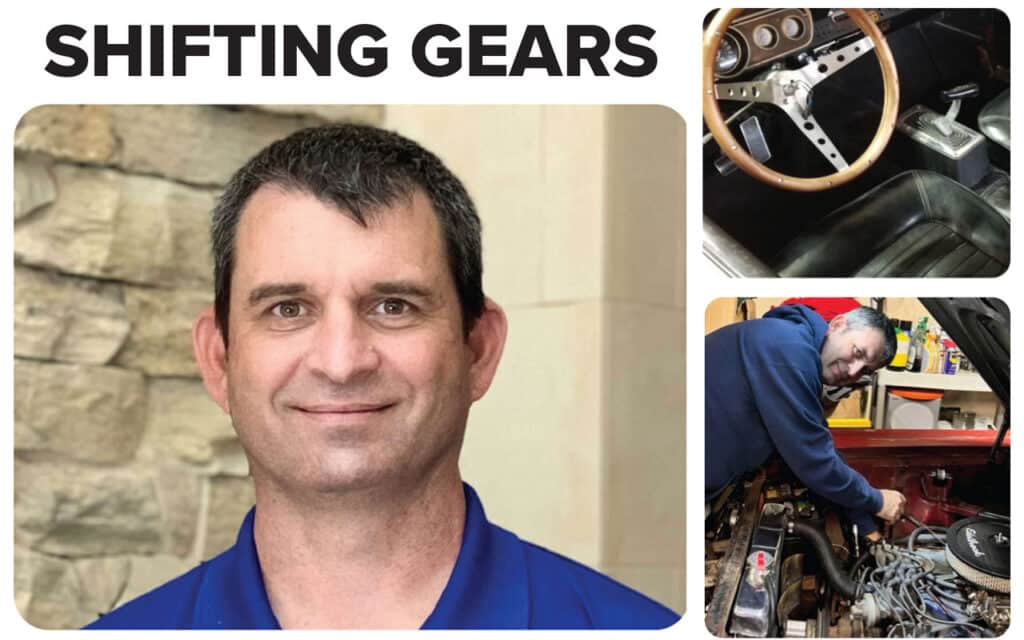
One of those enthusiasts is Scott Gillett, BSAST, CBET, manager in the healthcare technology management department at Baylor Scott & White Health in McKinney, Texas.
Gillett wanted a “driving project” car and located his 1966 Mustang about 45 minutes away from his home. For years, he wanted to own a classic muscle car, and after a long search, found the Mustang. Gillett has been a fan of car restoration since he was a kid.
“I remember my father driving a 1965 Ford F-250 my whole childhood. He had the same vehicle as long as I could remember. With that, he had to maintain it, and I was there watching and helping. My first car was a 1977 Rabbit that I paid $100 for. It needed work and he helped with things like the motor and brakes until I learned to work on them myself,” Gillett says.
He says that he has always liked older cars, and if they needed work, he saw it as a way he could personalize them to his own liking.
“If I worked on them, I knew what was done and I could repair it the next time. I also knew more about the car and could tell if something wasn’t right or needed to be adjusted. There is a lot of satisfaction in taking a vehicle and making it road worthy,” Gillett says.
Besides the Rabbit, one of the other vehicles Gillett owned was a 1980 GMC Sierra short bed. He says that was his first V8-powered vehicle and he got a lot of practice replacing header gaskets on it.
Of all the classic Detroit muscle cars; why did Gillett choose a 1966 Mustang?
“I think the Mustang is a good project car because there are so many available parts for it. There are plenty of parts in junk yards or for sale from local sellers. The Internet has numerous websites for aftermarket parts as well,” Gillett explains.
He says that some of the original parts are hard to find if you are looking to restore it back to factory specs, but restored modified (restomod) parts are readily available.
“There were challenges locating a set of original seats. Remanufactured frames, foam, and seat covers are available, but can run into the thousands of dollars. Looking into the restomod side of building one of these cars people have put everything from modern coyote engines to electric motors in these cars. Many of the Ford cars from that time period have parts that fit in the Mustang. The motor in my car is a 302 from a later model Maverick. Many Ford Falcon parts are almost identical as well,” Gillett adds.
Getting into the Nuts and Bolts
The drivable project car has had a lot of restorations and modifications. It has been improved substantially.
“As far as improvements I’ve done so far, I replaced all the steering components and rebuilt the steering box. Switched out the front springs with one-inch lowered springs as well as did the “Shelby drop.” The Shelby drop is when you lower the upper control arm and move it back slightly. The rear suspension has been replaced with new leaf springs and shocks. Tires were replaced with BF Goodrich Radial T/As wrapped around classic American racing torque thrust wheels that I got from a fellow biomed, James Jumper, who has a fastback Mustang,” Gillett says.
He says that the engine was in pretty good shape when he got the car. The original 289 was replaced with a 302.
“I’ve added an electronic ignition and replaced the carburetor with a new Edelbrock 650 cfm. A new radiator and fan cool the temps down. For the interior, I replaced the 1971 Mach 1 seats with original 1966 seats. Replaced all the dash gauges with more accurate working units. A stock shifter was located to replace the bulky aftermarket shifter. A new headliner, carpet and new weather stripping are waiting to be installed,” Gillett says.
Another improvement that awaits installation is a front disc brake set with new master cylinder.
“The body is straight with almost no rust and a very sloppy paint job. The original red paint is not in that bad of shape. I’m thinking of getting it back down to the original paint and leaving it for a while. I kind of like the patina look on older cars. A good paint job can run high in the cost department and I’d like to drive it and not worry about the paint from everyday chips and dings,” Gillett says.
When not working on his Mustang, Gillett keeps busy doing the other work he enjoys.
“I’ve been in the biomed field for about 17 years now and most of my interest comes from working on things like cars in my past. I enjoy learning how things work and having the ability to repair things with my hands. I completed biomed school when I was in the Navy. A Navy Biomeds’ rating is HM (Hospital Corpsman). We used to joke in the shop saying HM stood for hospital mechanic.”
He says that now that he is in a management role, he does not get to work on equipment as much but enjoys sharing his knowledge with his team.
“I believe it is a lot easier to build a close team having come from the same place they are at now. I can relate to them and they relate to me as we work together keeping the equipment at the hospital safe by doing what we enjoy,” Gillett says.
During 2023, the car is likely to be found at some north Texas car shows. Gillett’s advice to others contemplating a similar project is “to pick a project you are not going to get tired of. Something that reminds you of a time in your life, or a car you had when you were younger. Know what you want when you start, it’s easy to start going down rabbit holes.”
Shifting Gears Nomination
