



By K. Richard Douglas
Jumping out of a plane may be on some people’s bucket list, but it is likely on many other “no-way in the world” lists as well. It takes a special personality with an adventurous and unconventional spirit to strap on a parachute and step out of a plane at 5,000 feet.
One biomed and business owner has dared to take that leap.
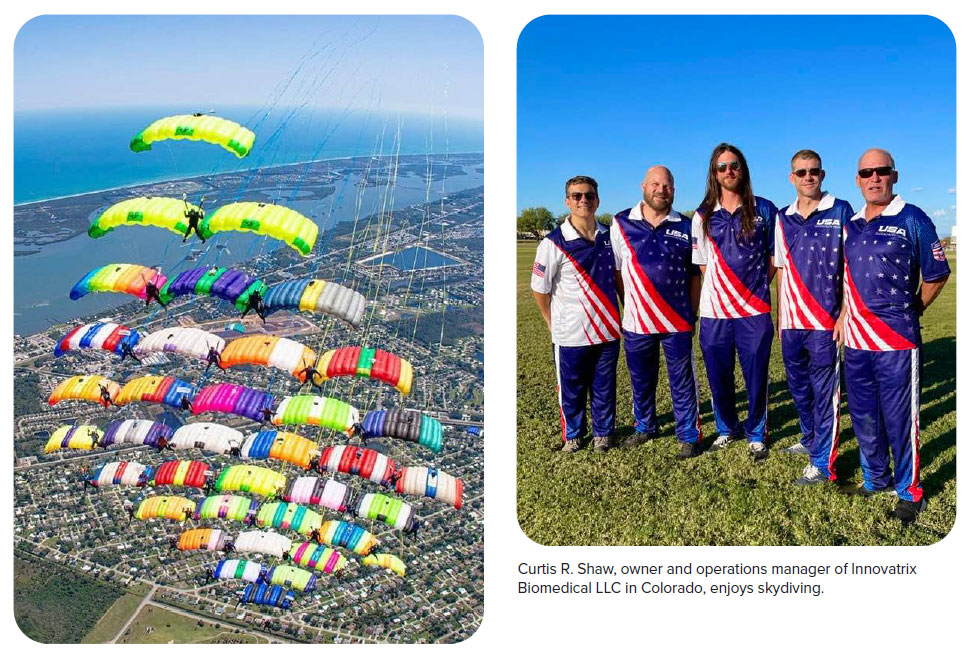
Curtis R. Shaw, owner and operations manager of Innovatrix Biomedical LLC in Colorado, has strapped on a parachute many times and stepped out of a plane.
“I have always been a fan of extreme sports; skydiving was just something I didn’t think ‘normal’ people got into. When I was really young, my friends and I were into skateboarding, snowboarding, bikes, etcetera, and we always tried to push the edge. As we got older, we got more into building fast cars, racing motorcycles, street luge; really anything that made me feel ‘alive.’ When a friend of mine called me to go do a tandem with them, I didn’t even have to think about it. ‘Yes, send me the time and place,’ ” Shaw says.
He says that when they got to the dropzone (DZ) that day, the group of six was down to a group of three.
“We were on a wind hold – winds gusting too much to be safe for landing – and we spent about four hours waiting to go. During those four hours, I talked to everyone; the owner of the DZ, the DZ staff, the packers, the tandem instructors, the students taking their AFF (a class to get your skydiving license), and even just other tandem students that were there that day,” Shaw says.
He says that he has always been interested in gear/mechanics and how things work, and in his spare time, before skydiving, he built a lot of engines for cars, diesels and rotary engine vehicles.
“I spent a lot of those four hours at the DZ asking about the gear and how it all worked. Before we went up to do our tandem, I was enrolled in a class the next day at Skydive Ricks in Petersburgh, Ohio. I knew before ever having gone that these people were more than just skydivers, they were a family. I was hooked already,” Shaw says.
A More Challenging Technique from 14,000 Feet
It was that experience that started Shaw on his skydiving adventure, along with graduating to more advanced techniques and maneuvers. After a large number of jumps, Shaw moved into Canopy Relative Work (CRW), a more intricate version of skydiving, compared with the more common “free fall,” and which requires additional training and safety procedures.
While the more common singular, free fall skydive comes with instructions to avoid other parachutes and separate from others, CRW is all about bringing the skydivers together in the sky with a much more prolonged period of free fall. Shaw says the difference can vary by as much as 50 seconds compared to 13-15 minutes.
“CRW comes with a whole other set of emergency procedures and a whole other unique set of gear. The reserve we use is the same as normal skydiving, the main parachutes we use are specifically designed to be used for CRW and are not that good for much else. They land differently than any other parachute I’ve ever used, they open very abruptly — sometimes it hurts — but they do stay pressurized well and are great for CRW. We, like most skydivers, carry hook knives (like a seatbelt cutter knife) but we have several of them. The joke is: ‘Why does the CRW dog (what they call us) have five hook knives?’ ‘Because they didn’t have room for six.’ We use open face helmets, like you’d see someone skateboarding wear so our ears aren’t covered and we can hear each other yelling,” Shaw explains.
He says that some parachute containers, the backpack worn that contains the main/reserve parachutes, are better for CRW than others.
“Oftentimes, we have a lot of lines on us and we want a ‘rig’ – the whole parachute container/reserve/main – all together, that doesn’t have very many snag points on it,” Shaw says.
He says that CRW only represents about two percent of skydivers and that those who practice the sport have become like family.
Similarities of Running a Business and Skydiving
When his feet are planted on the ground, Shaw is focused on the biomed business he started in 2020.
“I formed Innovatrix Biomedical LLC in January 2020, but didn’t tell anyone for about a year. December 3, 2021, was when I put in my two-week notice and four days later, I had my first meeting with the CNO and plant ops director of another, larger critical access hospital in Colorado. They asked me for a proposal; all I had was a blank Word document. I spent the next four days writing my own contract and paid my lawyer thousands to get it proofread/corrected over the weekend. A few days after that, we had an agreement and now this is the third year I’ve been there,” Shaw says.
He says that since that time, his company now works in three different states, has hired an employee and paid for his CABT certification through AAMI.
“We have full-service contracts with two critical access hospitals in Colorado, work for some local health care offices, seven nursing homes across Colorado, a lot of urgent care clinics in Wyoming and we add more every day,” Shaw says.
He says that it is his mission for his company to be the best healthcare technology management company in Colorado and surrounding states; maybe even the entire U.S. and beyond.
“All the goals I’ve set for five years, I’ve exceeded in less than three. My competitiveness as a skydiver translates very well to owning a business. A lot of skydivers are also coincidently business owners, too,” Shaw says.
He finds many parallels between the challenges of skydiving and the work of biomeds and running a business.
“If I can be calm entangled in one of my friend’s parachutes, falling towards the ground at a rate of speed high enough to kill me on impact, I can be calm when OR equipment breaks with a patient in the room. It takes a special breed of person to take that chance and possibly fail; for me I’d rather fail than regret. As of now, I have no regrets in life and my only fear is to ‘peak,’” Shaw adds.
