



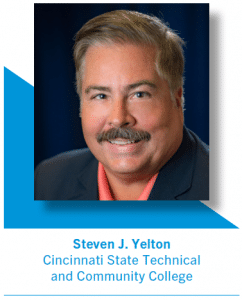
By Steven J. Yelton
 As educators, we are all striving to make ours the best HTM program possible. We want our program to be great! We also are generally very open to help in achieving this goal. I credit much of the success of my own program to the strength of our advisory board and both our co-op and graduate employers. Without these people, we would not have adequate laboratory facilities and obviously would not have the demand that we currently do for our graduates.
It seems that currently our programs are struggling to attract enough students to fill the needs of local employers. You have heard this again and again! You in cooperation with your advisors and employers can bolster enrollment. When an employer tells a prospective student that upon completion of a semester or two at the college there could be a co-op or internship waiting for them, there is no greater recruiting tool.
Notice that as I start this column on “Great HTM Educational Programs,” I discuss advisors and employers. I feel that these groups of people working with the educators are the core and key to great HTM educational programs!
I would like to take the time to revisit what we are doing to help the HTM community with attaining quality college programs which result in quality graduates that enter the workforce.
I’ve written before in my column that AAMI is the lead society within the Technology Accreditation Commission of the Accreditation Board for Engineering and Technology (TAC-ABET). In this role, AAMI helps guide TAC-ABET with items related to the criteria used for accrediting college healthcare technology management (HTM) and similarly named programs. These could be associate or bachelor degree programs. I serve as the chair of AAMI’s Healthcare Technology Accreditation Committee (HTAC). The HTAC makes recommendations for accrediting these health care engineering technology programs. The HTAC is comprised of educators and industry personnel.
TAC-ABET approved AAMI’s first criteria for HTM engineering technology programs. Programs evaluated will be evaluated under criteria provided by AAMI. We feel that this is a great improvement of the previous criteria and are reflective of what the industry desires from college programs.
Don’t forget, the HTAC in conjunction with AAMI’s various departments has been working hard to support health care engineering technology and similarly named programs with support, discounted or free AAMI memberships for students and educators, resource materials and related items.
The HTAC is also looking at ways to be able to provide some sort of base level credential signifying that an HTM program meets minimum criteria based on nationwide vetting for what constitutes a quality program. We are currently investigating the possibility that this be in the form of an AAMI standard. One thing about TAC-ABET accreditation is that when a program is reviewed, much more than just the content of technical courses is considered. Everything is looked at from the credentials of faculty, quality of the learning resources center, laboratory facilities, student services and on and on. We admit that these are good things and are very important to attaining TAC-ABET accreditation. However, we also understand that not all programs meet this stringent criteria in all areas, but still want to have a quality educational opportunity for students.
In order to help college programs improve their curriculum, we have numerous resources available to educators on the AAMI website. We have the core competencies document, help with career ladder and certification help to name a few.
If it is determined that it makes sense for AAMI to support the development of a standard for HTM programs, we hope that every HTM program in existence will take part in this standard in some way or another. This standard could possibly be an entry-level standard for an HTM program. Our hope is that programs will be enhanced when they work on their quality utilizing AAMI resources and the standard. Ultimately, this may also be the launching pad for attaining TAC-ABET accreditation. This will further enhance the working relationship between AAMI, ABET, HTM programs and HTM employers. A win for everyone involved. The bottom line is that even if you don’t want TAC-ABET accreditation, there is much out there to help you.
Another exciting development is the enhancement of scholarships awarded by the AAMI Foundation. The AAMI Foundation awards scholarships for HTM engineers, technicians and health systems engineers. I feel that all educators and students should take advantage of all that the AAMI Foundation has to offer. This is a largely untapped resource for HTM professionals – including educators and students.
In addition to the scholarships, the AAMI Foundation endeavors to award grants, provide various awards and, in general, strives to strengthen the knowledge of health technology professionals. AAMI is working to make the application process for all of these much easier. My hope is that all HTM professionals will take advantage of this great opportunity.
– Steven J. Yelton, P.E., CHTM; is a senior HTM engineer for The Christ Hospital Health Network in Cincinnati, Ohio and is a professor at Cincinnati State Technical and Community College where he teaches biomedical instrumentation (HTM) courses. He is the chair-elect of AAMI’s board of directors, chair of the AAMI Foundation board of directors, past chair of AAMI’s Technology Management Council (TMC), chair of AAMI’s HTAC Committee and is a member of the Accreditation Board for Engineering and Technology (ABET), board of delegates.
