



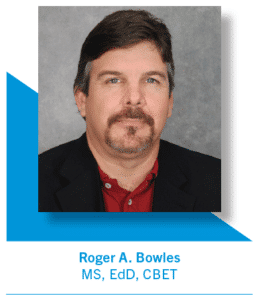
By Roger A. Bowles, MS, EdD, CBET
 I would like to provide an update to my previous column with some good news. I’m writing this column as we prepare for the 2021 summer semester. Our 2020 fall semester and 2021 spring semester remained totally virtual. As I mentioned in my previous column, our enrollment was down for the fall semester. It was also down for the spring semester. We felt this was partly because students thought that they would let the pandemic run its course and start college in the 2021 spring semester. However numbers remained slightly down. Second-year students who needed to complete biomedical instrumentation courses to graduate, did sign up and complete their coursework. First-year students who had the opportunity to take a first-year biomedical instrumentation course decided to wait until the 2021 fall semester.
We plan to go back to our typical “hybrid” approach for biomedical instrumentation courses in the 2021 fall semester. We will teach the lecture portion of these courses online with a supplemental live class each week. The live class will provide hands-on laboratory experiences and allow for live tests and quizzes, as well as question-
and-answer opportunities. We will continue to have live co-operative education placements as we have had throughout the pandemic.
Another part of our educational experience has been instruction at local hospitals. This enables us to teach topics such as imaging, cath lab, laboratory equipment, intensive care units and virtual intensive care units in actual spaces. This has been suspended due to the pandemic, but we feel confident that we will be able to resume this activity in the fall – at least partially if not completely.
A return to face-to-face instruction include extra precautions. At the time of writing this column, and unless something changes drastically, we will require students to wear masks and eye protection while on the college campus. If the governor of Ohio makes changes before the fall semester, we may make slight changes. As far as the hospital-based instruction, we use a few different hospitals and will follow the protocols that each facility has in place at the time.
We will also implement enhanced requirements that hospital-based HTM technicians have implemented since the pandemic hit. I have spoken to many of our cooperative education students and managers to get a feel for how things have changed in their workplaces. Masks and eye protection must be worn in the hospital environment. Most of the hospitals require that each individual’s temperature be taken upon arriving for work. However, this has been relaxed somewhat.
We plan to add additional requirements to our laboratory work to conform with the additional precautions taken in hospitals when servicing equipment. We will include such things as enhanced cleaning protocols and precautions for equipment that may have been used in a COVID-19 rich environment. We plan to include this instruction even after COVID-19 is in the rear-view mirror.
The concern that I mentioned in a previous column is our students’ fear of working in a COVID or even a post-COVID environment. Currently, cooperative education students working in hospitals as part of their education have been offered COVID-19 vaccinations. This has greatly helped their anxiety. We hope that by mid-summer all of our students will have the opportunity to receive a vaccination. We anticipate that the vaccinations and precautions enable us to provide a safe and effective learning environment including within hospitals and college-based laboratories.
Recruiting for our program is as important as ever. As I mentioned, we continue to experience a slight decline in our HTM program’s enrollment. With all of this considered, an interesting fact is that the HTM program at Cincinnati State continues to be the largest of the electronics programs at the college.
I like to emphasize in my column that there are lots of good paying jobs available and it’s up to every HTM professional’s advantage to support the field. We need to make sure that we emphasize that with proper precautions, we have been able to perform our duties in a safe and effective manner.
As always, please stay safe!
Steven J. Yelton, P.E. is a senior HTM engineer for a large health network in Cincinnati, Ohio and is a professor emeritus at Cincinnati State Technical and Community College where he teaches biomedical instrumentation courses. He is the chair of AAMI’s board of directors, vice-chair of the AAMI Foundation board of directors, previous chair of AAMI’s Technology Management Council (TMC), chair of AAMI’s HTAC Committee and is an Accreditation Board for Engineering and Technology (ABET), Board of Delegates member.
The views expressed here are those of the author and do not necessarily represent or reflect the views of TechNation or MD Publishing.
