



By K. Richard Douglas
The concept of “efficiency” comes with many meanings. It can mean doing more with less, maximizing output with minimum input, streamlining a process, making the best use of fuel or electricity, allocating resources or wasting less.
The evolution of the common light bulb in recent years is an example of efforts to achieve greater efficiency – using less power to illuminate a bulb for a longer time period.
The federal government seems very inefficient while the local fast-food restaurant is buzzing along and getting food out. Efficiency is often missing when it is not a priority. Charities are measured by how efficiently they utilize donated funds. The best charities have found ways to reduce administrative costs and efficiently use the largest percentage of donations toward their purpose.
Efficiency must be a part of business operations for a business to prosper and succeed. The same is true for hospitals and healthcare systems. Healthcare systems operate on a budget that is often determined by Medicare and Medicaid reimbursements. Hospitals rely primarily on billing insurance companies for the services they have rendered to patients.
Many of these operating revenues are derived from surgeries, diagnostic imaging, doctor services and, to a lesser extent, gift shop or food sales.
While all departments in a hospital look for ways to achieve greater efficiencies, HTM departments in hospitals worldwide have found ways to cut costs. HTM departments can also achieve greater levels of efficiency with a few tweaks.
At the 2024 MD Expo in New England, G. Blake Collins, MBA, CBET, CHTM, FABC, director of clinical engineering for ChristianaCare Health Systems, and Theresa Street, operations supervisor with ChristianaCare Health Systems, presented the continuing education session “Increase Efficiency in Support of Clinical Engineering.” Check out the MD Expo presentation at https://tinyurl.com/47w9pxvd/
The CE department at ChristianaCare is ISO 9001 certified and has branded itself as “your solution provider.” The department will attempt to assist clinical colleagues in any way they can. At the very least, the team will connect the caregiver with the appropriate source.
What motivated Collins and Street to present on this topic?
“After learning about the various departments and their respective technologies, as well as observing the daily responsibilities of ChristianaCare technicians, I realized that I could assist by alleviating some of their workload. I wanted to demonstrate that others can support our technicians as well,” Collins says.
Would application of the ideas in the presentation apply to biomed departments that don’t have a dedicated operations supervisor?
“If a department lacks an operations supervisor, receptionist, or phone operator, anyone managing the front desk could assist during times of low activity,” Collins says.
Knocking Off the PMs with Inspectors
Another area for creating efficiency is to have a para-professional person handling many of the more routine duties that can monopolize a biomed’s time.
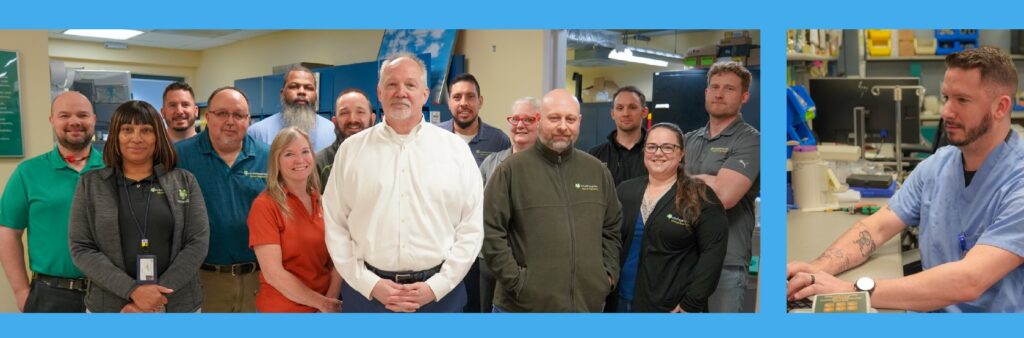
Collins explains that his department includes four “inspectors,” who are not biomeds, but mechanically literate individuals who are able to do PMs on high-volume, low-acuity equipment.
The inspectors have electronics training. Also, the inspector position is often a stepping-stone into a biomed position within ChristianaCare.
“Our inspectors conduct preventive maintenance (PM) on our high-volume, low-impact devices, such as scales. Clinical Engineering has assigned each off-site location a specific month to complete all necessary PMs. Additionally, we have designated asset types to be serviced in each month on a recurring basis,” Collins says.
He says that individuals are selected for these roles based on their attitude and willingness to learn.
“This serves as an opportunity for them to gain experience in the biomedical equipment technician (BMET) field. We provide opportunities for learning, but it is also essential for them to take advantage of these opportunities and demonstrate the knowledge they acquire. Ultimately, our goal is to have them become BMETs and advance through the various levels of the profession,” Collins adds.
The inspectors handle 400 to 700 PMs every month. Offsite PMs are scheduled so that everything can be accomplished in one visit. The efficiencies achieved in the department allow other biomeds in CE the time to train inspectors.
The Right Person for the Job
The department leadership utilizes a spreadsheet that pinpoints the biomeds and the modalities that they have expertise with so they can quickly determine the primary person for a particular call. Knowing the strengths and skill sets of every biomed allows for efficiency in this area.
“During the annual reviews, each technician completes a checklist of their qualifications, while our supervisors validate their skills, training and any new modalities they have acquired. Additionally, a spreadsheet has been created to assist me in assigning work orders based on the modalities of each technician,” Collins says.
Staff-Centered Scheduling
Another efficiency is gained by not having a set schedule, originating from management, that determines staffing and availability.
Instead, the schedule is determined by the staff themselves based around availability and a life/work balance. Some biomeds are early risers, according to Collins, while others have family commitments that determine different hours.
“The four groups – inspectors, biomed, imaging and sterilizers – are informed a month in advance about the preventive maintenance schedules. This allows them to plan accordingly for the completion of these tasks. Family commitments will always take priority, and with approval, technicians have the flexibility to come in after regular office hours. ChristianaCare Clinical Engineering maintains a minimum staffing requirement at each campus,” Collins says.
He also says that this approach to scheduling allows him to keep his shop open later. At the same time, Collins says that it provides more quality of life and family life for the CE staff.
In short, greater levels of efficiency are found through flexible scheduling that accommodates technicians.
Rounding and Retrieving Help
Another method to free up the tech’s time is for a member of the operation team to find equipment, retrieve it and bring it to the shop. Don’t require techs to do this function; it requires time away from their bench. The CE department at ChristianaCare has two members who are able to handle rounding and retrieve broken equipment.
Removing this chore from technicians increases efficiency and allows techs more time to turn a wrench. Collins says that this allows repairs to happen more quickly.
“Every Tuesday, we generate a report detailing open work orders that are not assigned to technicians. Our part-time front assistant uses this report to help locate devices while she is delivering them back to the floors. We encourage all our technicians to stay vigilant in order to help find devices and bring them down when possible. Additionally, we utilize a real-time location system (RTLS) to aid in locating devices,” he says.
The department also gains more efficiency through an assistant or an operations supervisor’s involvement with the return merchandise authorization (RMA) process.
“Over time, you can create a list that the admin can use to help the technicians with generating RMAs. This process won’t happen overnight, but by gradually building this list, it will become a valuable tool to assist with the RMAs. Additionally, establish an open communication system with the technicians to facilitate follow-ups and track the equipment more effectively,” Collins says.
Tracking Parts
Accounting for parts and avoiding ordering duplicate parts that cannot be quickly located provides another efficiency.
In the ChristianaCare CE department, parts bins are kept along one wall. Another grouping of parts bins contain more commonly retrieved parts. The department even utilizes old file cabinets to store parts. Because the department is ISO 9001 certified, there is a requirement of core areas of expertise.
Collins says they have developed a hybrid system using both their CMMS and a kanban system. A card that represents each part contains the number of parts that should be stocked in each bin, the number that should be par and the reorder point.
When the tech sees that the stock is low, they pick up the inventory card and drop it into a bucket. The operation’s supervisor then reorders those parts. When parts come into the department, the card is pulled, barcodes are scanned and the parts are placed in the bin
Collins says that one of the requirements of ISO 9001 is that they must segment into new parts, known-good, known-used, known-bad and unknown. He says that following this discipline prevents parts from being hoarded and unaccounted for within the department.
It proves to be efficient because parts can always be quickly located and available. There is no need to order a part that is actually on-hand but not locatable. Everything is tracked.
“Having a well-stocked parts room with high-demand items saves time during repairs. Our caregivers no longer face long delays due to shipping times for parts. As a result, the turnover rate for repaired devices increases because we have the necessary parts readily available. Our vendor provides an application that helps us determine appropriate par levels based on parts usage and purchase frequency, ensuring we don’t have underutilized parts in our inventory,” Collins says.
The department endeavors to keep three months of parts available. The parts vendor that the department uses provides reports that detail if there were bad parts or parts that had to be returned or if a tech ordered the wrong part. This data helps the department stay in compliance with ISO 9001 requirements.
If a new part also requires a core return, Street created a bright-green sticker that goes on the part and reminds the tech to send back the broken part.
A Commonsense Marketplace
Many of the innovations utilized in the department provide benefits to the techs. There is more of a focus on their core responsibilities. This frees up time for more problem-solving.
The department also created a “marketplace” which allowed the team to “advertise” extra equipment that might be needed in a department. In 2022, when the department first launched the marketplace, there was a savings to the healthcare system of $192,000 from 346 requests that resulted in relocating equipment where it could continue to be utilized.
“ChristianaCare has several warehouses that store devices, furniture and accessories for the hospital. However, these warehouses were becoming overcrowded. The marketplace has facilitated communication with our caregivers regarding the items available for request. Our vendor developed an application that allows users to view what is available. The app includes pictures and descriptions of each item. Additionally, our vendor has established a delivery system to ensure these items are accessible to all of our campuses and offsite locations,” Collins says.
Marketplace relocations through October 2024 accounted for $1.6 million in savings. The marketplace, which first included only medical equipment, now includes furniture, office supplies, lamps and even artwork.
In time savings, and allowing techs to focus on maintaining equipment, the efficiencies gained by the ChristianaCare CE department has improved quality of life, allowed for quick repair turnarounds and measurable savings.
Check out the MD Expo presentation at tinyurl.com/47w9pxvd/
