By Carol Davis-Smith, MS, CCE, FACCE, AAMIF
For those of you who don’t know me, I’m Carol. An iconoclastic clinical engineer who has been stirring the pot for over 35 years. Yes, even as a clinical engineering intern, I was stirring the pot with more questions than my advisor cared to entertain.
The plan for this column is to highlight opportunities and challenges related to educating the next generation of HTM professionals. My contributions will leverage primarily my work with the University of Connecticut (UCONN) clinical engineering (CE) internship program. Occasionally, though, I may incorporate input from colleagues and lessons learned in my clinical engineering private practice.
Let’s begin with an introduction to the UCONN CE internship program. This is a rigorous two-year Master of Science in Biomedical Engineering (MSBME) program that couples academic course work with real-world work experience in highly respected healthcare delivery organizations. The core curriculum includes:
• Clinical Engineering Fundamentals
• Human Error & Medical Device Accidents
• Medical Instrumentation in Hospitals
• Engineering Problems in Hospitals
• Clinical Engineering Systems
• Medical Device Cybersecurity
• Healthcare Technology Clinical Rotations
The academic course work is delivered via a formal distance learning platform – affectionately called HuskyCT – created and maintained by the university. In most cases, the content is asynchronous but frequently includes “live” sessions for project presentations and topic discussions. This allows the interns to be placed at highly regarded host healthcare organizations across the United States – i.e., Massachusetts, Connecticut, Rhode Island, Pennsylvania, California, Oregon, West Virginia and Texas.
Perhaps the most unusual academic course is “Healthcare Technology Clinical Rotations.” The interns are required to register and complete this course each of their four academic semesters. By the end of their internship, each intern will have completed at least 40 rotations though clinical and non-clinical areas of the hospital observing the clinician-technology-patient interfaces. Per the syllabus, by the end of each semester, students should be:
• Able to effectively describe the interface and relationships between the technology, clinical user, and patient in at least 10 clinical and non-clinical areas of their internship host hospital or health system. This description is inclusive of advantages, disadvantages, safety, and risk attributes as well as simple observations.
• Aware of which technologies are managed by their clinical engineering department as well as those not managed by their clinical engineering department and why.
By the second year, the interns begin understanding the practical value of rotations as a technique for gathering information before projects are fully underway. Some interns have also found the rotations helpful in determining what type of work they want to do after graduation – i.e., remain a generalist or become a specialist.
One of my primary responsibilities within the program is to host UCONN Clinical Engineering Week each semester. Typically, we meet on campus for extracurricular learning. That is, content that is not covered in or doesn’t lend itself to traditional academic courses. I suspect that most of my columns will be derived from UCONN CE Week content and interactions.
One of the lessons I’ve learned over the past five years with the UCONN CE internship program is that these students learn most effectively when they “do” as much as they “hear.” While lectures (aka, presentations) may be the traditional mode of education, they aren’t always engaging. However, when intermixed with individual and group activities, engagement increases dramatically.
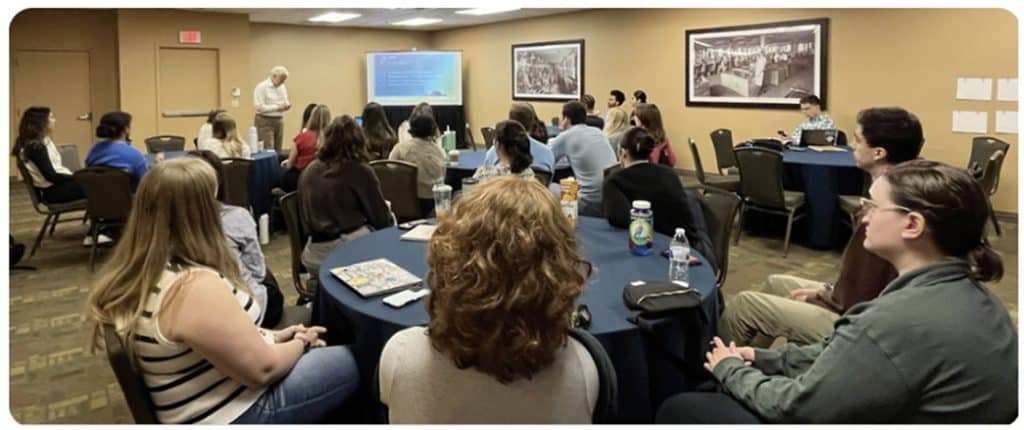
For example, on our first day of the 2025 fall semester UCONN CE Week, we were joined by Frank Painter and Matt Baretich who shared their hazard vulnerability analysis (HVA) knowledge and experiences. Matt began the morning by explaining the concepts within HVA along with its relationship to emergency operations and regulatory compliance. He also shared three very important lessons learned over the course of his career.
1. HTM must be included in the Emergency Operations Plan
2. Standards compliance is not enough
3. Think outside the basement
The importance of these three principles became immediately apparent when Frank shared his experience as the forensic investigator after the historic Hurricane Katrina hit New Orleans. After walking us through the horrific scenario and his investigation in the aftermath of the storm, Frank facilitated a workshop that allowed us to put the HVA concepts into practice. We broke into small groups each with a distinct geographic area. Each group was asked to identify the hazards, assess the level of risks associated with each, and then present their work to the group. It’s safe to say, we all learned a lot!
The rest of the day was spent preparing for the New England Society of Clinical Engineering (NESCE) Symposium. Attendance at a conference is not a regular occurrence during our UCONN CE Weeks. However, we try to align our dates so that every intern has at least one opportunity to attend a conference. More importantly, the interns learn how to get the most out of their conference attendance.
So how do we do this? First, my job is to coordinate attendance with the conference committee – e.g., local society, MD Expo. Next, the interns are typically told to register for the conference (not always intuitive to students), review the educational offerings, and draft a list of those sessions they plan to attend. During the first day of CE Week, we use a polling method to see who plans to attend which sessions. Then we discuss what we think will be presented during each educational session and why we think it is important to attend. This is easier when the conference program provides at least a short summary of each educational session. The exercise is much more difficult when we only have session titles.
In the end, our lively discussion (and occasional debate) results in refined plans for each intern. Some stay their original course because they had a fairly robust strategy. Others make minor to major adjustments with insights gained from their peers.
So now that we’ve been introduced, I look forward to sharing more experiences and adventures from my journey with the UCONN clinical engineering interns. Our next CE Week will be held in February 2026 and I’m confident there will be much to share with you afterwards. Until then, feel free to reach out to me if you have questions or suggestions. And be sure to catch columns from Steve Yelton (Cincinnati State) and Joie Marhefka (Penn State New Kensington)!