


Defibrillator and AED management leaves little room for uncertainty — when a patient’s life depends on a defibrillator or automated external defibrillator (AED), the device has to perform as intended. For healthcare technology management (HTM) professionals, keeping these mission-critical devices deployment-ready requires much more than routine preventive maintenance. Battery and electrode management, accurate performance testing, documentation, staff communication and life cycle planning all play important roles in maintaining a reliable fleet.
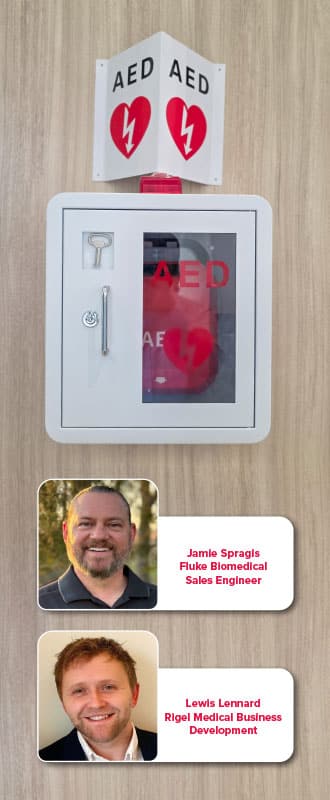
TechNation collected expert insights on defibrillator and AED management, including testing best practices, consumables, collaboration with clinical teams and emerging trends that could shape how HTM departments support these lifesaving devices for this roundtable article. Participating in this roundtable article are Fluke Biomedical Sales Engineer Jamie Spragis and Rigel Medical Business Development Manager-Americas Lewis Lennard.
Keeping Defibrillators and AEDs Deployment-Ready
Q: Defibrillators and AEDs are among the most mission-critical devices in healthcare. What strategies do you recommend for ensuring these devices remain deployment-ready and fully compliant across an organization?
SPRAGIS: Preventive maintenance and inventory verification is the most important strategy you can take with defibrillators and AEDs. Preventive maintenance helps ensure the device is working and ready to perform when needed. Asset inventory certification ensures the defibrillator/AED is in the location and accounted for.
LENNARD: Preventive maintenance needs to go beyond confirming that a defibrillator powers on and passes its own self-test. Using a calibrated defibrillator analyzer, HTM teams can independently verify delivered energy, charge time, synchronization and, where applicable, pacing performance. Regular testing provides confidence that the device will perform as expected when it is actually needed.
Managing Batteries, Electrodes and Consumables
Q: Batteries, electrodes and accessories all have finite service lives. What best practices do you recommend for managing consumables and reducing the risk of expired or unavailable components?
 SPRAGIS: Always add a task in your procedure to verify the battery replacement date and expiration of the pads. It is very important to document both pads and battery dates to ensure they get replaced at intervals instead of at failure.
LENNARD: Batteries, paddles, cables and electrodes should be considered part of the complete defibrillator system rather than managed separately. Expiration dates and replacement intervals should ideally be tracked within the facility’s asset management system, with alerts before action is required. Functional testing alongside visual inspections can also help identify issues that might otherwise only become apparent during clinical use.
Evaluating New Defibrillators Beyond Purchase Price
Q: As healthcare organizations evaluate new defibrillator technologies, what features or capabilities should HTM professionals consider beyond the initial purchase price?
SPRAGIS: The defibrillator technology has not really changed since we went from monophasic to biphasic. What has changed is the number of options for vitals monitoring. Making sure you have the right instruments to fully test all parameters of the defibrillator is key.
LENNARD: HTM should consider the total cost and complexity of supporting the equipment throughout its life cycle. That includes batteries and accessories, serviceability, manufacturer support and whether existing test equipment can support the required waveforms, energy levels and pacing technologies. From our perspective developing the Rigel UniPulse 400, we’ve also seen how important portability and ease of use are when HTM teams need to test a large and varied fleet.
Collaboration Across HTM and Clinical Teams
Q: What role does collaboration between HTM, clinical staff, emergency preparedness teams and facility management play in ensuring successful defibrillator and AED programs?
SPRAGIS: HTM professionals play a very important role with clinical staff. Not only can they perform extensive preventive maintenance but also can provide regular defibrillator/AED in services to ensure the staff is knowledgeable and ready to execute when the time comes. Hospital staff are always changing, that is why we need to maintain a great relationship with all clinical leadership. HTM professionals also can play a big role in new employee orientation.
LENNARD: Technical performance is only one part of ensuring a defibrillator is ready for use. Clinical teams may perform routine or daily checks, while HTM provides scheduled maintenance and independent performance verification. Clear ownership and communication between these groups help ensure problems are identified early and devices remain genuinely deployment-ready.
The Future of Defibrillator and AED Management
Q: Looking ahead, what emerging technologies, regulatory changes or industry trends do you believe will have the greatest impact on the management of defibrillators and AEDs over the next three to five years?
SPRAGIS: Documentation is always the best practice. Building a preventive maintenance checklist to match OEM procedures will help ensure compliance every time. Making sure all PMs are completed within the interval and having a solution when you have defibrillator PMs that become non-compliant. Communication back to the staff is also very important. We must communicate when we have removed a defibrillator/AED from the department. If we fail to communicate that we have removed the defibrillator and the staff is unaware, this can cause a critical error when a life is dependent on it.
LENNARD: One of the biggest changes we’re seeing is the expectation for better connectivity and test-data management. HTM departments increasingly want test results that can be saved, transferred and ultimately integrated into their CMMS without significant manual entry. I think better traceability and easier integration with hospital systems will become increasingly important alongside the measurement itself.
What Else HTM Should Know
Q: What else should HTM professionals be aware of when it comes to defibrillators and AEDs?
SPRAGIS: HTM professionals have a wealth of knowledge about the defibrillators/AEDs in their hospital. Use it to your advantage, perform extensive PMs, ensure all batteries and consumables are ready to go and document, document, document.
Across testing, consumables and collaboration, the two experts return to a consistent message: defibrillator and AED management depends on independent performance verification, disciplined tracking of batteries and electrodes, and constant communication with the clinical teams who reach for these devices in an emergency. As connectivity and CMMS integration mature, the departments that pair rigorous testing with clean documentation and easy traceability will be best positioned to keep every unit genuinely ready when it counts.
LENNARD: Testing AEDs can present some unique challenges compared with conventional defibrillators, particularly because certain electrodes and accessories are intended for single use and testing can affect their future availability for clinical use. HTM teams therefore need to understand the manufacturer’s recommended test procedure and use appropriate simulation and test equipment without unnecessarily consuming clinical accessories. At the same time, independent performance verification remains important for confirming energy delivery and ensuring the device is genuinely ready when needed.