



Infusion pump management has become one of the more demanding responsibilities in healthcare technology management (HTM). Infusion pumps remain among the most critical and widely used medical devices in today’s healthcare environment, placing increased demands on HTM professionals to ensure safety, reliability and performance. As health systems expand, device connectivity grows and software-driven technologies continue to evolve, managing infusion pump fleets has become more complex than ever.
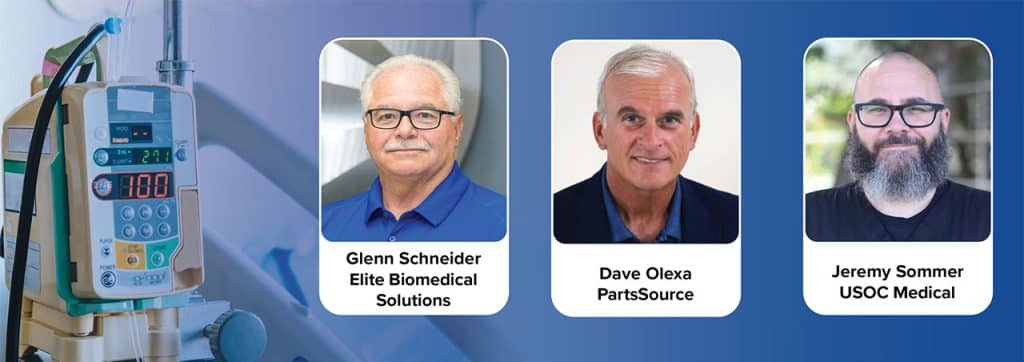
In this TechNation Roundtable, three industry experts share their perspectives on the trends shaping infusion pump management in the years ahead. Participants in this roundtable article on infusion pumps are:
- Elite Biomedical Solutions Chief Service Officer Glenn Schneider;
- PartsSource Director of Biomedical Sales Dave Olexa; and
- USOC Medical Infusion Pump Lead Tech Jeremy Sommer.
Managing Large Infusion Pump Fleets
Q: As healthcare systems continue to standardize equipment across multiple facilities, what strategies have proven most effective for managing large infusion pump fleets?
SCHNEIDER: Standardizing an infusion pump fleet across multiple facilities creates several efficiencies. Training costs decrease because staff work with fewer device brands, while shared parts inventory allows facilities to support one another when supplies run low, reducing downtime and expense. A single service team can also support the fleet organization-wide, lowering resource needs and creating an entry-level pathway for new technicians. In my time as a director, I found that moving from a fixed PM month to a floating PM schedule reduced the time spent retesting recently repaired devices and searching for pumps due for preventive maintenance.
OLEXA: Effective fleet management requires standardized workflows for preventive maintenance and software updates across all facilities in the health system. Second, implement a robust inventory management system to track infusion pump parts across locations – this allows facilities to share stock when others face shortages, which prevents backorder impacts. Third, establish standardized training programs for clinical and biomedical staff to ensure consistent device operation. Finally, develop relationships with both OEM services and qualified independent depot repair providers. For example, we’ve helped healthcare systems reduce repair turnaround from 2-3 months down to 2-3 weeks when they leverage secondary repair sources, saving significant money and improving equipment availability.
SOMMER: Inventory Management Software (IMS) allows for real-time tracking of devices both on and off-site, while keeping all applicable unit details in a centralized location that is easily accessible by authorized personnel. Using IMS moves away from the unreliable nature of multiple spreadsheets, which must be manually updated and may not be synchronized across facilities.
Connectivity and Interoperability Challenges
Q: Connectivity has become increasingly important for infusion pumps. What challenges and opportunities have you seen with wireless communication, interoperability and integration with hospital systems?
SCHNEIDER: Wireless communication and interoperability have created significant opportunities for infusion pump management. Pushing drug library updates wirelessly, rather than through a wired connection, saves considerable time and gives HTM technicians access to the manufacturer’s server, which improves visibility into pump status and location. Interoperability can also improve safety by reducing the potential for human error, but it may add steps to repair and PM processes to confirm functionality. Because these systems often use barcodes, typically tied to the serial number, to program devices through the EMR, any serial number change during repair must be carefully managed to prevent the wrong pump from being programmed, increasing patient safety risk.
OLEXA: Wireless connectivity is transforming infusion pump management by enabling automated drug library updates and software deployments rather than manual updates at each bedside. However, we’re seeing real challenges. When the Hospira Plum 360 was first rolled out, many health systems experienced Wi-Fi issues while loading drug libraries. This created concerns about using secondary market repair providers. Over the past couple of years, however, secondary repair vendors have identified and resolved these challenges. Today, they are an excellent source for faster turnaround times and meaningful cost savings. Beyond technical issues, reliable wireless coverage across hospital campuses remains inconsistent, and seamless integration with EHR and medication management systems requires extensive coordination between vendors, pharmacy departments and clinical engineering teams. Cybersecurity is equally critical. The opportunity is significant: successful connectivity implementation drives real-time medication safety, reduces therapy interruptions and provides performance data that can predict failures before they occur.
SOMMER: The challenge of properly trained personnel. HTM professionals are quickly becoming IT technicians as infusion pumps join the growing number of devices becoming wireless connected. While the ability to update software, install new drug libraries and switch from one patient’s needs to another seamlessly is absolutely invaluable, it can come at a sharp price when downtime increases because of:
- reluctance to embrace new technologies;
- confusion and frustration in applications and processes;
- a basic misunderstanding of principles; and
- a lack of on-site support for network related connectivity issues.
While boundless opportunities exist to continue to expand the connectivity of infusion pumps, the challenge of keeping professionals up to date with the latest and greatest will always be lurking in the shadows.
Repair, Replace or Upgrade?
Q: When evaluating whether to repair, replace or upgrade infusion pumps, what factors should healthcare organizations consider to maximize value and minimize risk?
SCHNEIDER: When deciding whether to repair, replace or upgrade infusion pumps, organizations should look beyond the initial purchase price and evaluate total cost of ownership, safety capabilities and technical compatibility across the enterprise. Financially, repair costs should be weighed against replacement value, with replacement often considered when repairs exceed 50 to 60 percent of the device’s value. Parts availability, failure frequency, battery support and access to OEM or qualified third-party repair options are also important. Reliable aftermarket sources for discontinued parts can extend fleet life by many years. From a safety and risk perspective, organizations should consider dose error reduction capabilities, EMR integration, recall history, wireless security protocols, server operating system support and the strength of the vulnerability management program.
OLEXA: Several critical factors drive these decisions. First, assess parts availability and repair turnaround time. If your primary vendor is experiencing backorders, independent repair providers may offer better value and speed. Second, evaluate total cost of ownership rather than upfront price. Third, consider the age and remaining lifespan of the device – mid-life cycle equipment is often worth repairing. Fourth, assess nursing and clinical staff training costs associated with new equipment. Fifth, review the equipment’s reliability history and failure modes. Finally, implement a structured life cycle management plan that keeps you ahead of failures rather than constantly reacting. This approach improves budgeting predictability, reduces clinical risk from sudden unavailability and helps healthcare organizations avoid supply constraints.
SOMMER: Every facility is more than likely to have its own standardized procedures put in place when it comes to making the decision to upgrade devices, outright replace units or to have them repaired. A few factors I find invaluable when I’m considering making purchases, upgrading equipment or having repairs performed:
- Reliability & Dependability: Has the facility/manufacturer initiated any recalls? Has the manufacturer implemented new and unproven technologies? Is the vendor ISO certified? Have I had success with previous models in past experiences with this manufacturer?
- Integration: How easily does this equipment integrate into my facility? Is it a seamless transition or is training necessary? Is this equipment compatible with current in-house devices?
- Necessity: Is there a need or demand for replacement? A need or demand for upgrade? Does the cost of repair justify replacing the unit?
The Future of Infusion Pump Management
Q: Looking ahead, what technological advancements or industry trends do you expect will have the greatest impact on infusion pump management over the next three to five years?
SCHNEIDER: Over the next three to five years, infusion pump management will shift from standalone device support to a more digitally connected model. As more care moves from hospitals to home and remote settings, technical teams will need to manage pumps as part of integrated systems rather than individual devices. AI-driven predictive maintenance, using real-time telemetry such as motor strain or battery impedance changes, will help identify pumps for service before clinical failures occur and reduce field failures. That same data can support automated parts ordering to speed repair turnaround, while remote patching and cybersecurity updates will become increasingly common while pumps remain in users’ hands.
OLEXA: We’re seeing three transformative trends. First, artificial intelligence and data analytics will enable predictive maintenance. Performance metrics collected during routine use can identify pumps at risk of failure before alarms occur, dramatically reducing downtime. Second, the right to repair movement is gaining legislative traction, which will increase healthcare organizations’ ability to work with qualified secondary vendors, manage costs and reduce dependence on single-source OEM services. Third, infusion pump management is becoming increasingly data-driven, allowing healthcare organizations to make more informed operational and financial decisions. Organizations that invest in strong asset management practices, leverage data-driven decision-making, and foster cross-functional teamwork between clinical, pharmacy and biomedical teams will be best positioned to maximize the value of their infusion pump investments.
SOMMER: Artificial intelligence (AI) and its ability to make quick decisions and minimize incidents and issues that arise via human error is immensely tantalizing across all industries, healthcare is not immune to its appeal. AI’s ability to successfully forecast trends and foresee turbulence on the horizon certainly could be invaluable. Time will ultimately be the judge as to whether this impact is received negatively or positively, regardless, the impact will be great.
Expert Advice for the HTM Community
Q: Is there anything else regarding infusion pumps that you would like to share with the TechNation community?
OLEXA: Yes. I’d emphasize two points. First, don’t let OEM backorders and lead-time pressures drive procurement decisions. When Baxter first rolled out the Sigma Spectrum, repair turnaround times reached 6-8 months, with repair costs climbing to approximately $850 per device. Those challenges were a major factor in PartsSource launching and expanding its depot repair program. We identified strategic repair partners that could service Sigma Spectrum pumps for approximately $450 per repair with turnaround times measured in weeks instead of months. Many health systems took advantage of the program with great success. From there, we expanded our flat-rate infusion repair offerings and eventually added additional modalities. Today, we have more than 900 flat-rate repair services available in our catalog. Second, the healthcare industry should support the ability of qualified independent service organizations and clinical engineering departments to repair and maintain infusion pumps. A 2018 FDA study concluded that third-party servicers provide the same level of quality as OEM technicians and are critical to the functioning of the U.S. healthcare system. Restricting access to repair information, parts and tools creates artificial supply constraints that harm patient care and inflate costs.
SOMMER: The future of HTM is bright and exciting! Many new ideas and innovations are becoming mainstream, while many others recently implemented have had smashing success. We are on the crest of a new era of HTM professionalism, so buckle up and enjoy the ride.
Across fleet standardization, connectivity, repair strategy and the road ahead, the three experts return to a common set of themes: data-driven decisions, total cost of ownership over sticker price, and a healthy, qualified secondary-repair market that keeps pumps safe, available and affordable. As AI-driven predictive maintenance and right-to-repair momentum reshape the field, the departments that invest in strong asset management and cross-functional teamwork will be best positioned to lead.